Latin American Cinema in Ten Films and Five Modernities
Table of Contents
Latin American Cinema in Ten Films and Five Modernities
Argentine Filmmaking between Three Eras
Nosferatu in Brazil
Nobody Alone and the Camera for Everyone
Memories of Encounter and the Encounter of Memories
Workings of Postmemory in Twenty-First Century Argentina
Home Movies and Family Archives in Latin-American Documentary Films
Transporting Memory
Living Archive – Before and After
This is an Open Access article distributed under the terms of the CC BY 4.0 License.
Suggested Citation: Schroeder Rodríguez, Paul A. “Latin American Cinema in Ten Films and Five Modernities.” In Research in Film and History 8 (2026). https://doi.org/10.25969/MEDIAREP/24916.
Introduction
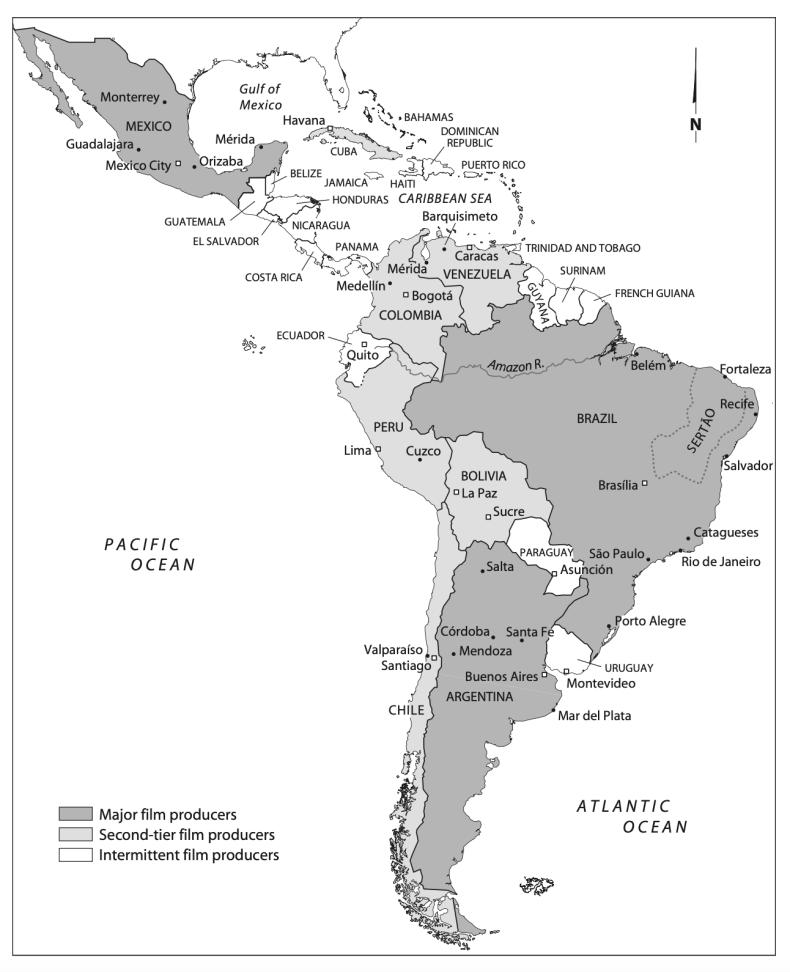
There are approximately twenty countries in Latin America, and the combined output of just three – Mexico, Brazil, and Argentina – have historically accounted for over eighty 80 percent of the region’s narrative film production. A second-tier group of countries with intermittent periods of production includes Venezuela, Colombia, Cuba, Peru, Chile, and Bolivia. The rest of the countries, including Puerto Rico, constitute a third group characterized by long periods with very little production.
For over a century now, three discourses of modernity, all of them capitalist, have prevailed in the region’s cinema, and even though in practice these discourses are intermingled, I have found that distinguishing between them allows for a productive analysis of the ideologies that many films represent both visually and narratively.1 The first of these discourses, liberalism or private capitalism, privileges private control of capital; the second discourse, state capitalism, alternatively called socialism or communism, favors state control of capital; and the third discourse, corporatism, also called the third way, advocates for a strong state to protect and balance the interests of labor and capital, both private and of the state. In addition to these three dominant discourses, I have identified two alternative, non-capitalist discourses of modernity in Latin American cinema: a neobaroque discourse and a discourse of convivial living rooted in concepts like ubuntu and suma qamaña. In the following I aim at surveying Latin American cinema via ten films that exemplify these multiple modernities during five distinct cinematic periods: silent cinema (1890s–1920s), studio cinema (1930s–1940s), Neorealism and art cinema (1950s), the New Latin American Cinema (1960s–1980s), and contemporary cinema (1990s–present).
Broadly speaking, each of the three dominant discourses of capitalist modernity I have mentioned – liberalism, socialism, and corporatism – prevailed during specific periods of Latin American cinema. During the silent period, oligarchic liberalism held sway on the ground and on the big screen. During the studio era of the 1930s and 1940s, corporatism was dominant. And in the 1960s, a socialist discourse of modernity crystallized and became known as the New Latin American Cinema. During other cinematic periods, on the other hand, no single discourse of capitalist modernity prevailed. During the 1950s, Neorealism and Art Cinema broke new ground aesthetically and politically, but neither can be said to be clearly aligned to any one of the three major discourses of capitalist modernity. In the late 1970s and 1980s, a neobaroque phase of the New Latin American Cinema privileged audiovisual and narrative excess to decenter and question notions of scarcity and utility that underpin capitalist discourses of modernity. And in the twenty-first century, the digital revolution has made possible the expansion of a community-based cinema that advocates for an alternative modernity of convivial living.
Understanding how and why certain discourses and representations of modernity have been represented in the past is of great importance today, when so much media – whether privately-owned social media platforms, private media conglomerates, or state-owned media companies – is purposely designed to lull us into complacency or else bring out the worst in ourselves us by exploiting our fears and insecurities. In the rest of the article, I will clarify these ideas with representative films from each of the major periods in Latin American cinema.
Silent Cinema (1890s–1920s)
Silent Cinema in Latin America was made exclusively by and for criollos, the Europeanized citizens of many cities and towns throughout the region. Indeed, the most important legacy of silent cinema on subsequent filmmaking in Latin America was the development of films tailored to this audience, via a strategy of triangulation whereby Latin American filmmakers adopted and adapted new technologies from both Hollywood and Europe to center criollo perspectives.
Take for example EL ÚLTIMO MALÓN (Alcides Greco, AR 1916). The film is about the last major malón, or uprising, of autochthonous people in Argentina, which took place near Santa Fe in 1904. It begins with a disclaimer that the film is a historical reconstruction, followed by a few minutes of ethnographic sequences on contemporary Mocoví life. Then suddenly, the film transforms three Mocoví historical figures into characters of a fictional love triangle: Rosa, played by white actress Rosa Volpe in brownface; the old cacique Mariano López as himself; and his rebellious young brother Salvador López, also as himself. In the clip below Rosa, who has publicly supported her young lover’s plans for an uprising, is held captive by the old cacique.
After the uprising fails, Rosa and her young lover escape to the jungles of northern Argentina, and the film ends with the two lovers kissing and an intertitle that explains how they learned this custom from the whites. Such melodramatic excess, whereby a complex social and economic reality is reduced to an emotional narrative between two Europeanized Mocovíes, underscores the film’s Eurocentric liberalism.
Most films of the silent period espouse Eurocentric liberalism, as we’ve just seen is the case in EL ÚLTIMO MALÓN. However, a small number of experimental films, notably LIMITE (Mário Peixoto, BR 1929) and ¡QUE VIVA MÉXICO! (Sergei Eisenstein, MX/US/SU 1931) explore the possibility of radically transforming the social structures and cultural values associated with private capitalism. On Friday at 8pm we will have a chance to watch LIMITE with a live score played by Ezzat Nashashibi. If you love experimental cinema, you will not be disappointed.
Studio Cinema
The Wall Street Crash of 1929 ushered the decline of oligarchic liberalism and the rise of corporatist states led by the likes of Lázaro Cárdenas in Mexico, Juan Perón in Argentina, and Getúlio Vargas in Brazil. Corporatist states subsidized and incentivized the industrialization of film production so long as it advanced the ideology of corporatist modernization. As befits any major industry, film production was standardized: nonfiction production centered on newsreels and educational films, while fiction film production revolved around a star system and three popular genres: musicals, melodramas, and comedies. Ideologically, the discourse of liberalism is still evident in the films of the early 1930s, but the corporatist discourse of modernity becomes dominant from the mid-1930s to the end of the 1940s, as evident in the Mexican film MARÍA CANDELARIA (Emilio Fernández, 1943).
MARÍA CANDELARIA is set in the gardens of Xochimilco in 1909, just before the Revolution. María Candelaria, played by megastar Dolores del Río, and Lorenzo Rafael, played by megastar Pedro Almendáriz, are poor but dignified indigenous peasants who face obstacles to marriage. Throughout the film, sentiments are racialized: the worst sentiments are projected on Don Damián (Miguel Inclán), a mestizo store merchant, and on all the Indigenous characters except our beloved stars. On the other hand, the best sentiments are reserved for the white characters, including a priest, a wealthy painter, and state workers who distribute medicine against malaria.
The film develops a corporatist discourse whereby Mexico is a body politic that can function properly only when everyone acts according to their role in a preestablished racial, gender, and class hierarchy anchored in the category of “noble savage.” In this reading, María Candelaria and Lorenzo Rafael are defenseless and childlike nobles who must be protected against socialism, represented by the savage Indians that kill María Candelaria; and capitalism, represented by the savage mestizo Don Damián.
Neorealism and Art Cinema
Neorealism and Art Cinema emerged in the 1950s in response to three important developments: (1) the rise of a sophisticated audience, (2) the availability of lightweight portable cameras, and (3) the decline of the industrial model of film production that defined studio cinema. All of this led some filmmakers to push the limits of studio cinema beyond its outdated formulas, while others decided to work outside that system altogether. Buñuel does both in LOS OLVIDADOS (1950), a film that examines juvenile delinquency through two protagonists: Pedro (Alfonso Mejía), a preadolescent boy who yearns for his mother's love, and Jaibo (Roberto Cobo), a young man recently escaped from a youth correctional facility. At first Pedro sees Jaibo as an older brother type willing to teach him to survive the mean streets of Mexico City. But the relationship quickly sours when Pedro witnesses Jaibo’s brutal murder of Julián (Javier Amézcua) and inadvertently becomes an accomplice to the crime. That night, Pedro’s trauma is dramatized via a Surrealist dream sequence whose slow motion and non-diegetic sound contrasts sharply with the film’s other realisms. In effect, the film links the limits of reformism, narratively represented in the film by the inability of the State to stop delinquency, to the limits of cinematic realism, whether it is social realism, socialist realism, or Neorealism.
New Latin American Cinema: Militant Phase
The New Latin American Cinema emerged from the heady political environment created by the triumph of the Cuban Revolution. It also coincided with the appearance in the market of mass-produced portable cameras with synchronized sound. For the first time in Latin America, film cameras were conceived as tools to record, re-present, and even help usher in a socialist revolution, as in the THE GUNS / OS FUZIS (Ruy Guerra, BR/AR 1964).
The idea of cinema as a tool of socialist revolution was theorized by Fernando Solanas and Octavio Getino in their manifesto Towards a Third Cinema, and put into practice in their agit-prop documentary THE HOUR OF THE FURNACES / LA HORA DE LOS HORNOS (Fernando Solanas and Octavio Getino, AR 1968). The film is structured in three parts that are dialectically related to one another. Part 1 of the film (“Neocolonialism and Violence”) corresponds to the current status quo; Part 2 (“Act of Liberation”) is the prolonged antithesis of Peronist struggle; and Part 3 (“Violence and Liberation”) represents a soon-to-be-achieved synthesis of social justice achieved through violent insurrection.
New Latin American Cinema: Neobaroque Phase
In the 1970s and 1980s, authoritarian and dictatorial regimes in Latin America set out to crush many liberatory movements. In response, many progressive filmmakers turned to Indigenous and African narratives of convivial living, and combined them with European Enlightenment narratives of freedom and democracy via baroque tropes and strategies such as doubles, hyperbole, theatricality, alternate narrative threads, intertextuality, and parody. The resulting films evaded censorship, subverted the totalizing truth claims of authoritarian and dictatorial regimes, and offered alternatives to the tropes of scarcity and utility at the heart of discourses of capitalist modernity.
FRIDA, STILL LIFE / FRIDA, NATURALEZA VIVA (Paul Leduc, MX 1983) takes a decisively neobaroque approach to question perspectives that center those in power. In the sequence reproduced above, which takes place inside Kahlo’s studio, two mirrors and a sketch underscore the malleable and positional nature of representation and identity. The composition references Diego Velázquez’s Las Meninas (1656), a key painting of the European Baroque whose only mirror, strategically positioned at the center of the painting, reflects the king and queen of Spain.
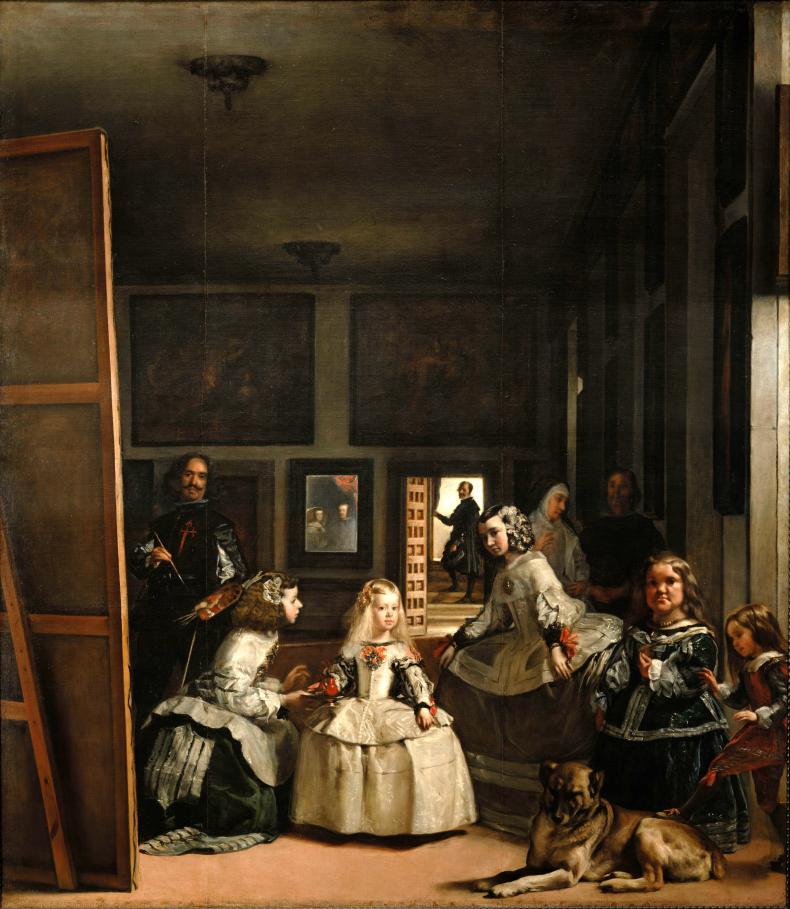
Public domain
In the film, on the other hand, the reflection in the small, beveled mirror is that of a marginalized subject, and is only one among several reflections in mirrors. This deconstruction of the stable subject is further developed by two metaphors of Kahlo’s identity as a malleable construct: first, the unfinished self-portrait to the left of the frame, which suggests that identity is a work in progress; and second, the shot of Kahlo carefully testing paint colors on her skin, as if she were creatively painting one of her many selves into existence.
QUILOMBO (Carlos Diegues, BR 1984), another standout film of this period, uses carnivalesque aesthetics to reassess Brazil's most famous community of runaway slaves, Quilombo do Palmares (1605–1694); while CLANDESTINE NATION / LA NACIÓN CLANDESTINA (Jorge Sanjinés, BO 1989), combines neobaroque and Aymara narrative practices to advance a vision of Bolivia as an Indigenous nation emerging from a centuries long clandestine existence.
Contemporary Cinema
After the fall of the Berlin Wall and the subsequent collapse of the Soviet Union, with the apparent end of state capitalism, it now became easier for private capitalism to expand into all corners of the planet. In Latin America, the result was a neoliberal wave that justified the abrupt end of any remaining state subsidies to the film industry and quickly led to an almost total collapse of filmmaking for several years in the early 1990s.
In the twenty-first century, new digital technologies have made it possible for filmmakers to reinsert Latin American cinema into the global cinematic marketplace through the reactivation of traditional genres and identification techniques, and by focusing on the micro-politics of emotion. Latin American cinema today is no longer epic, spectacular, or revolutionary as in the New Latin American cinema, but rather intimist, realistic, and politically reformist. It tends to mobilize affect to explore memory and identity without the excess of emotion one finds in studio cinema, or the excess of propaganda one finds in the militant phase of the New Latin American Cinema. Several of the films playing on Saturday exemplify this tendency: THE DIGNITY OF THE NOBODIES / LA DIGNIDAD DE LOS NADIES (Fernando Solanas, AR/BR/CH 2005), PERRO BOMBA (Juan Cáceres, CL/FR 2019), and LA CIÉNAGA (Lucrecia Martel, AR 2001).
One might object that the film BACURAU (Kleber Mendoçca Filho and Juliano Dornelles, BR/FR 2019), playing Friday night after LIMITE, contradicts this assertion because it is neither intimist, realistic, nor reformist. Indeed, BACURAU is far from intimist or reformist in its politics. As I understand it, BACURAU proposes an alternative community-based project of modernity that drinks from the well of Indigenous and Afro-descendant philosophies like suma qamaña (Aymara for convivial living) and ubuntu (Bantu language family for I am because we are). These are philosophies that value horizontal collaboration and consensus-building as paths to living in harmony with oneself, with others, and with the Mother Earth. In the end, the people of Bacurau take up arms after they realize that the only way to survive is to act as a collective to protect and preserve their convivial living. To that end, everyone in the community confers off screen about what to do, and they agree to ingest a psychoactive medicine that turbocharges their rich collective memory and allows them to act in unison to defend their community. This may sound like science fiction, but in fact using the wisdom of plants to help see things beyond the surface of everyday reality is a well-known practice among shamans throughout the world, and a recurring topic in Indigenous community-based cinema.
Community-Based Cinema
Community-based cinema is a cinema made by or with a community, for the benefit of the community, and about topics chosen by the community. Much of it explores convivial living, as well as threats to convivial living, through filmic narratives and styles as varied as the communities that produce them. Community-based cinema is the focus of my current research.2 I feel privileged to be collaborating with the Coordinadora Latinoamericana de Cine de Pueblos Indígenas (CLACPI), a grouping of some thirty community-based Indigenous organizations in Latin America whose mission is to promote and share this kind of cinema through workshops, publications, and a film festival that meets in a different location every two years. On that note, I would like to close my article with THE SPIRITS ONLY UNDERSTAND OUR LANGUAGE / OS ESPÍRITUS SÓ ENTENDEM NOSSO IDIOMA (2019); a 5-minute community-based film from the Manoki and Myki Cinema Collective in present-day Mato Grosso, Brazil. In it, Cileuza Jemjusi points out individualism and capitalism as the bases of non-convivial living / mal convivir: “The greed of capitalists and individualistic thinking harass us. But long before these problems our world already had all the solutions.” Two tropes of community cinema come together in this quote and form the basis of the solutions to our planetary crisis: a community perspective anchored and oriented towards the practice of convivial living; and a non-linear temporality where past, present and future generations of human and non-human beings communicate with one another. It is possible, in other words, to recover convivial living with individuality and without individualism, and to cultivate human and ecological capital without capitalism. This kind of convivial living is practiced more by Indigenous communities, as evidenced by the fact that although they make up 5% of the world’s population, they guard 80% of the planet’s biodiversity on their lands.3 However, we are all capable of cultivating it in our own lives and communities.
One could argue that this is no longer Latin American cinema, in the sense that it falls outside the realm of the national imaginaries at the center of what we call Latin America. Indeed, Indigenous peoples increasingly call the Americas “Abiayala,” the Guna term meaning “land in full maturity,” to reclaim their ancestral ways of knowing and being and to guide the path to follow. Personally, I see this as a step in the right direction and a powerful invitation for us to accompany Indigenous and like-minded communities as allies along the path of reparation and restoration.
- 1
This text served as the opening talk at the 27th International Bremen Film Symposium “Audio-Visual Memory: Latin America and Cinema.” Except for the conclusion, which deals with more recent research on community-based cinema, the article is based on the study of the region’s cinema from the silent period to the digital age through the lens of comparative modernity studies: Paul A. Schroeder Rodríguez, Latin American Cinema: A Comparative History (Oakland: University of California Press, 2016).
- 2
Paul A. Schroeder Rodríguez, “Cine comunitario de pueblos originarios en Abiayala en el siglo XX,” El ojo que piensa. Revista de cine iberoamericano 26 (2023): 9–23. http://www.elojoquepiensa.cucsh.udg.mx/index.php/elojoquepiensa/issue/view/27.
- 3
Anna Fleck, “Indigenous Communities Protect 80% of All Biodiversity,” Statista, July 19, 2022.
Fleck, Anna. “Indigenous Communities Protect 80% of All Biodiversity.” Statista, July 19, 2022.
Schroeder Rodríguez, Paul A. Latin American Cinema: A Comparative History. Oakland: University of California Press, 2016.
–. Una historia comparada del cine latinoamericano. Translated by Juana Suárez. Madrid: Iberoamericana Vervuert, 2020.
–. “Cine comunitario de pueblos originarios en Abiayala en el siglo XX.” El ojo que piensa. Revista de cine iberoamericano 26 (2023): 9–23. http://www.elojoquepiensa.cucsh.udg.mx/index.php/elojoquepiensa/issue/view/27.