Nosferatu in Brazil
“The vampire’s fang (made of plastic) on the sclerotic jugular of ‘serious’ cinema”
Table of Contents
Latin American Cinema in Ten Films and Five Modernities
Argentine Filmmaking between Three Eras
Nosferatu in Brazil
Nobody Alone and the Camera for Everyone
Memories of Encounter and the Encounter of Memories
Workings of Postmemory in Twenty-First Century Argentina
Home Movies and Family Archives in Latin-American Documentary Films
Transporting Memory
Living Archive – Before and After
This is an Open Access article distributed under the terms of the CC BY 4.0 License.
Suggested Citation: Seelinger, Christoph. “Nosferatu in Brazil: ‘The vampire’s fang (made of plastic) on the sclerotic jugular of ‘serious’ cinema.’” In Research in Film and History 8 (2026). https://doi.org/10.25969/MEDIAREP/24910.
Born in Rio de Janeiro in 1952, Ivan Cardoso is the undisputed master of the “Terirr.” This is mainly due to the fact that he is both the founder and the sole practitioner of this film genre. The portmanteau word “terrir” is made up of the terms “terror” and “laughter” (Portuguese: rir). Accordingly, from the early 80s onwards, Cardoso’s feature films consist of a potpourri of comedic and transgressive elements: traditional horror tropes (in which the director is particularly fond of the Universal classics of the 30s and 40s) meet the jokes of the Brazilian answer to the “Commedia sexy all’italiana,” the so-called “Pornochanchadas.” Cardoso also resorts to satirical sweeping blows at the political and social situation of his home country, while flirting with B-movie trash as well as conceptual material films through the use of different film formats, the use of color filters, primitive stop-motion tricks, stock footage, and manipulation of the analogue film material itself.
O SEGREDO DA MÚMIA (1982) formally constitutes the genre of “Terrir” as Cardoso’s first feature film. Even before that, however, Cardoso made several dozen Super 8 films from the early 1970s onwards, in which the divergent ingredients of his later feature films were laid out in nuce and which he subsumed under the label “Quotidianas Kodaks”: “Kodak” naturally refers to the analogue film material used; “Quotidianas” refers to the Symbolist poet Pedro Kilkerry, who wrote chronicles of everyday life in early 20th-century Bahia under the same title. Cardoso’s early films are shown outside the commercial cinema business at private parties in the subcultural milieu, where the director himself sets them to music using magnetic tapes and vinyl records as part of live improvisations.
It is not only the sheer productivity that the young amateur filmmaker displays that is astonishing, but also how multifaceted Cardoso’s early work is: He shoots short homages to idols and friends – including the icon of Brazilian horror cinema, José Mojica Marins, who had a significant influence on popular culture in Brazil from the late 60s onwards through the fictional character Zé do Caixão, which he created and embodied, or singer and actress Elvira Pagã, who in the later years of her career attacked the patriarchal structures of “machismo” in high-profile actions. Cardoso also made cultural films such as MUSEU GOELDI (1974) about the Museum of Nature and Folklore of the same name in Belém or RUÍNAS DO MURUCUTU (1976) about the history of the state of Pará from the arrival of the first Jesuit missionaries to the current Red Light District. Again and again, Cardoso, who is deeply rooted in the counterculture, ventures into experimental film territory: H.O. (1979) became particularly famous, in which he looks over the shoulder of avant-garde artist Hélio Oiticica as he designs his so-called “Parangolès,” “mobile sculptures” sewn together from colourful textile scraps, tent tarpaulins, canvases that can be worn like garments. While the Museum of Modern Art in New York houses a copy of H.O. as a cultural artifact worth preserving, SENTENCA DE DEUS (1972) is a norm-attacking exploitation film par excellence: necrophilia, foot eroticism, animal snuff are just a few of the taboo violations shown, before the film culminates in the explicit depiction of self-castration.
At just 19 years old, Cardoso shoots his debut film NOSFERATO NO BRASIL (1970) on the beaches of Rio. Six years before a military coup installed an authoritarian regime in Brazil; three years have passed since the government officially legalized torture – and since a handful of musicians such as Caetano Veloso, Gilberto Gil, and Gal Costa published the acoustic manifesto of the so-called “Tropicalismo” movement. Even in retrospect, “Tropicália” will be associated primarily with the combination of traditional Brazilian songs à la samba and bossa nova as well as Anglo-American pop and rock music à la Jimi Hendrix or the Beatles. Originally, the term “Tropicalismo” goes back to the aforementioned Hélio Oiticica, a friend of Cardoso’s, who had already exhibited under this name at the Museum of Modern Art in Rio in April 1967. With his idea of a decidedly Brazilian art style, which is supposed to incorporate influences from high and trivial culture, Latin America and Europe, popular music, poetry and the visual arts in order to create something radically new, Oiticica ties in with Oswald de Andrade’s Manifesto Antropófago published in 1927: Its author postulates in explicit protest against the European culture of dominance that one must not push away “the foreign.” Rather, it must be embraced in an act of devouring – in other words, subversively subverting colonialism by, for example, reproducing its racist stereotypes of man-eating savages on a cultural level, and cannibalistically eating up the imperialist export elements in turn.
The lack of sharpness of boundaries with regard to other arts from the outset suggests that the cinema movement of the “Cinema Marginal” should also be located in the “Tropicália” environment: from the decisive year of 1968, filmmakers such as Rogério Sganzerla or Júlio Bressane, who was a friend of Cardoso, also rebelled against the Cinema Novo, the specifically Brazilian New Wave, which began as early as the 1950s and found its best-known representative in Glauber Rocha. For the Tropicalists, Cinema Novo has moved further and further away from its confrontational and revolutionary roots: In the late 1960s and early 1970s, Brazil mainly produced well-budgeted feature films, which carry their social criticism in front of them as an alibi, but in reality are primarily aimed at economic profits and propaganda – especially since such works are often co-financed by the state. The “Cinema Marginal” wants to counter these softening phenomena with an explicit “garbage aesthetic.” Parodies of classic (Hollywood) narratives, phenomena of underground cinema such as camp and trash, deliberate decisions for poorly framed images, a bumpy editing, amateur acting, seemingly improvised scripts – these are all values of “Cinema Marginal,” which can also be encountered in NOSFERATO NO BRASIL.
The importance of the Super 8 medium for dissident filmmakers like Cardoso cannot be overestimated. In the context of the exhibition “Marginalia 70 – O Experimentalismo no Super-8 Brasileiro,” with which in 2001 the cultural institute Itaú Cultural in São Paulo, as the title suggests, dedicates itself for the first time in detail to the narrow film scene of Brazil in the 70s, curator Rubens Machado, quoting the philosopher and poet Jomard Muniz de Britto, writes with regard to the spontaneity and freedom inherent in Super 8, which, as is inevitable, also goes hand in hand with the exploration of hitherto prevailing sexual and social taboos:
Superoitist de-monumentalisation was linked to another trend that was quite evident in its contestation of established art standards: performance, the recording by the camera of a performative act that broke with “respectable” behaviour. [...] At the time, Super-8 was akin to theatrical happening, graffiti and the momentary nature of marginal poetry, which were transitory, immediate, more active than representative. Consistent with this kind of direct filmic action, the politics of the body and sexuality took centre stage in that veritable swelling of the present of Super-8 films. “It was a very political, erotic and political thing,” according to philosopher and poet Jomard Muniz de Britto, a protagonist of tropicalism in the Northeast, who became entrenched in “anarcho-superoitism.” Bisexualism, transvestites, the deconstruction of the bourgeois image of women, all frequented the “nice gauge.” Many of the films have something of a Dionysian party, a cinematic version of debauchery. With the strong presence of the counterculture in the 1970s, the dialogue of the body crying out for liberation seems to call out to nature, to which the body wants to return.1
In his autobiography, co-authored with Rubens Francisco Luchetti, an author of horror pulp books since the 1960s and screenwriter of several of Mojica Marins’ films, Cardoso himself also recounts how the Super 8 camera became an extension of his own existence and even a democratic weapon against the prevailing authoritarian regime:
It was a very simple camera to handle and was fundamental to my learning. With this Yashica I made my first experiments and also filmed Nosferato in Brazil. [...] I ended up opting for a language close to silent cinema and this gave me greater control over the results. The great contribution of Super 8 was that it democratised cinema and allowed young people to play at being filmmakers. [...] Super 8, in a way, became an extension of my life. I took the camera everywhere and explored the possibilities that arose: the class, the girls who went to the beach [...] They were voluntary participations, there wasn't much planning.2
The protagonist of NOSFERATO NO BRASIL, poet, songwriter and critic Torquato Neto, also sees Super 8 as a new type of technology under the banner of social democratization. Proceeding from the idea of reviving the ethos of Cinema Novo from the mid-sixties, which is expressed in Glauber Rocha’s maxim that, in order to make a film, all you have to do is have a camera in your hand and an idea in your head, Neto demands an occupation of public space by countercultural practices, such as those described by Cardoso: Film with your Super 8 camera everywhere and everything that comes in front of your lens. In an article written around the time of NOSFERATO IN BRASIL, Neto declares: “Invent. A camera in hand and Brazil in the eye: document that, my friend. [...] Reality has its cracks, look for them, take photos, make films, and enjoy. [...] Organize archives of Brazilian images from these times, everyone saving their own little films until one big film is ready.”3 In another text from August 1971, he makes direct reference to Cardoso’s assembly-line production of Super 8 films, which he models downright into a new way of perceiving:
Is superoito fashionable? And it's also cinema. There are people who are already in this business and they're not exactly just playing around. In my opinion, they're doing what's possible, when it's possible. Here, then, superoito is all the rage and Ivan Cardoso, for example, is experimenting with it. Good and cheap. Good. Keeping an eye out: squeeze it from the bus window, as Luiz Otávio Pimentel suggested, and then see. Is it pretty? Find out: squeeze it and then look at it. The adventures of Superoito, hero without sound [...] General shots, panoramas, details. If I've understood correctly, there's nothing better than enjoying Superoito, vampiristic, cool, mute.4
When Neto attests to the vampiric quality of the Super 8 film in his flaming plea, this also resonates, at least in the subtext, with the void that has gaped with regard to vampire figures in Brazilian popular culture up to Cardoso’s NOSFERATO NO BRASIL, and which only the new cinematic movement is able to close. For example, Laura Loguerico Cánepa speaks in this regard of the Super 8 sector being the actual hiding place of vampires within Brazilian cinema, “the hiding place of vampires in Brazilian film fiction.”5 In fact, before the second half of the 20th century, only a few instances can be found in which Brazilian literature deals with the motif of the blood-sucking revenant. As Ana Paula Araujo dos Santos notes, such references to the vampire myth focus primarily on its symbolic, metaphorical, or allegorical potential: “The vampire appears as a figuration of death, disease and evil.”6
Probably the earliest mention of the word “vampire” in Brazilian literature can be dated back to 1799, when the poet Manuel Inácio da Silva Alvarenga published a collection of his Poemas Eroticos in the poetry collection “Glaura.” Although the rondo “A Noite” printed there speaks of a “red-blooded” vampire, this only appears as a marginal phenomenon, flees even at the moment when it is addressed by the lyrical ego, and seems to be used primarily, like the hungry owl appearing in the same stanza, to create a gloomy mood:
Melancólico agoireiro
solta a voz Mocho faminto,
e o Vampir de sangue tinto,
que é ligeiro em se esconder.7
An important milestone in the reception of European horror literature with regard to an explicitly vampiric motif is also the long poem “Octavio e Branca Ou A Maldição Materna” by João Cardoso de Menezes e Souza from 1849. It tells the story of two lovers, Octavio and Branca, who, as veritable heirs to Romeo and Juliet, are denied marital bliss by their families. Tragically killed, they return from the grave to take revenge on the young woman’s father by sucking his soul out. Of course, the word “vampire” itself is not uttered, but after the deed is done, a bat circles in the vaults where Branca’s father breathed his last, its flapping wings being the only sound that stirs up the dead silence that has fallen:
Após momentos nada mais se ouvia
Pelas longas abobadas antigas;
Só o sussurro d'asa dos morcegos
Voando em torno à lâmpada, quebrava
Essa mudez solene e aterradora.8
The sonnet “O Morcêgo,” in which Augusto dos Anjos in 1912 allegorically declares the eponymous flying mammal to be the personification of the human conscience, also purely about the presence of a bat:
Meia noite. Ao meu quarto me recolho.
Meu Deus! E este morcêgo! E, agora, vêde:
Na bruta ardencia organica da sêde,
Morde-me a guéla igneo e escaldante môlho.“Vou mandar levantar outra parêde.”
— Digo. Ergo-me a tremer. Fecho o ferrolho
E olho o tecto. E vejo-o ainda, igual a um olho,
Circularmente sobre a minha rêde!Pégo de um pau. Esforços faço. Chego
A tocal-o. Minh’alma se concentra.
Que ventre produziu tão feio parto?!A Consciência Humana é este morcêgo!
Por mais que a gente faça, á noite, elle entra
Imperceptivelmente em nosso quarto!9
All these examples underline the marginal position that vampires occupy before NOSFERATO NO BRASIL within Brazilian highbrow culture. Consequently, one has to look for Cardoso’s role models in spheres that are either not of Brazilian origin or are located in areas that are often dismissed as trivial culture. In addition to a box-office hit such as HORROR OF DRACULA, with which the British Hammer Studios triggered a veritable pandemic of vampire films around the globe in 1958, comics and anthologies with translations of foreign-language horror stories could be mentioned as a source of inspiration for Cardoso, as Laura Loguercio Cánepa shows.10 Only a few years before the production of NOSFERATO NO BRASIL, for example, illustrator Editora Jotaesse and author Luis Quevedo created one of the first genuinely Brazilian monster characters with the “Mulher Vampiro” Mirza, a Polish-born, extremely sexualized bloodsucker, who ended up as a top model in Brazil in the 60s, where she is bleeding high society to ensure her own continued existence.
Also genuinely Brazilian and at least in some aspects related to the classic vampire type is the fictional character Zé do Caixão, which Cardoso’s idol and later companion, the already mentioned José Mojica Marins, developed in 1964 for his third completed feature film À MEIA-NOITE LEVAREI SUA ALMA, and then in the two sequels ESTA NOITE ENCARNAREI NO TEU CADÁVER (1967) and ENCARNAÇÃO DO DEMÔNIO (2008) as well as in numerous cameo appearances, TV shows, or other entertainment formants. Even the first sentences, which the gravedigger and serial killer, speaks in the prologue of À MEIA-NOITE LEVAREI SUA ALMA, breaking the fourth wall and directly addressing the audience, cannot do without invoking blood as the primordial cause of all existence: “What is life? It is the beginning of death. What is death? It is the end of life! What is existence? It is the continuity of blood. What is blood? It is the reason to exist! / O que é a vida? É o princípio da morte. O que é a morte? É o fim da vida. O que é a existência? É a continuidade do sangue. O que é o sangue? É a razão da existência!”
Of course, Zé, ideologically located somewhere between Nietzschean belief in superhumanity, nihilism, and racial theory, is never interested in drinking the blood of his numerous victims in order to keep himself alive. Rather, the gravedigger pursues the goal of fathering a son against their will with women, whom he selects in advance on the basis of their physical and psychological suitability, who will guarantee the continuity of his noble blood and form the nucleus of a future master race. Laura Loguercio Cánepa lists three other reasons that, despite obvious parallels, fundamentally distinguish Zé do Caixão from the type of vampire iconically embodied in Bram Stoker’s Dracula: On the one hand, the power of Mojica Marins’ anti-hero stems from the fact that he defies the laws of his fellow human beings, cheekily laughs in the face of any form of religion and morality; on the other hand, despite his conviction that he would walk like a god between a dull flock of slave natures, Zé is ultimately as mortal as the other members of the humanity he hates, and even his regular “resurrections” can always be traced back to a more or less plausible rational explanation.11
Even if Zé do Caixão should not be confused with a classic bloodsucker, the oeuvre of José Mojica Marins in general and À MEIA-NOITE LEVAREI SUA ALMA in particular must have been an important source of inspiration for Ivan Cardoso and other guerilla filmmakers of his generation. In the context of the early sixties Mojica Marins’ horror debut offers its audience extremely explicit excesses of violence between comic-like exaggeration and uncompromising harshness – be it the blood-smeared mouth of a woman while Zé ruthlessly rapes her (and then throws a strangled bird at her tortured body as a symbol of her lost innocence); be it his long, claw-like fingernails, which, when they gouge out the eyes of a coroner who threatens to track down Zé, poke head-on into the camera lens; be it his visible joy at the suffering of his own wife, when, in a perverse reversal of a failed act of procreation, she falls victim to a tarantula unleashed on her. In addition to such transgressions in terms of content, À MEIA-NOITE LEVAREI SUA ALMA impresses above all with its DIY aesthetics. Since Mojica Marins only has a shoestring budget at his disposal, he has to make a virtue out of necessity and uses the limited funds as creatively as possible: The film is made within thirteen days in a tiny studio in São Paulo. In order to be able to finance the project at all, Mojica Marins sells his car and his house; in order to simulate a forest, he has his employees cut down trees from a nearby park and rebuild them in the studio; to stay awake, he pumps himself full of amphetamines and shoots for days without a break, dividing his crew into two groups of twelve people each. Even though À MEIA-NOITE LEVAREI SUA ALMA as a 35mm film intended for the big screen sets itself apart from Cardoso’s Super 8 short films, which are not backed by a production team organized according to the division of labour, but by Cardoso holding all the creative strings in his own hands, Cardoso’s visual language is strikingly reminiscent of that of its predecessor.
NOSFERATO NO BRASIL © 1970 Something Weird Video. All rights reserved.
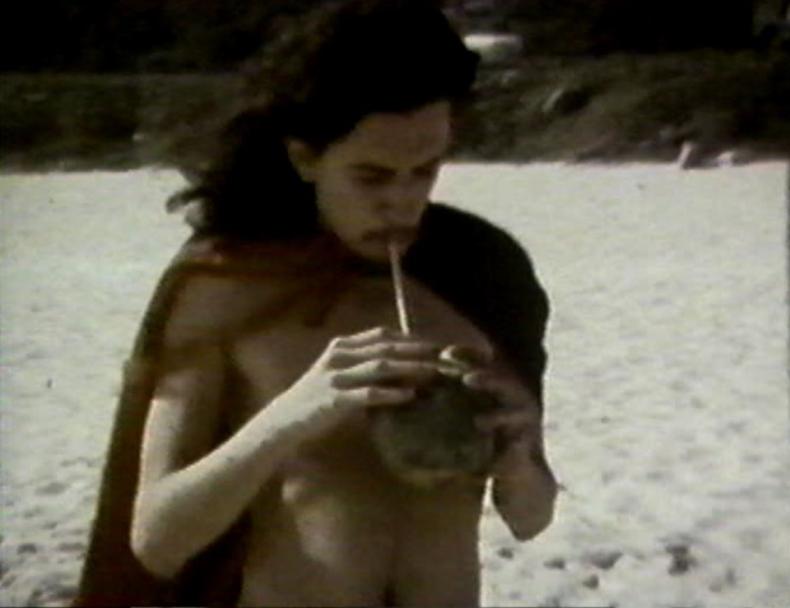
NOSFERATO NO BRASIL begins with shots of skulls and bones, accompanied by the sounds of the theremin, a musical instrument classically associated with horror movies. A text panel points out that the following prologue is supposed to be set in Budapest in the 19th century – which already causes irritation because Cardoso in no way conceals where the exposition was actually filmed: the clothes on display, the palm trees and cars driving along in the background clearly mark the place as Rio of the early 70s. Nosferato himself also resembles less an Eastern European aristocrat (and certainly does not resemble a rat-like creature like Count Orlok in Murnau’s silent movie classic from 1922, to which Cardoso unmistakably refers). With his dark cape and flowing black hair, he is more reminiscent of a mixture of intellectual and hippie: As already mentioned, the bloodsucker is embodied by one of the most important figures of “Tropicalismo,” Torquato Neto. In terms of content, the prologue consists of a crudely assembled sequence of violent and hunting scenes: Neto chases a female passer-by, he beats a young man first with a branch, then with a stone, and finally he finds himself face to face with a vampire hunter à la Van Helsing in a sword duel.
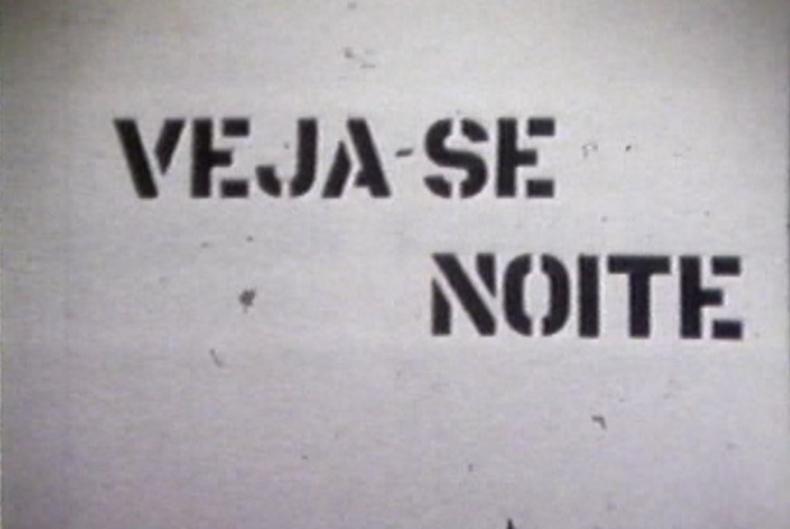
Characteristic of Cardoso’s oscillation between pop-cultural references and meta-reflexive self-irony is the text panel shown at the beginning of the film – “Whenever you see the day, see the night.” / “Onde se vê dia, veja-se noite.” – which is much more than the instruction for the audience not to be misled by daylight: Cardoso may not be able to shoot at night due to his limited technical means, but this should not stop the viewer from imagining a moon instead of a tropical sun in the sky. Moreover, as Cardoso himself explains in his autobiography, the phrase hides another tongue-in-cheek reference, this time to a poem by one of the most important innovators of Brazilian poetry in the 20th century, Affonso Ávila who wrote in one of his most famous poems: “Whenever you see this, see that instead.” / “Onde se vê isso, veja- se aquilo.” In Cardoso’s own words: “I found a rather unusual solution in Affonso Ávila's concrete poetry. He had a poem that went like this: ‘Where you see this, see that’. I made a card for Nosferato with the following warning: ‘Where you see day, see night’. / Encontrei na poesia concreta Affonso Ávila uma solução bastante inusitada. Ele tinha um poema que era assim: ‘onde se vê isso, veja se aquilo.’ Fiz uma cartela para o Nosferato com o seguinte aviso: ‘onde se vê dia, veja-se noite’.’”12

NOSFERATO NO BRASIL © 1970 Something Weird Video. All rights reserved.
NOSFERATO NO BRASIL © 1970 Something Weird Video. All rights reserved.
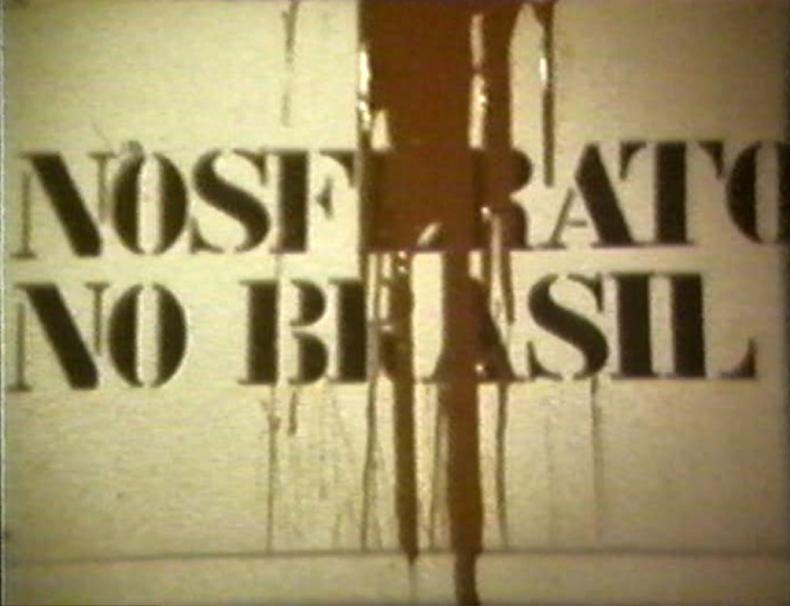
What we get to see in the middle part of the film are incoherent vignettes that illustrate how the vampire spends his time in present-day Rio – omitting how the bloodsucker is supposed to have managed to materialize at Copacabana, especially since he was actually defeated in the prologue by Cardoso’s version of Van Helsing. With dandy-like behaviour, the vampire roams the beach area, sits in the sand with swimming trunks and cape, sipping the juice from coconuts with a straw. He gets his favourite drink rather casually: in one segment he gains access to a female victim’s car as a hitchhiker; he seduces another woman after she has danced for him in the street (and dressed only in her underwear!) Since NOSFERATO NO BRASIL as a Super 8 film naturally lacks original sounds and dialogues, its soundtrack was – (at least in one of the many versions Cardoso made of its debut) – subsequently equipped with numerous pop songs that sound like a playlist of “Tropicália” favorites: Bob Dylan, Rolling Stones, Roberto Carlos. In general, NOSFERATO NO BRASIL gives the impression of a mixtape of images, sounds, references rather than that of an exponent of coherent narrative cinema: it ostentatiously flaunts its amateurishness (for example, when in the opening credits streams of raspberry-coloured fake blood drip from a vinyl record stuck to the wall); it devotes itself entirely to narrative redundancy, (when the core plot consists almost exclusively of escape and eating scenes as well as a vampire strolling around in the sunshine); it surprises again and again with visual taboo breaks, (for example, when Cardoso cuts to two copulating dogs in the prologue without any context).
NOSFERATO NO BRASIL © 1970 Something Weird Video. All rights reserved.
Another text panel towards the end of the film reads: “Without blood, no history is made.” / “Sem sangue não se faz história.” In the next shot, media mogul Silvio Santos, closely tied to the military government, can be seen in one of his talk shows, while a bottle of ketchup is standing next to the TV set. Immediately afterwards we witness our antagonist having fun with his harem of women, whom he has meanwhile infected with the vampire virus and with whom he lives in a kind of undead commune, where they read comics, watch TV, listen stoned to pop music all day, as it seems. In the end, however, Nosferato says goodbye to a plane to Europe in order to contaminate the Old World from then on: With the arrival of summer, an intertitle says, Nosferato returns to his homeland, as if he were not a bat, but a swallow that has spent the winter in warmer regions.

NOSFERATO NO BRASIL © 1970 Something Weird Video. All rights reserved.

NOSFERATO NO BRASIL © 1970 Something Weird Video. All rights reserved.
It is especially this ending that eludes clear interpretation and opens up a wide scope for interpretation: is the vampire supposed to be a metaphor for capitalism and colonialism, a bloodsucker who invades Rio from the outside to bring disaster to the local population so that his eventual departure allegorically stands for the withdrawal of the colonial powers from Brazil, leaving the country bled dry and infected with the bacillus of imperialism? Is Cardoso’s critique rather aimed at the repressive government, which in turn sucks off the people’s vital forces and, in order to nip a possible revolt in the bud, conveniently relies on the temptations of innocuous capitalist consumer goods? Does Cardoso imagine himself as a representative of a new breed of vampires, who, similar to the thoughts Oswald de Andrade articulates in his Manifesto Antropófag, are brimmed with an ocean of references and completely outside the commercial and conventional film business working on a cinema of a democratic future, which another poet friend of Cardoso’s, Haroldo de Campos, described in reference to NOSFERATO IN BRASIL as the “the vampire’s fang (made of plastic) on the sclerotic jugular of ‘serious’ cinema”?13
Due to its peripherical status, Brazilian mainstream culture does not ask itself these questions because it never took notice of Cardoso’s film at all. Accordingly, the influence that NOSFERATO NO BRASIL exerts on later films is limited to similarly situated niche products from the underground cinema sector, accessible only to a small circle of insiders. As examples of the manageable number of vampire depictions in productions beyond the experimental film scene, Laura Loguerico Cánepa cites such different aesthetic artefacts as the soap opera VAMP, which ran successfully on Brazilian television in the early 90s, or the comedian Valdenio Bento Carneiro, who regularly plays the role of an impoverished resigned bloodsucker, and in this way makes satirical criticism of Brazilian society.
If you turn your gaze from such spectacles intended for a mass audience to adult entertainment, you may also come across the over-the-top grotesque porn AS TARAS DE UM MINIVAMPIRO, in which, under the direction of José Adalto Cardoso, the diminutive actor Carlos Nascimento – pseudonym “Chumbinho” – terrorizes the area around São Paulo by attacking couples in the middle of the sexual act, which prompts the major to hire a vampire hunter in order to capture the “mini-vampire” so that he can be used as a tourist attraction. Even Cardoso in his films from the early 80s onwards, with which he puts his concept of “Terrir” into practice, only associatively draws on the vampire theme, when he names AS SETE VAMPIRAS (1987), offers his audience as a monster not a classic vampire, but an oversized plant with a greed for human flesh. Accordingly, the eponymous “Seven Vampires” are not diegetic characters, but rather refer to a ballet number in which the female protagonist of the film, a nightclub dancer, is involved. Of course, all these examples have nothing to do with NOSFERATO NO BRASIL, except the (often rudimentary) vampire theme.
The countercultural Super 8 scene, however, seems to draw much more inspiration from Cardoso’s debut. In particular, there are two films that make direct reference to NOSFERATO NO BRASIL. WAMPIROU (1974), an 18-minute long Super 8 film by sculptor and painter Lygia Pape is much more closely based on Cardoso’s NOSFERATO. In fact, both films are similar not only in their aesthetic design with their shaky, grainy images, their handheld camera movements, their overall improvisational appearance but above all because of their almost identical plot premises: Pape’s film first illustrates the everyday life of the titular hero Wamp, a vampire apparently stranded in Rio who, like Torquato Neto’s Nosferato, is immune to sunlight. He spends his time strolling along the sea beach, amuses himself with comics, cartoons, Coca Cola, and Anglo-American rock music à la Jimi Hendrix in his home apartment, and otherwise prefers to visit ruined houses that stand like relics of a missing past in the urban jungle of the Brazilian capital. Invited to a dinner party, the bloodsucker, iconically dressed in a cape lined with red fabric, tries to bite the throat of several people, including the filmmaker herself. Page subversively stages this bizarre sequence, which probably not coincidentally evokes associations with a group sex orgy, according to pictorial patterns traditionally used for depictions of the Last Supper of Christ. Towards the end, there is a plot twist that identifies the disoriented and misplaced protagonist as an (unsuccessful) artist. When Wamp receives a visit from an art dealer, who has probably promised to buy some of his works from him, he is unceremoniously chased out of his own four walls by a crucifix. What’s more, the art dealer now assumes Wamp’s identity: in a safe, he finds his (plastic) vampire teeth and his Dracula cape and now operates as a vampire roaming through Rio. Pape’s film ends with a shot of a disillusioned Wamp sitting in the window of a half-ruined house.
In a way similar to NOSFERATO NO BRASIL, WAMPIROU, whose title is made up of the Brazilian words for “vampire” and “crazy” (“pirou”), refuses to be reduced to an overly explicit message. Rather, like Cardoso, the director weaves a multi-layered web of meanings and allusions, the interplay of which is unmistakably aimed at satirizing the (Brazilian) art market or the role of artists within (Brazilian) society. Detailed questions, such as whether Wamp’s consumption of Western cultural goods should be read as a positive counter-project to autochthonous cultural products or rather as a criticizable appropriation of even the individual’s leisure time by Western capitalism, are delegated to the individual recipient.
Although O TERROR DA VERMELHA, Torquato Neto’s only surviving directorial work, does not feature a vampire figure, from a purely structural point of view, the film, whose shooting began in 1972 and now has a running time of about half an hour, seems like a pastiche of NOSFERATO NO BRASIL. Neto shoots O TERROR DA VERMELHA in his birthplace Teresina in the state of Piauí on Super 8 without the slightest budget, instead with friends from the world of literature, art and experimental scene or even his own parents in front of the camera. However, O TERROR DA VEMELHA will not be shown to the public for the first time until almost 30 years later as part of the aforementioned exhibition “Marginalia 70” on the Super 8 scene in Brazil. Neto didn’t finish his film himself; just one day after his 28th birthday, the poet, who had been suffering from drug abuse, mental health problems and the repression of the military dictatorship for years, committed suicide. Today, however, there are two versions of the film: Carlos Galvão, who was responsible for the camera in O TERROR DA VERMELHA and also takes on a small acting role, is responsible for one of them; the other is taken care of by Neto's widow, Ana Maria Duarte.
Like NOSFERATO NO BRASIL, Neto’s film consists of largely disjointed vignettes that give a largely improvised impression; like NOSFERATO NO BRASIL, Neto’s film is full of subtle ironic allusions to Western or domestic pop culture, when there are clear staging references to duelling scenes in Italo Westerns, for example, or when the main character rubs his lips in the same gesture as Jean-Paul Belmondo iconically does in Godard’s À BOUT DE SOUFFLE (1960); like NOSFERATO NO BRASIL, Neto’s film is a genre deconstruction that oscillates between mischievous and serious, when a serial killer roams the alleys of Neto’s hometown, where he randomly, senselessly and aimlessly kills both male and female passers-by – and as with NOSFERATO NO BRASIL, this extremely redundant plot can either be dismissed as a primitive sequence of chase and murder scenes without added value, or interpreted as a cynical commentary on the extremely repressive Brazilian state at the beginning of the 70s, which was by no means stingy with censorship and torture. In addition to its offensive violence, which is so disturbing precisely because of its complete lack of motivation, as well as the fact that Neto will gas himself in his bathroom only a short time after the end of filming, O TERROR DA VERMELHA also has unmistakable melancholic-nostalgic moments, which make the film, especially in view of Neto’s early death, seem like a farewell letter in the form of moving images: Neto brutally settles accounts with the political situation in Brazil; before taking his own life, Neto revisits the place where he was born, visits places of his childhood and youth, which may be associated with very specific memories for him; Neto erects a monument to those and those who are supposed to outlive him: his adolescent niece, whom we experience in a wonderful scene for minutes performing a rehearsed dance, his mother, who films Neto hanging up the laundry, his poetry, which accompanies the film in the form of text panels, and finally O TERROR DA VERMELHA itself as his cinematic legacy – and the same, of course, also applies to his earthly enduring incarnation as Nosferato. The poet and songwriter Waly Salomão (1943–2003), who also appeared in the banquet scene of Pages WAMPIROU, sums it up beautifully when he writes: “The poet himself being the body of poetry, the poet being the poem. Murnau's Nosferatu descends, via Ivan Cardoso, on a polluted Brazil and takes such a hold of Torquato that it becomes his definitive logo, Nostorquatu.”14
- 1
Author's translation. Original: “A desmonumentalização superoitista estava ligada a outra tendência bastante evidente em sua carga contestatória aos padrões da arte estabelecida: a performance, o registro pela câmera de um ato performático rompendo com o comportamento “respeitável”. [...] O Super-8 aproximava-se, nesses momentos, do happening teatral, da pichação e da momentaneidade da poesia marginal, que se propunham transitórias, imediatas, mais ativas que representativas. Coerente com essa espécie de ação fílmica direta, a política do corpo e da sexualidade adquiria centralidade naquele verdadeiro inchaço do presente dos filmes Super-8. “Era uma coisa bem política, erótica e política”, segundo o filósofo e poeta Jomard Muniz de Britto, protagonista do tropicalismo no Nordeste, que se entrincheirou no “anarcossuperoitismo”. Bissexualismo, travestis, desconstrução da imagem burguesa da mulher, frequentavam a “simpática bitola”. Muitos dos filmes têm algo de festa dionisíaca, versão cinematográfica do desbunde. Com a forte presença da contracultura nos anos 1970, o diálogo do corpo que grita por libertação parece clamar pela natureza, à qual o corpo deseja retornar.” In Rubens Machado, Marginália 70: O Experimentalismo no Super 8 Brasileiro (São Paulo: Itaú Cultural, 2001), 30.
- 2
Author’s translation. Original: “Era uma máquina muito simples de manusear e foi fundamental para o meu aprendizado. Com essa Yashica fiz minhas primeiras experiências e também filmei o Nosferato no Brasil. […] Acabei optando por uma linguagem próxima do cinema mudo e isso me permitiu um controle maior sobre os resultados. A grande contribuição do Super 8 foi ter democratizado o cinema e permitido ao pessoal jovem brincar de cineasta. […] O Super 8, de certa maneira, virou uma extensão da minha vida. Eu levava a câmera para todos os lugares e explorava as possibilidades que surgiam: a turma, as meninas que iam à praia. […] Eram participações voluntárias, não havia muito planejamento.” In Ivan Cardoso, O mestre do terrir (São Paulo: Imprensa Official, 2008), 69–71.
- 3
Quote n. Christopher Dunn, Contracultura. Alternative Arts and Social Transformation in Authoritarian Brazil (Chapel Hill: University of North Carolina Press, 2016), 93 et seq.
- 4
Author’s translation. Original: “Superoito é moda? É. E é também cinema. Tem gente que já está nessa firme e não está exatamente só brincando. Em minha opinião, está fazendo o possível, quando é possível. Aqui, então, nem se fala: superoito está nas bocas e Ivan Cardoso, por exemplo, vai experimentando. Bom e barato. Bom. O olho guardando: aperte da janela do ônibus, como sugeriu Luiz Otávio Pimentel, e depois veja. É bonito isso? Descubra: aperte e depois repare. As aventuras de superoito, herói sem som – e se quiser falar também tem [...] Planos gerais, panorâmicas, detalhes. Se eu compreendi direito, nada melhor do que curtir de superoito, vampiresco, fresco, mudo.” In Torquato Neto, Torquatália (Do lado de dentro) (Rio de Janeiro: Rocco, 2004), 207.
- 5
Author’s translation. Original: “o esconderijo dos vampiros na ficção cinematográfica brasileira.” In Cánepa, Laura Loguerico, “Nosferato no Brasil (1971): vampiro pop no cinema brasileiro,” Animus Revista Interamericana de Comunicação Midiática 20, no. 44 (2021): 308, https://doi.org/10.5902/2175497763092.
- 6
Author’s translation. Original: “O vampiro aparece como figuração de morte, doenças e maldades.” In Ana Paula Araujo dos Santos, “O vampiro como metáfora na literatura brasileira oitocnetista,” Revista Abusões 9, no. 9 (2019): 139, https://doi.org/10.12957/abusoes.2019.40690.
- 7
Manoel Ignacio da Silva Alvarenga, Obras Poeticas (Rio de Janeiro: Garnier, 1864), 10.
- 8
João Cardoso de Menezes de Souza, Poesias e Prosas Seletas (Rio de Janeiro: Leuzinger, 1910), 113.
- 9
Augusto dos Anjos, Os melhores poemas de Augusto dos Anjos (São Paulo: Global Editora, 1986), 44.
- 10
Cánepa, “Nosferato,” 320 et seq.
- 11
Ibid., 328.
- 12
Author’s translation. In Cardoso, O mestre do terrir, 95.
- 13
Quote n. Dunn, Contracultura, 93.
- 14
Author’s translation. Original: “O próprio poeta sendo o corpo da poesia, o poeta sendo o poema. Nosferatu de Murnau desce, via Ivan Cardoso, no Brasil empesteado e se apossa tanto tanto de Torquato que vira sua logomarca definitiva, Nostorquatu.” In Waly Salomão, Armarinho de miudezas (Rio de Janeiro: Rocco, 2005), 63.
Anjos, Augusto dos. Os melhores poemas de Augusto dos Anjos. São Paulo: Global Editora, 1986.
Cánepa, Laura Loguerico. “Nosferato no Brasil (1971): vampiro pop no cinema brasileiro.” Animus Revista Interamericana de Comunicação Midiática 20, no. 44 (2021): 308–332. https://doi.org/10.5902/2175497763092.
Cardoso, Ivan. O mestre do terrir. São Paulo: Imprensa Official, 2008.
Cardoso, Ivan, and Rubens Francisco Lucchetti. Ivampirismo: O cinema em pânico. Rio de Janeiro: Editora Brasil-América, 1990.
Cravançola, Esmeralda Barbosa. “Torquato Neto em Nosferato no Brasil: cinema e performance como resistência à invisibilidade e à ausência de voz.” XV Congresso Internacional da Abralic (2017): 6184–6194. https://abralic.org.br/anais/arquivos/2017_1522174051.pdf.
Dunn, Christopher. Contracultura. Alternative Arts and Social Transformation in Authoritarian Brazil. Chapel Hill: University of North Carolina Press, 2016.
Machado, Rubens. Marginália 70: O Experimentalismo no Super 8 Brasileiro. São Paulo: Itaú Cultural, 2001.
Menezes e Souza, João Cardoso de. Poesias e Prosas Seletas. Rio de Janeiro: Leuzinger, 1910.
Neto, Torquato. Torquatália (Do lado de dentro). Rio de Janeiro: Rocco, 2004.
Salomão, Waly. Armarinho de miudezas. Rio de Janeiro: Rocco, 2005.
Santos, Ana Paula Araujo dos. “O vampiro como metáfora na literatura brasileira oitocnetista.” Revista Abusões 9, no. 9 (2019): 189–216. https://doi.org/10.12957/abusoes.2019.40690.
Silva Alvarenga, Manoel Ignacio da. Obras Poeticas. Rio de Janeiro: Garnier, 1864.