Nobody Alone and the Camera for Everyone
Third Cinema and Versions of Grupo Ukamau
Table of Contents
Latin American Cinema in Ten Films and Five Modernities
Argentine Filmmaking between Three Eras
Nosferatu in Brazil
Nobody Alone and the Camera for Everyone
Memories of Encounter and the Encounter of Memories
Workings of Postmemory in Twenty-First Century Argentina
Home Movies and Family Archives in Latin-American Documentary Films
Transporting Memory
Living Archive – Before and After
This is an Open Access article distributed under the terms of the CC BY 4.0 License.
Suggested Citation: Harrasser, Karin. “Nobody Alone and the Camera for Everyone: Third Cinema and Versions of Grupo Ukamau.” In Research in Film and History 8 (2026). https://doi.org/10.25969/MEDIAREP/24915.
The title of this paper paraphrases Werner Herzog’s recently published autobiography Every Man for Himself and God Against All: A Memoir. The reason behind this choice is that Bolivian Grupo Ukamau developed a mode of filmmaking that was pitted decidedly against both commercial (first cinema) and auteur-arthouse film (second cinema), the latter being the mode Werner Herzog’s work embodies exemplarily. Founded in the 1960s, Ukamau opposed commercial films as inherently imperialist and culturally intrusive and arthouse films as bourgeois and individualistic. Their filmmaking wanted to go beyond what they viewed as a bourgeois, idiosyncratic approach that was bound up with concepts and practices of the genius of the author or the great actor. Grupo Ukamau instead was interested in developing a “cinema with the people,”1 with respect to production, aesthetics and distribution. Since Ukamau has been active for over 60 years in different constellations, it is necessary to draw some important distinctions. The term ‘group’ in the 1960s referred to collaborative, revolutionary filmmaking, and Ukamau was a group of likeminded friends and relatives engaged in this practice. The term ‘group’ subsequently acquired the meaning of participatory creation. Ukamau soon began working with amateurs, specifically working-class indigenous actors in the Andean mountains. Nowadays, the term ‘group’ refers to an intergenerational and cross-media project that stands out for its continued political commitment, as Ukamau keeps producing and co-producing films and has even founded a film school (Escuela Andina de Cinematografía). Furthermore, it is the name of a foundation, tasked with taking care of the heritage of over 60 years of filmmaking.2 Although the term ‘Third Cinema’ is controversially discussed today, as it is historically associated with decolonial struggle of the then so-called ‘third world countries’ in the 1960s and 70s, I decided to employ it here nevertheless, so as not to lose this important context. The term ‘third’ does not necessarily need to mean ‘third in row’ in the qualifying sense of ‘behind.’ Originally, it carried the meaning of a third way beyond market capitalism and Soviet communism. It was associated with the political goals of the non-aligned movement, an international initiative led by Yugoslavia, Egypt, and India with strong connections to revolutionary movements in Latin America. Moreover, filmmakers from all over the world built ties to the non-aligned movement. They held meetings such as the “Meeting of Third World Cinema” in Algier (5th to 13th December 1973), discussing modes of filmmaking, national funding schemes, international distribution, repression of filmmakers, as well as possible alternatives to commercial and arthouse production.3
Why study Ukamau today? Because of their political commitment, their inventive communitarian approaches and their ongoing reflection on media and aesthetics, I consider the continued work of the group groundbreaking. It prefigured and pioneered the ongoing search for a decolonial, anti-patriarchal, emancipatory cinematic language and practice. Step by step, the group developed modes of filmmaking that undid established modes of production and distribution, continuously and critically engaging with aesthetic strategies that stem from popular culture. Ukamau experimented with participatory filmmaking and re-enactment from early on, but most importantly, the group lived what I would call participation as friction, thereby avoiding both the traps of folklorization and of pseudo-democracy in collaborative art practice. Ukamau’s films and unique filmmaking practices are not as present in film history as they could and should be. For sure, some of their films are highly acknowledged, and are considered as politically relevant as they are formally unusual and innovative. But this comes with a bias: While film historians and theoreticians of cinema only rarely talk about the collective, Grupo Ukamau, they do often discuss one of its members, Jorge Sanjinés, who acted as the director in most productions and who has experienced popularity in Europe and the US since the late 1960s. The films of the group are usually attributed to him as author, and indeed, he is the only member of the initial group that still produces under the label of Ukamau today. One of the controversial aspects of Ukamau is that while Jorge Sanjinés emphasized the collective character of the productions throughout, he nevertheless did not shy away from standing out as the central figure and director/auteur. The mechanisms of Western film reception took care of the rest – nowadays, even when Grupo Ukamau is mentioned as a collective, little is said about the actual working methods of the group.4 Isabel Seguí’s research emphasizes both the collective character of their Andean cinema and the mostly invisible work and investment of women in Ukamau, and is therefore of central importance for my understanding of their work.5 For instance, Seguí carves out the crucial role of Beatriz Palacios, Ukamau producer and director, as well as wife of Jorge Sanjiné; she underscores Palacios’ creative share in the productions as well as her work as a researcher (studying reception in indigenous communities) for the group. With a feminist perspective, she also points out the systematic nature of familial ties and the affective character of the work of Ukamau. Interestingly, this specificity also shows in the available source material: The archive of Grupo Ukamau is physically situated in the private home of Jorge Sanjinés (Beatriz Palacios passed away 2003) and the website of Fundación Ukamau, responsible for taking care of its heritage and tradition, features the couple more than every other member.
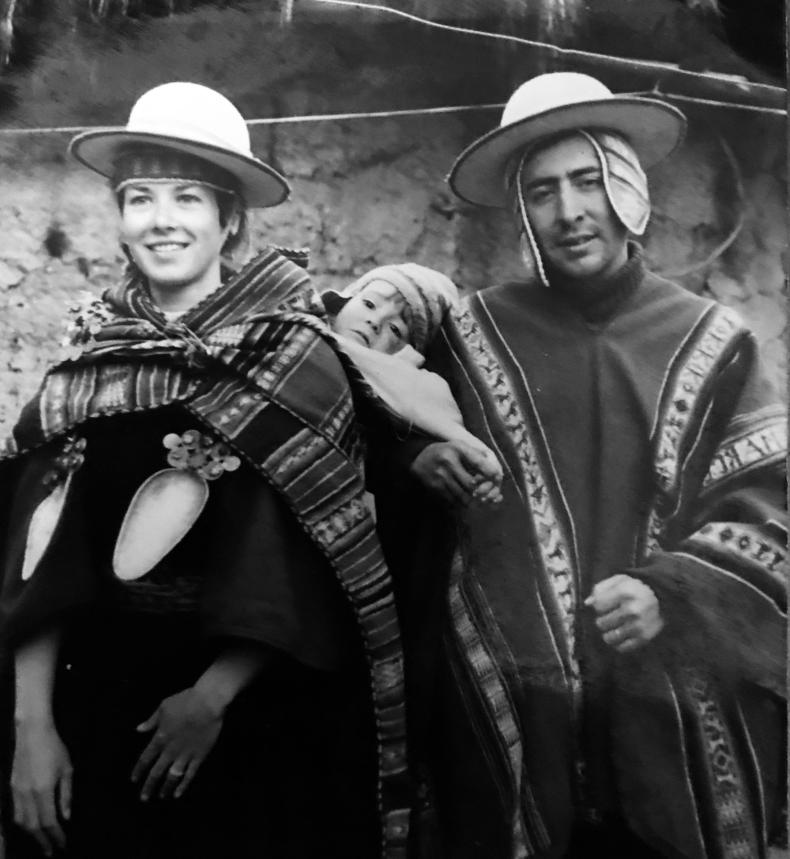
Isabel Seguí argues that this structure – a collective with a married couple at its center – appears with some regularity in the cultural sphere in Bolivia and Peru. This is very likely connected to the ways collectivity is conceptualized and lived throughout the region. As complementarity is central to Aymara and Quechua understandings of community, groups are often organized around a couple that symbolizes duality. This couple can be temporary (as in the case of Bolivian festivities called prestes) and need not be complementary in a biological sense. But as Catholicism is widespread, the ‘married couple’ has become something like a proxy for this structure.6 And since urban leftist cultural circles in the 1960s were very interested in Aymara and Quechua forms of collectivity, it is probable that this practice was adopted by formations such as Ukamau. For instance, there is evidence for such a self-fashioning as an indigenous married couple in this double-portrait: French born Danielle Caillet and Antonio Eguino with their child are dressed up in a typical way for married couples in the Andes. Both Caillet and Eguino were part of Ukamau and they brought their young child to the shooting of YAWAR MALLKU / THE BLOOD OF THE CONDOR (Jorge Sanjinés, BOL 1969) in the 1960s to a village far from La Paz.
© Danielle Caillet
The collaborative mode, which included relatives and friends, also had political and economic motivations. The lack of resources forced filmmakers to rely on people they knew and trusted, both with regard to workforce and financing. Additionally, with increasing political repression, family and friends figured as a means of protection against police violence and the threat of detention. I can confirm this situation from my own research into the political and artistic universe of Tota Arce and Mario Arrieta, an artist-researcher couple that took part in the early Ukamau films. They formed the nucleus of a cultural milieu that encompassed theatre, film, visual arts, social sciences and had strong connections to the militant left. In what follows, I will weave in aspects of this specific mode of production wherever necessary, but in order to give women’s labor and creativity more weight, I will end with an unrealized film that Beatriz Palacios had planned, but was never able to finalize.
So It Is, But It Should Be Otherwise: Film as Revolution
The collective named itself after the first film produced by the group. In Aymara, the word Ukamau means: “So it is,” an affirmative formulation often used in collective deliberations. The first collaboration of the later members was a documentary short film called REVOLUCIÓN (Jorge Sanjinés, Oscar Soria, BOL 1963), which won the Joris Ivens Prize at the Leipzig Documentary Film Festival. REVOLUCIÓN addressed social grievances and, as such, the motives for the seizure of power by the Bolivian Movimiento Nacionalista Revolucionario (MNR). When the film was shot, the 1952 national revolution was perceived to have failed in eradicating misery and social injustice, and criticism from the left for the revolutionary movement was becoming more pronounced. REVOLUCIÓN is a silent film and follows Eisenstein’s montage aesthetics. It was very different from Bolivian documentaries of the time, with voice-overs done at the Instituto Cinematográfico Boliviano (ICB). The latter was founded immediately after the Revolution, starting work in 1953. REVOLUCIÓN was meant as a critical contribution to the state’s founding myth and was even screened at the presidential palace. MNR-president Víctor Paz Estenssoro found the film good but “very dangerous” and had it banned.7 State-funded but also critical of the state, REVOLUCIÓN was followed by the medium-length ¡AYSA! (Jorge Sanjinés, BOL 1965), which was shot in a mining region. UKAMAU (Jorge Sanjinés, BOL 1966), the film that granted the collective its name, was produced after the military coup and seizure of power by right-wing General René Barrientos in 1964. To get it funded, the group submitted a fake script to the National Film Institute (ICB). But by the time the authorities found out and the film was confiscated, already 300,000 Bolivians had seen it.8 It tells the story of an Aymara man’s revenge for the rape and killing of his wife. Jorge Sanjinés, who was employed by the National Film Institute at the time, lost his job and the institute closed soon thereafter. These first films develop in nuce the themes of the group: the intertwining of economic, political and cultural oppression and forms of resistance against it. But it was not until the next film, that Grupo Ukamau began to develop a new way of filmmaking that centered on – often complicated – collaborations with non-bourgeois, indigenous amateur actors.
For many reasons their next film, the docu-fiction YAWAR MALLKU, can be considered a turning point. It deals with the problematic activities of the American Peace Corps in Bolivia in the 1960s, namely, with illegally performed sterilizations that US doctors had carried out without the consent of the indigenous women affected. During filming, a conflict unfolded between the filmmakers and the indigenous community at the center of the film. This conflict, as well as tensions within the crew, are worked through in an artistic meta-reflection in a much later film, PARA RECIBIR EL CANTO DE LOS PÁJAROS / TO HEAR THE BIRDS SINGING (Jorge Sanjinés, BOL 1995).9 For YAWAR MALLKU, the film crew consisted of friends and family and travelled to the Andean village Kaata. The filming was planned in consent with the village and the collaboration was planned with the mediation of one of the cabildo members, Marcelino Yanahuaya, who lived in La Paz part-time. After arrival, the film-crew was confronted with the problem that the community did not want to participate in the filming, despite the filmmakers’ good intentions and the political message they hoped to communicate, ostensibly in favor of them. It seemed as though the indigenous mediator was unable to resolve the situation. Sanjinés later describes it like this:
We had thought that by mobilizing one influential man we could get the rest of the people moving, because they would have to depend on him. We had not understood that the Indians put the interests of the collective above the interests of the individual, that what was not good for each individual could not be good for all of them […].10
Only when the film crew agreed to submit to the established communal decision-making mechanisms could the production move forward. In a ceremony and with the help of coca leaves, it was decided that the intentions of the film crew were in line with the village’s struggles and that a cooperation was possible.
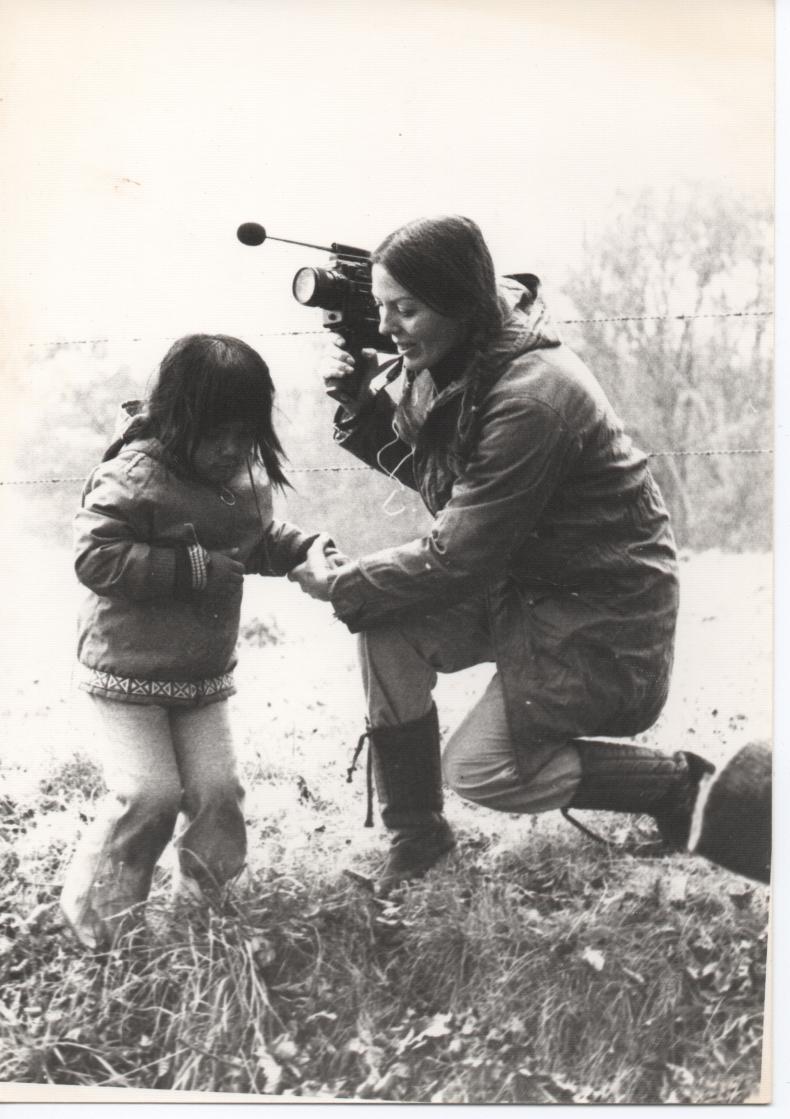
Within the urban film crew the production was also full of potential conflicts, since roles and obligations needed to be resolved on spot and because the collaboration was very much based on principles of reciprocal support.11 Although tasks were shifting throughout the crew and flexibility was crucial, some tasks were feminized (organizational tasks, domestic labor) and rendered invisible. Because of the affective and personal ties, productions of this kind were fragile: “Emotions such as companionship, enthusiasm, and generosity could turn an impossible film project into a great success. Conversely, jealousy, betrayal, or abuse could turn a utopian project into a painful human experience.”12 Three women were part of what cinematographer Antonio Eguino called a “tribe:” 1) Consuelo Saavedra, Sanjinés’ wife at the time, who had come with their three children and who is credited as assistant director, 2) Gladys de Rada, only known by the name of her husband, who had the important task of a translator, credited as assistant producer, and 3) the already mentioned Danielle Caillet, who acted but also took on the tasks of maintaining continuity and set photography. Eguino’s partner became a well-known sculptor and filmmaker later on.13
Archive of Tota Arce and Mario Arrieta © Arce family
Around 1970, shortly after wrapping up shooting, cinematographer Antonio Eguino recalled both the high personal commitment and collaborative spirit of the shooting, as well as the growing tensions surrounding the film’s production: “There came a time when personal relationships were tense, there were arguments, shouting, disagreements. There was a constant tension between us. Jorge and his wife fought, that was the beginning of the break that came later.”14 One of the issues could have been a romantic relationship between Sanjinés and a girl in Kaata, a topic also taken up in the afore-mentioned meta-film.15
The conflicts with the community lead to systematic reflection both of the modes of filmmaking and of the reception by those who were shown on screen. With a lot of effort, Ukamau films were screened in the countryside, later even with specially created projection settings and a power generator. In group discussions people were asked what they thought and felt about what they saw. In these feedback sessions, the filmmakers were made aware of the fact that certain film techniques, such as flashbacks, were not well understood by their collaborators as an aesthetic device that symbolized the act of remembering, and instead, often had disturbing effects. This was an important initial experience with the different conception of time and memory in Andean culture, which subsequently became central for LA NACIÓN CLANDESTINA (Jorge Sanjinés, BOL 1989). Initially, however, the lessons they took from this experience were decisive for making sure the following productions would be radically collective.
YAWAR MALLKU, a narrative about domination brought back from the Bolivian countryside to La Paz, gained great importance within the nexus of film and politics: The first attempted screening was interrupted by the police and was followed by a massive march on the streets of La Paz in which the – very politically active – art scene played a big role.16 Filmmakers, dramatists, actors, musicians, writers, and visual artists that joined together for this demonstration usually mixed with left-wing militants in a particular gallery and venue: Galeria de Arte and Peña Naira. The founder and manager of Galeria Naira was Pepe Ballón, a graphic artist, printer and founding member of the Bolivian Communist Party (PCB). There, everybody met: Violetta Para from Chile, the folklore Band Las Jairas, even Tota Arce, doing Brechtian theater, and her husband Mario Arrieta, one of the major contact points between the Bolivian militant left and Cuba, who – I was told17 – accompanied Ernesto Che Guevara by train to Bolivia. Mario Arrieta played a Peace Corps-Member, the ‘Gringo,’ in YAWAR MALLKU, and his brother-in-law, José (Pepe) Arce, who later died as a member of the Guerilla de Teoponte (ELN) played a medical doctor. At the same time, the political atmosphere in Bolivia was becoming increasingly repressive and leftists suspected of collaborating with the Guerilla militants were frequently imprisoned. The film already had become a symbol of resistance. When left-leaning general Alfredo Ovando seized power and the situation for political prisoners improved, the film was shown in the infamous Panóptico de San Pedro, La Paz’ prison.18 Additionally, the film led to protests against the activities of the US Peace Corps and it was then expelled from the country by the short lived, left government of Juan José Torres in the early 1970s.19
The group’s next film was even more radical, both with respect to the topic and the filmmaking process itself. EL CORAJE DEL PUEBLO / THE COURAGE OF THE PEOPLE (Jorge Sanjinés, BOL 1971) was shot in the short time between the dictatorships of René Barriento and Hugo Banzer. It is a re-enactment of the so-called “Massacre of St. John’s Night,” a key dramatic event in recent Bolivian history. The massacre occurred in 1967 near the Siglo XX-mine in the province of Potosí. The miners, including female miners and domestic workers, had been very well organized in Bolivia since the National Revolution, and tended to be Trotskyist in orientation. They often disagreed with the Communist Party and had their own ideas about national politics. The meeting was setup primarily to discuss support for Che Guevara’s guerrillas. Some of the younger trade unionists did indeed join the ELN guerillas – against the decision of the communist party. Also at issue was opposition to the reduction of wages, food scarcity, and placing the nationalized mining industry under a new general manager. In the night of the meeting, the camp of the assembled unionists was raided by the Bolivian army. About hundred people lost their lives in the massacre and a wave of arrests took place; among others, Domitila Barrios de Chungara, the leader of the housewives’ union, was imprisoned with her daughter and tortured in a La Paz prison.
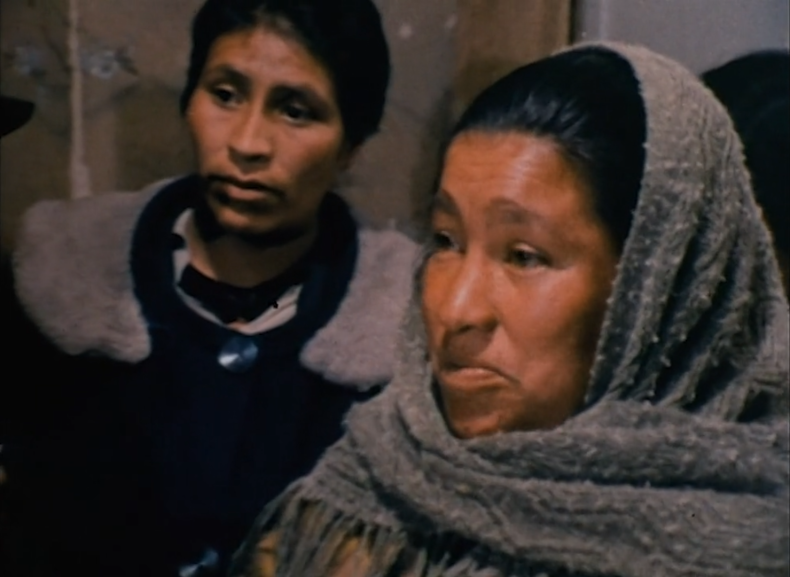
The scenes of EL CORAJE DEL PUEBLO were developed and scripted together with witnesses of the massacre and were shot with survivors at the locations where it took place. Ukamau managed to work with the – already liberated – Domitila Barrios de Chungara, who in my opinion, is the most outstanding figure in the film. She appears in three scenes: First, her home is shown, where she is preparing food to be sold by her children. Contrasting the images of the domestic space, she (in a voice over) speaks about her political engagement and commitment in the housewives’ union. In a second scene, she and other women complain about the scarcity of goods in the pulpería, a shop run by the mining company that provided the families with their entitled weekly nutritional basics (meat, rice, flour, oil, sugar). This is where Domitila gives an impressive speech:
[D]ozens of women are gathered at the door of the pulpería waiting for the results of the negotiation. A group of male miners is also present. Men are portrayed as inactive and faint-hearted, even being accused by women themselves of having a cowardly attitude. The community emerges as a collective protagonist where women lead the scene, and men are represented without agency. Th is collective portrait is emphasized by the position of the handheld camera that moves from the inside of the scene as a member of the community. The cameraman (Antonio Eguino) is not seeking a privileged position for recording. He acts as a participant in the events, striving to do his best, but without visual or auricular privileges. This way of operating the camera is a clear example of the decolonization of the cinematic language implied in the ‘cinema with the people’ technique […], showing how the director Jorge Sanjinés renounces the hegemonic voice in the narrative.20
© Fundación Grupo Ukamau
The third scene with Domitila is a hunger strike. The women re-enacting the hunger strike in the film are the same that became iconic years later (1977–1978) when engaging in a hunger strike against the Hugo Banzer dictatorship with strong public support. Watching the film nowadays makes it clear why it is considered important for the formation of Bolivian insurgent politics as it shows a future key political instrument (the hunger strike) in iconic pictures.
In 1971 the film was ready. With a military coup, Hugo Banzer forced Juan José Torres out of office. The film could, of course, not be shown in Bolivia and Grupo Ukamau split; some members went into exile until the end of the Banzer dictatorship. Although the group had more or less dissolved even before that, films were now made in different constellations in exile, such as ¡FUERA DE AQUÍ! in Ecuador in 1977. The film about Andean villages under great economic and political pressure was a milestone – with it, Sanjinés and Palacios were able to gain experience with self-organized distribution in cooperation with the university of Quito: 20 copies of the film were distributed in the countryside through trade unions and neighborhood committees, so that the film could also be shown in remote villages – a strategy that Ukamau also later used in Bolivia, where it also invested in a mobile screening infrastructure.21 At the same time, the films were being distributed in regular cinemas, so that large numbers of visitors could be reached. The group also published the book Teoría y practica de un cine junto al pueblo (Theory and Practice of a Cinema with the People, 1979).
Andean Time and the Integral Sequence Shot
After returning from exile to a still-unstable Bolivia, Ukamau produced several films, but it was with LA NACIÓN CLANDESTINA that the vision of a “cinema with the people” was to be realized with advanced cinematic means and a production budget of 800.000 dollars in total. The film was not only preceded – as with every Ukamau production – by in-depth research and long stays on location, the film plot was developed by taking into account what Sanjinés conceived of Aymara cultural traits. With this film the group began to implement an educational program for young, indigenous filmmakers.22 Six young people, who – like the protagonist Sebastián Mamani/Maisman – had come to La Paz from the countryside and struggled through with precarious jobs, worked on the film as so-called assistants. They are mentioned in the credits and received a scholarship for theoretical and practical film training. The young woman who plays Basilia was one of them. She was active both in front of and behind the camera. For Ukamau, the idea of “camera for everyone” should therefore not be understood metaphorically. Filmmaking was about giving young people professional training. To this day, Grupo Ukamau runs the Escuela Andina de Cinematografía and offers film education in La Paz.
LA NACIÓN CLANDESTINA accompanies Sebastian Mamani, who changes his name to Maisman to conceal his Aymara roots, on his inner and outer journey. Coming from an Andean village, he is a lost soul, a coffin maker who returns to his village where he is no longer welcome because he had betrayed the community. He carries a mask from La Paz to the village in order to perform a death dance to rebalance his relationship to the community. The movie was a great success both in Bolivia and at international film festivals. It was especially celebrated for its consequent use of integral sequence shots. The film has 130 scenes and 135 shots, which means that the vast majority of scenes are shot in only one take. Sanjinés claims that, for this film, the editing has been shifted completely into the camera work. Instead of breaking up scenes into different shots, the camera followed the choreography of the characters. In a sense, it accompanies the movements of both the narration and the characters, it takes on their impulses to move:
There are shots where the cameraman is on a six-meter-high crane, which slowly swings down; the cameraman gets out with the camera, goes into the scene with the actors, moves, then sits on a dolly and drives ten meters away with it. And you don’t notice, you don’t realize he’s moving.23
All the scenes had to be meticulously planned and rehearsed, a challenge, for the non-professional actors, the cinematographer and the technical staff alike. Alongside the film, Sanjinés published a theoretical text in which he explains that with the integral sequence shot a non-fragmented and anti-individualistic view of society, which he associates with Andean ideas of community, would be translated into film language:
A non-integrated society is characterized by permanent ruptures both in human relations and in its organic composition. By breaking space, we will often be painting a social universe of fragmentations, of jumps, of psychological violence. A society of individual spaces, of demarcated territories, of ‘proper’ places; a society of ranks, of social differences, of privileges, of classes, finally. There is no continuity, no harmony in Western society.24
What became even more influential for what is now called ‘indigenous film’ was the claim that an Andean cosmovision and non-western concepts of time were transformed into a cinematic language by making extensive use of the integral sequence shot. This is presented by Sanjinés as the resolution of Ukamau’s struggles with indigenous culture and agency since the 1960s; an interpretation of an Andean cosmovision for non-indigenous audiences:
We were developing our own aesthetics, a language, a narrative that was to culminate later in La nación clandestina, where we developed and constructed the ‘integral sequence shot,’ which is a way of showing an interpretation of the sense of circular time of the Andean world. Among the Aymara and Quechua, time is not linear, as with the Europeans, it does not correspond to a Cartesian logic. A space where the time is circular and everything will be back, that is what the camera narration performs in each sequence.25
Before and after, present and memory, although linearized and rhythmically organized appear as thread and weft, as in a weaving mill, as a unit of contrasts. The integral sequence shots indeed attempt to cinematically implement a peculiarity of Andean cosmovision that does not fit easily with film’s forward-oriented plot and editing logic. ‘Circularity’ and a specific understanding of memory needed to be translated into cinematic language. Andean cosmovision, so it is broadly described in ethnographic and linguistic research, conceives of the past in front of us, in front of our eyes, and the future behind our back. This is allegedly inscribed in the Aymara language. For the concept of the past, the Aymara use the root word nayra, which also occurs in the words eye, front and sight. Future events are often expressed with the root word qhipa, which spatially also means behind. Nayra mara, last year, can be literally translated “year lying in front.” This understanding is often expressed gesturally, when, for example, to indicate tomorrow, the thumb is pointed over the shoulder. Linguists Rafael Núñez and Eve Sweetser think that one reason for this could be that the Aymara attach special meaning to the directly observable. The past was witnessed with the eyes and therefore stays in front of the eyes; the future categorically eludes eye witnessing.26
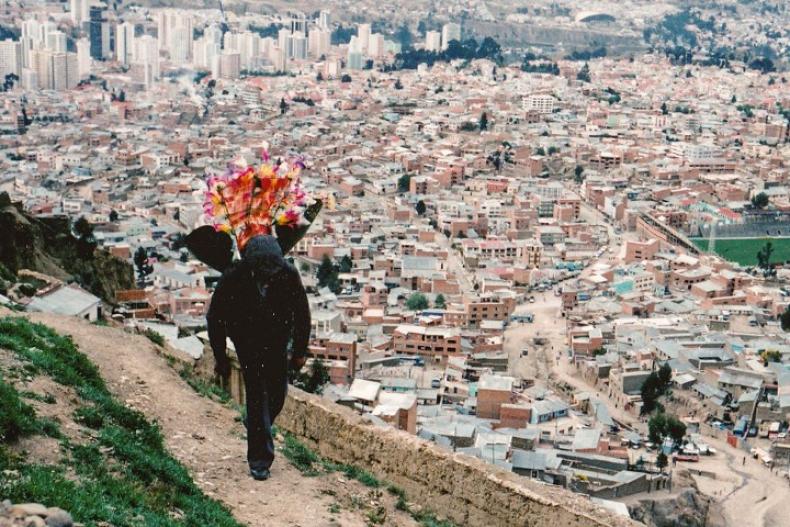
Against this background, it is particularly significant that the protagonist Sebastián wears his costume with his mask on his back when returning to the village: his future is the dance with the mask that will bring him death. He walks simultaneously towards his past, towards his origin and into an unknown future. Sebastián has his own past, of which he is both ashamed and longing for, “before his eyes.” But he does not think back to the past, as European conceptions of memory would have it, he witnesses it, while the future, the death(mask), waits on his back (Fig. 1).
Recently, and with good reason, it has been questioned whether such a total opposition between Aymara concepts of time and Western ideas can be maintained. Filmmaker Miguel Hilari Sölle of Aymara-German descent argues that both in Aymara and in Western time circular and linear time coexist and that Sanjinés heavily exoticized the Andean people by attributing ‘circularity’ to them as the sole and dominant mode.27 Indeed, in the final scene, Sebastián is doomed to dance in circles until he dies in order to be redeemed from the betrayal of his origins. In this scene he and an ‘Andean cosmovision’ are placed outside of historical time, much in the way Johannes Fabian has pointed out. He criticized ethnological narratives that construct the ‘other’ as being doomed to live in an ahistorical continuum outside of historical time.28 Hilari Sölle sees an idealization of Aymara culture at work and identifies Sanjinés’ ‘solution’ of the integral sequence shot “as an analogy to the ritual sacrifice of the protagonist: both signify the birth of a new authentic representation and the overcoming of false representations.”29 He does have a point here insofar the film was indeed viewed by urban and Western audiences as presenting an authentic version of Aymara culture and not as a translation of Aymara worldviews. This is also problematic insofar as we have heard that the initial impulse of Ukamau was not a translation of Aymara time for the cinema-audience but to find tools to enable Andeans to use cinematic language, which would actually be a translation of sorts in the other direction.
An additional perspective, that of the indigenous participants, is therefore needed. Fortunately, Reynaldo Yujira, who plays Sebastián Mamami/Maisman was interviewed several times. He was hired as an actor straight from a mechanical metal shop in La Paz by Jorge Sanjinés. For Yujira, the experience was quite different when compared to the heroic story of the invention of the integral sequence shot as a metaphorical device. He recalls first entering into a rather hierarchical relation with Sanjinés, with long political speeches by the latter and confusion on his side over the question of what acting meant. But due to the overlaps between his own story (coming from an Aymara village and making a precarious living in La Paz) and the politization of indigeneity that took place right at that time in Bolivia, culminating in the March for Dignity and Territory in 1990, through his acting, he “found in his own person the possibilities to communicate some of his own experience through the character,” as Gabriela Zamorano Villarreal has noted.30
It is Yujira’s and the other amateur-actors participation that, in my opinion, saves the film from being stuck in a romantic othering of Aymara culture. Also, explicitly political imagery that enters the film makes a difference: scenes of marches or the thematization of the filmmakers’ class-situatedness in the figure of the leftist militant fleeing the police across the plateau. The urban Marxist believes he represents the interests of the Andeans but his cry for help in Spanish is not understood (or granted) by them. Unlike in the earlier films, the racialized division between mestizo urban elites and the indigenous rural population is therefore straightforwardly addressed. This was to become the main theme of Ukamau’s next feature film PARA RECIBIR EL CANTO DE LOS PÁJAROS / TO RECEIVE THE BIRD’S SONG (Jorge Sanjinés, BOL 1995).
Dreams of Redemption
PARA RECIBIR EL CANTO DE LOS PÁJAROS came six years late when it appeared on screen. It was planned as a contribution for the commemorations of the beginning of the European conquest, but due to financing issues it was only released in 1995. For Grupo Ukamau, the film was a step consistent with their reflection of cinema as tool for cultural domination. With a film-in-film structure the movie tells the story of an urban film crew shooting a critical film about the conquista of the Inca empire by Francisco Pizarro’s troops. Therefore, the crew travels to the countryside looking for scenery and cheap extras. The film narration takes up quite directly what the first Ukamau group had really experienced in the 1960s, when shooting YAWAR MALLKU. The contradictions between urban, progressive-left, White or mestizo cultural workers and the interests and concerns of the indigenous rural population of an ayllu are worked through in a neo-baroque manner: Abundant landscapes, costumes and ornaments clash with arrogant urban interests and stubborn villagers, allegorical images are interspersed with political arguments. Both Bolivia’s internal class and race contradictions and the question of how much Latin American cinema is influenced by the US film market or European cinema are at stake. One of the first scenes picks up directly on the depiction of the encounter with the pueblo during filming YAWAR MALLKU. Sanjinés narrates it this way in 1979:
At the end of 1968 we arrived […] in the very high altitude community of Kaata, 400 kilometers from La Paz. Fifteen kilometers of this distance had to be covered on foot, conquering a mountain with slopes 500 or 600 meters deep. […] Drenched in sweat, exhausted and with a strong palpitating heart, we reached the surroundings of the community.31
This scene is taken up and cross-edited with a scene of Pizarro’s men marching into the Andes.
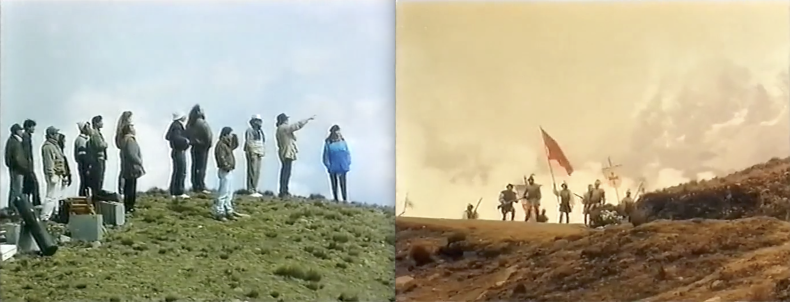
© Fundación Grupo Ukamau
The shooting of the film is being portrayed as a continuation of colonization with other means. The struggles with the villagers, who are not willing to participate, come to a head when they partake in an attack. The tensions fortunately can be quelled through a coca-ritual, as was the case during the actual film shoot. The title of the film refers to a ritual that is about to take place in Janco Amayu. In impressive, mimetic dances, birds are to be attracted, in order to learn new melodies from them. After consulting coca, the film crew is finally allowed to record the event, but their technical equipment is not capable of registering the bird songs, unlike the indigenous musicians who catch the latest songs from the air with their flutes.
Redemption (from white guilt) and cultural appropriation are the themes of the film. Right from the start they are put into baroque images: the masked, armed angels from the opening scene are – in art history – considered a primary example of the appropriation of Christian symbolism into indigenous imagery and vice versa. The impossibility of immersion into the Andean world is thematized with the love story between the producer’s brother and a young village teacher – a relationship that is strongly opposed by the older brother with racist undertones. The film ends with gifts that make the crew feel asahamed: The villagers bring animals and talismans to the already departing crew that did not even have the dignity to say goodbye.
The most erratic character of the film is probably Catherine, a French woman living in the village with her husband. Catherine is played by Geraldine Chaplin and acts as a cultural broker. Visually she stands out because she wears Andean clothes that contrast with her European appearance. She is the one who explains the Andean value-system and the expectations of the villagers to the film crew. I think, the character is modelled after Danielle Caillet, whom we met as a group member for YAWAR MALLKU and who performed the ‘Andean couple’ with her husband. What today – quite rightly – would be seen as an act of exoticized cultural appropriation was then part of a much more in-depth engagement. Caillet was very committed to supporting the struggle of indigenous women in Bolivia. In 1980 she released the documentary WARMI (Aymara for Woman) that dealt with the socioeconomic difficulties of women in these communities, but also focused on the strength and important role of women in the Andes.
Unlike in earlier films, the focus of PARA RECIBIR EL CANTO DE LOS PÁJAROS is on individual insight and the impossibility of redemption rather than on collective action. Although beautifully shot and narrated in a complex way, the film remains largely a gesture of self-accusation and does not articulate the possibility of resistance as in previous films. The film, which won the Palme d’Or, started a heated debate both in Bolivia and in Europe. It was criticized for its lack of political engagement and for giving up the idea of a collective protagonist.
As the question of appropriation is paramount, a note on another film, not by Ukamau, is necessary: TAMBIEN LA LLUVIA (Icíar Bollaín, MEX, ESP, FRA 2010) by Iciar Bollaín. Like Ukamau’s 1995 release it is a film-in-film set and shot in Bolivia. Like the latter, it is a meta-film: A film about a film crew shooting a critical film about the conquista that ‘enters’ a Bolivian community in search for scenery and cheap extras. Like PARA RECIBIR EL CANTO DE LOS PÁJAROS, it, too, narrates a redemption-story, one less fragile than the one the Bolivian production had worked out. The film’s argument resembles Ukamau’s: Film as a Western production system is an involuntary heir of colonialism. It is hard to believe that Iciar Bollaín and Paul Laverty (who wrote the script) would not have known about Ukamau’s production. Bollaín claims, she was told about the film while filming in Bolivia, but that it was hard to get it. This seems very unlikely, since Grupo Ukamau is very well known in Bolivia and the films are available in the Cinemateca Boliviana. Or the production company could have simply called Sanjinés, whom Paul Laverty says he admires. There are, of course, differences in the two productions, as the latter features a mostly European film crew and the background-story is the water-wars in Cochabamba. The question to what extent the European production is plagiarism shall be dealt with by lawyers. What I want to stress is, that up to the present something is wrong with the reception of Latin American cinema in Europe when a film that presents itself decidedly as decolonial, that thematizes how money and market mechanisms reproduce inequalities, does not even consider it necessary to name a Bolivian precursor.32
A Land Without Evil: Nonsolutions
I hope that I have shown, that the term ‘group’ has acquired different meanings for Ukamau between the 1960s and the 1990s: In the beginning, it was a name for a group of urban intellectuals and artists working together in a novel mode of mutual support for militant film projects. From the years in exile on, the meaning shifted to a dedication to experimentation with participatory methods of filmmaking with indigenous communities. With the establishment of Ukamau as a guiding star of Bolivian filmmaking in the 1990s, the term acquired the meaning of a transgenerational project of politically engaged filmmaking with the director Jorge Sanjinés at its center. Today’s shape of the project is a production company, foundation and film-school – Sanjinés released his last film LOS VIEJOS SOLDADOS (BOL 2022) and a number of co-productions have been realized since then.
I want to end this text with an unfinished film that reconnects to one of the most important female group members: Beatriz Palacios. In doing this, I want to pick up one of the loose threads in the historiography of Grupo Ukamau. It is an exercise in imagining an otherwise: What would the story of the manifold group Ukamau look like if Beatriz Palacios, producer and co-author of all films since the mid-1970s, would have been able to realize her own film-project LA TIERRA SIN MAL / THE LAND WITHOUT EVIL? She had planned, written and preproduced it at the turn of the century, but was never able to finalize it because of her death in 2003. Her husband made the film LOS HIJOS DEL ÚLTIMO JARDIN / THE CHILDREN OF THE LAST GARDEN (Jorge Sanjinés, BOL 2004) with the money that was foreseen for Palacios’ production, and he would have acted as her assistant for the first time in their collaboration.
What is known, thanks to Isabel Seguí, about the planned film is exciting: Palacios wanted to take up a popular and politically loaded myth from the Amazon region – the land without evil. The Guaraní legend of a ‘land without evil’ has attracted significant amounts of ethnographic attention over the last 100 years.33 It tells the story of a land of plenty, free from the maladies of colonialism. Time and again Guaraní groups, guided by so called ‘Karais,’ prophet-like leaders, set-off to search for it. One of the best known accounts of the cultural complex comes from French anthropologist Hélène Clastres, who connected it to Guaraní shamanism and stressed the performative and utopian character of the myth: Not only in real collective movement, but also by singing about the legend, the idea of a less strenuous and richer life was kept alive.34 In the late 20th century, political marches alluded to the myth – such as the one mentioned above: the March for Dignity and Territory 1990, performed by low-land indigenous groups from the Amazonian regions to La Paz.35 As a result of the Bolivian constitutional process, that for the first time included multiple indigenous peoples, the narrative even entered the constitution of 2009: the Guaraní term ivi maraei is called upon as one of nine indigenous ethical-moral principles of Bolivians plurinational society.36 I am sure that the growing awareness that Bolivia was made up by a multiplicity of indigenous cultures was the background for Palacio’s decision for the narrative and title. The complex plot foresaw five street children from the Aymara city El Alto, situated above La Paz, that were to travel to Urubichá in the lowlands with a little dog, looking for the loma linda (the beautiful hill), a term associated with the Guaraní legend.37
What if this film would have been made? Grupo Ukamau would have enriched their understanding of indigenousness, as their focus for over 50 years of filming was Andean indigenous groups, their cultural specificities and political struggles. It would have opened the door to participate in the immense political transformation that began with the Gas War (2003), led to the founding of the Moviemento al Socialismo (MAS) and culminated in the establishment of the already mentioned plurinational constitution of 2009. It’s hard to say, what aesthetic solutions Beatriz Palacios would have presented, but it is interesting to see that with the ‘land without evil’ she had already opted for what could, with Siegfried Kracauer, be called a nonsolution38: If Hélène Clastres was right, telling the stories about the search for the ‘land without evil’ was not about a concrete place or an already predefined way of life there, but about keeping alive the idea that it could be otherwise, that the established order/disorder can and must be questioned. This connects well to how the group, or the different groups Ukamau, experimented with participation: not as a solution, as an easy way out of structural racism or colonialism, but as a mode to make friction and the constitutional incompleteness of political processes visible and hearable.
- 1
Jorge Sanjinés and Grupo Ukamau, Teoría y práctica de un cine junto al pueblo (México: Siglo Veintiuno Editores, 1979).
- 2
Cf. Isabel Seguí, “Ukamau abigarrado. Nuevas miradas críticas y fuentes de investigación: Presentación,” Secuencias 49–50 (2020): 8; David M. J. Wood, “¿Ukamau antes de Ukamau? Nuevos acercamientos a la historia del cine en la Bolivia de los años sesenta,” Secuencias 49–50 (2020).
- 3
Proceedings “Encuentro de Cine del Tercer Mundo”, Archive of Tota Arce and Mario Arrieta, La Paz, box ‘Cine’.
- 4
See, for example, the much quoted book by José Sánchez-H. that is made up of portraits of film directors and hardly mentions the group in his portrait of Jorge Sanjinés. José Sánchez-H., The Art and Politics of Bolivian Cinema (Scarecrow Pr, 1999). The same is true for many of the consulted handbooks or companions on Latin American cinema I consulted. Research on the group in Spanish that underscores collective production is presented in: Secuencias. Revista de Historia del Cine, nos. 49/50, Ukamau abigarrado, ed. by María Aimaretti, Isabel Seguí.
- 5
Isabel Seguí, “Auteurism, Machismo-Leninismo, and Other Issues: Women's Labor in Andean Oppositional Film Production,” Feminist Media Histories 4 (2018); Isabel Seguí, “Las mujeres del Grupo Ukamau: dentro y fuera de la pantalla,” Secuencias 49–50 (2020); Isabel Seguí, “Creating the Archive for Incomplete Feminist Cinematic Narratives: The Andean-Amazonian Case,” in Incomplete, ed. Alix Beeston (University of California Press, 2023).
- 6
Mary Weismantel and Mary E. Wilhoit, “Kinship in the Andes,” in The Cambridge Handbook of Kinship, ed. Sandra C. Bamford (Cambridge: Cambridge University Press, 2023).
- 7
Sánchez-H., Art and Politics, 80–81.
- 8
Sánchez-H., Art and Politics, 83.
- 9
Cf. Stephen M. Hart, A Companion to Latin American Film, Colección Támesis (Tamesis, 2004), 75; Sánchez-H., Art and Politics, 83–84.
- 10
Sanjinés and Grupo Ukamau, Teoría y práctica, 159–160, trans. KH.
- 11
Cf. Seguí, Auteurism, Machismo-Leninismo, 16–18.
- 12
Seguí, Auteurism, Machismo-Leninismo, 18.
- 13
Seguí, Auteurism, Machismo-Leninismo, 18.
- 14
Quoted in Seguí, Auteurism, Machismo-Leninismo, FN 13, 35.
- 15
Interview with Leni Ballón, La Paz, 31.10.2024.
- 16
One of the accounts of the events is by Jürgen Schütt Mogro, member of the ELN who was incarcerated by the Barrientos government: Jürgen Schütt Mogro, “Pepe Ballón. El imprentero anónimo de la subversion,” Fuentes, April 2018, 06.12.2024, online: http://revistasbolivianas.umsa.bo/scielo.php?script=sci_arttext&pid=S1997-44852018000200012&lng=pt&nrm=iso.
- 17
Interview with Juan Pablo Muñoz Arce, 7.1.2024, Santa Cruz.
- 18
Schütt, imprisoned for political activities, vividly recounts this event that brought together both militants and the art scene, Schütt, Pepe Ballón, 47.
- 19
Cf. Hart, Companion, 72.
- 20
Isabel Seguí, “The Embodied Testimony of Domitila Chungara in The Courage of the People (Jorge Sanjinés, 1971),” Interlitteraria 22, no. 1 (2017): 186–187.
- 21
cf. Rita Nierich et al., “‘Voraussetzungen für das Verständnis sind Interesse an und Achtung gegenüber der anderen Kultur’. Gespräch mit dem bolivianischen Filmemacher Jorge Sanjinés,” Filmbulletin 178 (1991): 4, 56–63, 57.
- 22
Nierich et al., Voraussetzungen, 58.
- 23
Nierich et al., Voraussetzungen, 63.
- 24
Quoted in: Miguel Hilari Sölle, “Reflexiones sobre el lenguaje a partir del Plano Secuencia Integral,” Secuencias 49–50 (2020): 83, transl. KH.
- 25
Cristina Alvares Beskow, “A combative cinema with the people. Interview with Bolivian filmmaker Jorge Sanjinés,” Cinema Comparat/ive Cinema 4, no. 9 (2016): 25.
- 26
Rafael E. Núñez and Eve Sweetser, “With the Future Behind Them: Convergent Evidence From Aymara Language and Gesture in the Crosslinguistic Comparison of Spatial Construals of Time,” Cognitive Science 30 (2006).
- 27
Hilari Sölle, Reflexiones.
- 28
Cf. Johannes Fabian, Time and the Other How Anthropology Makes Its Object (Columbia University Press, 2002).
- 29
Hilari Sölle, Reflexiones, 92.
- 30
Gabriela Zamorano Villarreal, Indigenous Media and Political Imaginaries in Contemporary Bolivia (University of Nebraska Press, 2017), 150. For the acting of Reynaldo Yujira cf.: Daniela A. Nahmad Rodríguez, “La nación Ukamau: apropiaciones de la técnica cinematográfica y actuación indígena en La nación clandestina (1989),” Secuencias 49–50 (2020).
- 31
Sanjinés and Grupo Ukamau, Teoría y práctica, 26–27, trans. KH.
- 32
The similarities were of course seen and discussed in Bolivian press: Carlos Tena: https://rebelion.org/tambien-la-lluvia-coincidencia-o-plagio/, 26.8.2024; Andrés Laguna: https://tiemporecuperado.blogspot.com/2011/01/tambien-la-lluvia-sobreviviendo.html, 26. August 2024; Valentin González-Bohorquez: https://www.valentingonzalezbohorquez.com/tambin-la-lluvia-la-mirada-del-otro-en-las-guerras-del-oro-y-el-agua, 26. August 2024; Rafael Archondo: https://hparlante.wixsite.com/digital-media/single-post/2015/12/21/sanjin%C3%A9s-y-bolla%C3%ADn, 26.8.2024; in Germany, only Christina Nord wrote about it: https://taz.de/Spielfilm-ueber-Indigenas/!5104456, 26.8.2024.
- 33
Cf. Karin Harrasser, “Import /Export. Gebrochene Heilsversprechen zwischen Südamerika und Europa,” Zeitschrift für Kulturwissenschaften 14, no. 1 (2020).
- 34
Hélène Clastres, The Land-Without-Evil: Tupí-Guaraní Prophetism (University of Illinois Press, 1995), cf., especially the chapter on prophetism.
- 35
Cf. Jürgen Riester, and Bernd Fischermann. En busca de la Loma Santa (Editorial Los Amigos del Libro, 1976).
- 36
Cf. Seguí, Creating the Archive, 113; Harrasser, Import /Export, 56
- 37
Seguí, Creating the Archive, 112–113. Seguí writes that Palacios had learned about the legend from a homeless child from the lowlands in the streets of La Paz.
- 38
Cf. Gabu Heindl and Drehli Robnik, Nonsolution: Zur Politik der aktiven Nichtlösung im Planen und Bauen (adocs, 2024).
Alvares Beskow, Cristina. “A combative cinema with the people. Interview with Bolivian filmmaker Jorge Sanjinés.” Cinema Comparat/ive Cinema 4, no. 9 (2016): 21–28.
Clastres, Hélène. The Land-Without-Evil: Tupí-Guaraní Prophetism. Chicago: University of Illinois Press, 1995.
Fabian, Johannes. Time and the Other How Anthropology Makes Its Object. New York: Columbia University Press, 2002.
Harrasser, Karin. “Import /Export. Gebrochene Heilsversprechen zwischen Südamerika und Europa.” Zeitschrift für Kulturwissenschaften 14, no. 1 (2020): 53–70.
Hart, Stephen M. A Companion to Latin American Film. Woodbridge: Tamesis, 2004.
Heindl, Gabu, and Drehli Robnik. Nonsolution: Zur Politik der aktiven Nichtlösung im Planen und Bauen. Hamburg: adocs, 2024.
Hilari Sölle, Miguel. “Reflexiones sobre el lenguaje a partir del Plano Secuencia Integral.” Secuencias 49–50 (2020): 79–96.
Nahmad Rodríguez, Daniela A. “La nación Ukamau: apropiaciones de la técnica cinematográfica y actuación indígena en La nación clandestina (1989).” Secuencias 49–50 (2020): 57–78.
Nierich, Rita, Peter B. Schumann, and Jorge Sanjinés. “‘Voraussetzungen für das Verständnis sind Interesse an und Achtung gegenüber der anderen Kultur’. Gespräch mit dem bolivianischen Filmemacher Jorge Sanjinés.” Filmbulletin 178, no. 4 (1991): 58–63.
Núñez, Rafael E., and Eve Sweetser. “With the Future Behind Them: Convergent Evidence From Aymara Language and Gesture in the Crosslinguistic Comparison of Spatial Construals of Time.” Cognitive Science 30 (2006): 401–450.
Riester, Jürgen, and Bernd Fischermann. En busca de la Loma Santa. La Paz: Editorial Los Amigos del Libro, 1976.
Sánchez-H., José. The Art and Politics of Bolivian Cinema. Lanham: Scarecrow Press, 1999.
Sanjinés, Jorge, and Grupo Ukamau. Teoría y práctica de un cine junto al pueblo. México: Siglo Veintiuno Editores, 1979.
Schütt Mogro, Jürgen. “Pepe Ballón. El imprentero anónimo de la subversion.” Fuentes, April 2018.
Seguí, Isabel. “The Embodied Testimony of Domitila Chungara in The Courage of the People (Jorge Sanjinés, 1971).” Interlitteraria 22, no. 1 (2017): 180–193.
Seguí, Isabel. “Auteurism, Machismo-Leninismo, and Other Issues: Women's Labor in Andean Oppositional Film Production.” Feminist Media Histories 4 (2018): 11–36.
Seguí, Isabel. “Las mujeres del Grupo Ukamau: dentro y fuera de la pantalla.” Secuencias 49–50 (2020): 33–56.
Seguí, Isabel. “Ukamau abigarrado. Nuevas miradas críticas y fuentes de investigación: Presentación.” Secuencias 49–50 (2020): 7–12.
Seguí, Isabel. “Creating the Archive for Incomplete Feminist Cinematic Narratives: The Andean-Amazonian Case.” In Incomplete: The Feminist Possibilities of the Unfinished Film, edited by Alix Beeston, 107–24. Berkeley: University of California Press, 2023.
Villarreal, Gabriela Zamorano. Indigenous Media and Political Imaginaries in Contemporary Bolivia. Lincoln: University of Nebraska Press, 2017.
Weismantel, Mary, and Mary Elena Wilhoit. “Kinship in the Andes.” In The Cambridge Handbook of Kinship, edited by Sandra C. Bamford, 179–210. Cambridge: Cambridge University Press, 2023.
Wood, David M. J. “¿Ukamau antes de Ukamau? Nuevos acercamientos a la historia del cine en la Bolivia de los años sesenta.” Secuencias 49–50 (2020): 15–32.