Argentine Filmmaking between Three Eras
Radical Cinema and South-South Political Connection
Table of Contents
Latin American Cinema in Ten Films and Five Modernities
Argentine Filmmaking between Three Eras
Nosferatu in Brazil
Nobody Alone and the Camera for Everyone
Memories of Encounter and the Encounter of Memories
Workings of Postmemory in Twenty-First Century Argentina
Home Movies and Family Archives in Latin-American Documentary Films
Transporting Memory
Living Archive – Before and After
This is an Open Access article distributed under the terms of the CC BY 4.0 License.
Suggested Citation: Stites Mor, Jessica. “Argentine Filmmaking between Three Eras: Radical Cinema and South-South Political Connection.” In Research in Film and History 8 (2026). https://doi.org/10.25969/MEDIAREP/24918.
In 2000, director Gabriela Jaime produced the documentary film GIANNONI, NO NAME, THAT’S ME / JORGE GIANNONI, NN, ESE SOY YO with the independent outfit Grupo Boedo Films. The film begins with a short explanation of its title: a photograph presented to a friend in which many of the major figures of Argentine film in the 1960s are all seated. The image is captioned with each of these towering directors’ names, all except one, which is unidentified. Under this name is the notation “NN,” for No Name or unknown. The film relates that Jorge Giannoni, the one who in presenting this image to the narrator, identifies himself as the NN in the photo. This is me, “ese soy yo.” The history of connection between the radical experimentation of the late 1950s and early 1960s in Argentine filmmaking and the growing movement of solidarity between Latin America and the anti-imperialist and liberation movements outside the region is a story which has now become a critical historical anchor within global cinema history. But beyond the framing of the Third Cinema Movement or the cultural moment of New Latin American Cinema, there remain many unknown events and lives that have been vital to reconstructing this history.
Argentina is well regarded as the home of a vital grassroots and activist tradition of political filmmaking and for the participation of its intellectuals and artists in the cultural front of resistance to capitalist imperialism and the designs of rival powers during the Cold War. The works of filmmakers like Fernando Birri, Octavio Getino, and Fernando “Pino” Solanas are studied in film schools around the world. The rise of political documentary filmmaking that began in the 1990s and became a boom phenomenon during the late 2000s can trace its origins to these forerunners, to the “generaciones 60/90” that participated in inter-generational exchange, well documented by film scholar Fernando Martín Peña.1 But a thread of this exchange that has often been hidden, suppressed, and sometimes purposefully erased, is the throughline that connects the complex set of institutions and actors of political filmmaking to the radical work of internationalist solidarity that permeated the movements to which they belonged.
Part of the recovery of the work of Giannoni, along with that of others, that were deeply engaged in internationalism through film, requires a broadening of the analytical frame of cinema studies. Responding to the calls set out by the historically-minded film scholarship of Charles Acland and Haidee Wasson, to understand the ways in which images and cinema are “integral to our experience of institutional and everyday life,”2 the ways they participate in economies of organizational and aspirational political events or underpin relationships between various people, places, and ideas. Roughly following Robert Darnton’s communication circuit,3 Chris Atton argues that radicalization of media can be found at any stage of the circuit,4 which means that political agency can come through the modes of production, conceptualization, or via the circumstances of circulation and reception. This means that radical political agency can occur both through intentional acts and as a result of circumstantial or accidental interactions created by media as it traverses complex political lives and moments.
To connect the radical impact of Argentine cinema on politicizing and elevating cinema practice to new heights during the decolonization struggles of the 1960s and 1970s and the lasting influence of the Latin American film theories and methods that continue to be inspirational to filmmakers across the global South, this article turns its attention to the key historical contingencies that sparked agency across three distinct eras. It begins by examining the role of the creation of an industrial cinema during the early Peronist era and the relationship of filmmaking to the state as it navigated an early Cold War third position, and then looks at the way that filmmaking shifted at the end of the Cold War and again in the aftermath of the neo-liberal crisis that resulted from Cold War alliances. Together, these moments provided important political context within which politicized filmmaking as a form of South-South solidarity would emerge.
While I’ve written about this in the context of the emergence of cine piquetero and at greater length elsewhere, this article will focus on the connections between South-South internationalist solidarity during this period and the work of filmmakers like Giannoni who until now have remained mostly anonymous, the memory of their work disappeared, like so many of their peers, or maintained in secret due to the nature of the causes to which they were attached. By opening up the conversation about these connections, we can understand in greater depth why these movements were so vital in buttressing the connections of resistance that united disparate movements of liberation on various continents.
Obreros de cine and the Non-Aligned State
During the period that is often referred to as the Golden Age of Argentine cinema, the era of big film studios and the birth of collective bargaining for film workers from technicians to actors, writers and directors,5 Argentina was poised between two important regional trends. First, rising pressure to suppress unions and suspected leftists had followed the increasing influence of the United States in industrial-labour relations across the hemisphere. Second, the end of foreign rule in places like India, Algeria, Lebanon, and Syria, inspired waves of support for decolonization movements and raised confidence in resistance to an international system imposed by the victors of European wars. Argentina’s own political landscape, which had been dominated by the first two presidencies of Juan Perón (1946–1952, 1952–1955) and the experience of multiple military coups (1930, 1946, 1955), provided a backdrop for cinema ripe for political critique and engagement.
Part of the rapid advance of the great studio age was the result of an increasing domestic appetite for cinema and the investment of several large companies in creating production chains that could deliver a regular stream of locally-made content.6 Under the first Peronist government, labour relations were rapidly adjusted toward more favourable representation and greater access to dispute resolution through legal channels. As clashes between workers and employers threatened to result in violence in other parts of the region, Edward Brundey argues that in Argentina “labor, management, and government authorities repeatedly sought to avoid such violence by appealing to the country’s legal and political institutions, in particular the Ministry of Labor, the federal judiciary, and the ruling junta itself.”7 In the context of obreros de cine, public protests and the threat of occupation of the national film institute forced the Argentine state to incorporate cinematographers’ union and professional associations in both wider scale labour relations and in determining how the state would administer the regulation of the industry.8
This relationship between film labour and the state provides a backdrop to the context of internationalism in Argentina from the mid-1950s to the 1960s. Argentina’s labour sector did not uniformly move toward militarism but rather exhibited a greater variety of political positions. Thus, as national liberation movements and civil rights struggles became tuning instruments for the articulation of local struggles, Argentine filmmakers, with strong unionization and increasingly incorporated into state-led cultural production, experienced a degree of collective political agency that was somewhat higher than that of their counterparts elsewhere. During this period, filmmakers like Fernando Birri, Leopoldo Torre Nilsson, and Leonardo Favio experimented with forms of social and neo-realism inspired by Italian cinema; Manuel Antin adapted works like Julio Cortázar’s short story La cifra impar to the screen; and directors like Humberto Ríos, Octavio Getino, Fernando Solanas, Raymundo Gleyzer, and others began making film from an openly Marxist political standpoint.9
Argentina’s artists participated in many worlds. They participated in a great number of cinematic traditions, with long relationships to and influences from French, Italian, and Hollywood producers.10 Film workers also participated in the efforts of regional and international labour organizations that were oriented toward collective goals that sometimes spoke to the work of artistic production as a form of labour. In conjunction with these, individual filmmakers were also politicized by the world around them. Events such as censorship or military rule at home directly impacted their work, and through their connections to events happening abroad, they were also engaged with the shifting politics within creative communities, in places like Havana, Algiers, or Paris, that were taking on new revolutionary direction and speaking directly to power.11
At the same time, the Argentine state had its own relationship to the rise of political radicalism. Militancy and civil protest, which grew over the decade of the 1960s, was greeted in Argentina with state violence. Filmmakers became just one of many groups that could be targeted by the military as suspected terrorists. Argentina, like many Latin American nations, joined the U.S. embargo of Cuba, and found itself outside of the Non-Aligned Movement that emerged in the aftermath of the Korean War. Latin American nations were not a part of the Afro-Asian solidarity bloc that represented formerly colonized countries at the United Nations, but were linked to these countries often through representation to international political organizations via party-led delegations. Argentine filmmakers that adopted positions of solidarity with the movements like that of Tricontinentalism that emerged from Cuba, or that supported the liberation of Palestine or Vietnam, found themselves in an increasingly marginalized space within their own national associations and political life. Thus, as a result of consolidating industrial and labour gains in this first era, Argentine filmmakers entered into the late 1960s and early 1970s with a strong political voice, but weak support from political organizations to be able to connect their positions to action.
Filmmaking and Solidarity during Latin America’s “Cold War”
Already by the mid-1960s, filmmakers from across Latin America began to migrate to escape persecution by military regimes allied with the United States. Forming artistic communities in exile, politicized artistic production shifted its focus from educating an internal audience to raising awareness abroad. Those that could not leave participated in clandestine cinema spaces where they were able to sometimes screen their denuncialist films within student organizations, militant groups, or other spaces of political radicalism. The pressure from outside Argentina on various military leaders and on the return of Perón, who would not live through his third presidency, elevated distrust between filmmakers and the state.
The era of censorship and blacklisting in Argentina of that began as early as 1966 when a new law was passed that denied classification to films that contradicted national and Catholic values.12 Forced displacement meant the construction of networks of support and the increasing identification of common cause among filmmakers within highly politicized transnational communities. For filmmakers like Pino Solanas and Octavio Getino, under the ausipices of their Grupo Cine Liberación, this meant circulating their films to new audiences, such as the Pesaro Film Festival in Rome in 1968 and penning a manifesto “Toward a Third Cinema” that centered the role of radical filmmakers between Europe and national liberation movements to identify Algiers as their intellectual capital and decolonization as a primary goal. Michael Chanan has written extensively about the role the Cuban revolution played in bringing together filmmakers under the auspices of both the Instituto Cubano del Arte e Industria Cinematográficos (ICAIC) and later, beginning in 1979, the annual International Festival of New Latin American Cinema, also known as the Havana Festival.13
The cultural Cold War within Latin America witnessed figures like Patricio Guzmán, Chilean-born displaced director, make films that mirrored important cinematic works of decolonization. Guzmán’s The Battle of Chile / La batalla de Chile (1976–1979) emulated Gillo Pontecorvo’s 1966 Battle of Algiers / La battaglia di Algeri both in style and in political analysis. During this period filmmakers like Jorge Giannoni would spend his exile making a film on neocolonialism in Palestine and helping to found the Third World Cinema Committee. The intention of this grouping was to bring filmmakers together under the banner of triconinentalist solidarity to collectively organize a way forward for political filmmaking from the decolonizing world. Holding a meeting first in Algiers in December of 1973 and later in Buenos Aires in May of 1974. Giannoni helped to found and direct a cinematheque within the ‘Manuel Ugarte’ Third World Institute at the University of Buenos Aires, which organized film cycles and hosted colloquia. The Third World Cinema Committee was comprised of filmmaking that participated solidarity networks that came together to consider alternative film production models and potential agreements. According to Mariano Mestman, “Giannoni remembers that a circuit fed by the Archive had been organised around 30 projectors.”14 While the lifespan of the committee was short, the influence of the connections made between Argentine filmmakers and their counterparts in Africa and the Middle East would extend far beyond its work.
This era of political filmmaking in Argentina gave way to rich theorization of cinema, which built upon previous traditions of thinking about the role of social cinema, Italian Neorealismo, Kino-Pravda, French New Wave, and new stirrings in Latin America, such as the experimental work of Santiago Álvarez in Cuba or Jorge Sanjinés collective filmmaking with the Grupo Ukamau in Bolivia. As manifestos of militant cinema, Third Cinema, and New Latin American cinema multiplied, so did serious interest among scholars and activists in the cultural affairs of Latin America under U.S. intervention. Films made under the banner of cinematic mantras such as Third Cinema often participated in other political projects, such as the work of the Popular Unity and the Movimiento de la Izquierda Revolucionaria (MIR) in Chile, opening new distribution channels from Venezuela and Cuba, and creating cinema screening events that could be used to mobilize workers or support militant efforts, such as happenings, in places like Tucumán in Argentina.15
Solidarity in this second era, which was premised on the politicization of an Argentine film community that had strong roots in the labour movement and had been successful in organizing social protest, became intertwined under the sign of the Cold War with the experience of displacement, repression and, ultimately, movement. Experimentation with new models and new forms, all of these created a new kind of foundation for filmmakers interested in internationalism to strike out and forge new political itineraries. Military rule in Latin America became an impetus to filmmakers to see themselves as protagonists in larger geo-political narratives and movements. Radicalism within filmmaking practice and within the political goals of filmmakers forced a parting of ways with earlier more insular methods of activism.
Filmmakers and the Permanent Neo-Liberal Crisis
From the outgrowth of violent neo-liberal economic reforms and the political repression of leftists, Peronists, militants, and activists of many stripes in Argentina emerged first a cinema of escape and then a cinema of truth-seeking. While the nation lumbered toward a transition to civilian rule and the re-establishment of democratic institutions, filmmakers began to experience a degree of notoriety outside of the domestic market. As films began to be produced from exile that directly confronted dictatorship, audiences in Europe and North America began to fuel investment into increased production on these themes. Luis Puenzo’s 1984 Oscar win for THE OFFICIAL STORY / LA HISTORIA OFICIAL catapulted recent events into public consciousness abroad,16 and film seemed to have a new role to play in helping to sustain the solidarity movements started by and behalf of exiled Latin Americans.
Cine testimonial and films about the dictatorship began to surface as an increasingly useful vehicle for translating the experiences and collective memory of Argentine across borders. And harnessing the increased interest in the Argentine industry became a top priority for the transition government of Raul Alfonsín. Enhancing the role of the state in the production of these highly visible forms of transnational communication and reinventing the state’s mechanisms to financially support such work through the industry was identified by Alfonsín as a means to conduct part of the cultural project of recovery in the era of destape. Manuel Antín, the celebrated intellectual of the 1960s generation, was an obvious choice to head the Instituto Nacional de Cine y Artes Audiovisuales not only due to his political background but also his close ties to the associations of collective bargaining that had been so important to the Argentine industry’s early relationship with the state.17 Antín would oversee an important period of expansion in international co-productions and distribution networks that would support the work of groups on university campuses, within political organizations, and in communities to address the human rights challenges left in place after years of Cold War-oriented policy.
An expanding market for Argentine political films brought co-production assistance from a wide variety of partners that had not only market but also political interests in supporting these projects. Canal Plus, for instance, had only just begun its subscription service in 1984, and aimed to walk the line between appealing to the political establishment in France and bringing online programming that challenged the status quo.18 Mama Cash, an international women’s fund founded in the Netherlands in 1983 sought to support women’s collective activism and the Jan Vrijman Fund founded later in 1998 both expressly aimed to bring the cultural production of countries of the previously colonized world to the international marketplace. The Havana Festival sought to organize an alternative distribution market for Latin American films, while major media distribution companies sought a way to carve out their own market shares.19 This nexus of resources created conditions that favored the return of filmmakers from exile to work in Argentina and to assume a place in the process of re-democratizing civil society.
The post-1989 films of the Latin American literary and cinematic international “boom” contributed significantly to the courting of international interest in human rights movements that began to flourish during this same period. However, from a political economy and a labour perspective, they also contributed to a larger shift that cemented neo-liberal gains in the region. Independent film producers, encouraged by the new cinema subsidies organized by the state, quickly found ways to work around film workers’ collective bargaining associations and the national industry. Their increasing ability to negotiate the terms of their production, premised on the flexibilization and deregulation of the market, together combined with the affordability of new digital technology, meant that local filmmaking no longer relied on a domestic market. The freedom to create independent films for an international market came, thus, at the expense of the very institutions that had afforded filmmakers political agency in the past.
From 1989 onward, the number of lower budget and independent films made by Argentine filmmakers began to grow and distribution entered an entirely new phase as the networks established by groups acting in solidarity or as new market participants created increasing avenues for films to be seen. Film exhibition spaces also multiplied as film festivals proliferated, museums and cultural centres featured new works, and ultimately networked platforms would provide means for uploading and experiencing film work. The collapse of the national studio system did not, however, mean that foreign films would simply refashion the commercial markets in Argentina. Local filmmakers began working in increasingly cooperative structures to be able to continue to produce critical work and to circumvent commercial interests. This phenomenon gave way to the era of vibrant grassroots cinema, one that would be receptive to not just a formal critique of the long era of neo-liberal economic compromises but also one that would re-center internationalist solidarity.
Documentalismo and South-South Solidarity
In 2001, Argentina experienced a major financial crisis. The result of an aggressive neo-liberal, developmentalist agenda that had been pursued vigorously by both military and civilian administrations from the 1960s, most middle-class Argentines were plunged into crisis after their savings were “corralled” on the eve a significant currency devaluation.20 In the deep recession that followed, new groups took to the streets. Middle-class women participated in clamorous marches on the presidential palace, banging of pots and pans to signal the impact of the financial reforms on daily struggles to survive. Students, retirees, and the unemployed organized protests and collective actions. Neighborhood assemblies began printing their own forms of currencies and exchange systems, workers occupied abandoned factories, and, in that fertile time of unrest, the left that had disappeared during the dictatorship began to reconsolidate.
Victims of neo-liberal capitalism came together in the wake of the crisis to publicly denounce structural violence. Protesters created blockades on important thoroughfares through the city and reinvigorated tactics from previous labour movements in order to push for urgent change. Piqueteros and desocupados who took to the streets and began organizing themselves into unions of the unemployed faced violent police repression and quickly adopted means to record their experiences and transmit them in alternative forms of news media.21 Independent groups of filmmakers like Insurgent Cinema Group and Grupo de Boedo organized to host documentary festivals that would sometimes include marches or demonstrations. Kino Nuestra Lucha and LuchArte emerged as forms of alternative media sources to contradict official newsmedia that refused to cover police repression.
Filmmakers became a part of a movement which saw the merging of independent media production and social movements. Their activism began to create an archive of worker experiments, demonstrations, and the birth of new political organizations for which an international audience was already primed. Documentalismo emerged as a form of political activist cinema that benefited from cooperative and anti-commercial forms of production. And this form of filmmaking was welcomed by foundations and festivals whose criteria aligned with the social goals of the movements to which they were attached. At its best, some of these productions were made in tandem with the workers which they documented.22 Transnational activism was able to flourish between these multi-sited movements. The Getino and Solanas “Toward a Third Cinema Manifesto”, with its call to follow the activist cinema of the 1960s, following workers in their everyday struggles, focusing on the reinvention of collective forms of resistance, and militant cinema again became a worthy objective.23
Films during this period were politicized not only in their content, their authorship, and their intended audiences. They were also politicized in their circumstances of production and their relationship to international markets and social movements. The critical reception of these films offered another space for consideration of the conditions under which they were made. Films made to capture the perspective of workers occupying an owner-abandoned factory demonstrated the process by which self-management could critique the economic models that had been inherited by a global economic system that privileged imperial power and financial capital. These critiques echoed the political ambitions of internationalist filmmakers of previous eras. As such, it should be no surprise that projects like that of rebuilding Tricontinental cinematic exchange quickly followed.
Radical Cinema, Solidarity, and Temporality
Filmmakers like Giannoni that experienced earlier moments of internationalist solidarity and participated actively in connecting Argentina to liberatory struggles elsewhere became notable links to the past for emerging artists in the post-crisis era. For instance, Grupo Boedo sought to reclaim his legacy and correctly identify the NN, the missing piece, within Argentina’s history of film radicalism. Scholars, of which I am an example, began to examine the ties between regions that began or were extended by leftist groups as a result of internationalism within the Latin American left.24 Carolina Bracco and Mariano Mestman each began to look closely at ties between filmmakers that circulated between the Middle East and Argentina during this period,25 while others, like Eugenia Palieraki and Rafael Pedemonte, looked to ties between militant, activist, and intellectual groups.26
In one sense, for leftists like Giannoni, important moments of internationalist solidarity, such as the fight for Palestine, provided an emblematic struggle by which to reimagine the way in which imperialism was inscribed upon Argentina’s own political history. Many groups of the emerging left during the crisis tied together a critique launched against unequal forms of citizenship and access to rights, while simultaneously taking aim at international institutions that had likewise failed to create a solution for stateless peoples. Periods of solidarity in Argentina’s past, such as that which Giannoni represented, provided an alternative vision for the future in terms of rebuilding and re-legitimizing the left. The left which began to assemble through social movements and new political formations were able to remind their constituencies of the connection of the Peronist Montoneros militancy to the Palestinian Liberation Organization (PLO) and to the solidarity expressed for boatlifts to Palestinians in Gaza that faced displacement and state violence. In a similar way in which the Palestinian cause has served as a lightning rod to connect temporally distant events, the tricontinentalist solidarity of filmmakers during the 1960s provided a framework for understanding the consequences of the corralito and the financial crisis in Argentina as part of a larger struggle against empire and capitalism.
Filmmakers engaged in internationalist solidarity could serve not only guideposts but also reminders of the mutual commitments made by Argentines engaged in armed struggle who no longer were able to speak for themselves. Argentina’s legacy of leftist connection to both a critique of Zionism and support for Palestinian liberation, despite official neutrality, is a classic case of the use of South-South solidarity to help consolidate a vision for collaboration between emerging left-leaning parties. Having been decimated by the Cold War and state violence, then starved of resources, the political left in Argentina in the transition era seemed unlikely to be able to reenter the process of officeholding. During the crisis, the use of social protest which included piqueteros donning the keffiyeh, or the checkered Palestinian nationalist scarf, to identify themselves within broader social movements as a form of representational solidarity facilitated a means for these political parties to come together and overcome the challenges of indeterminacy that followed Argentina’s return to democracy.27
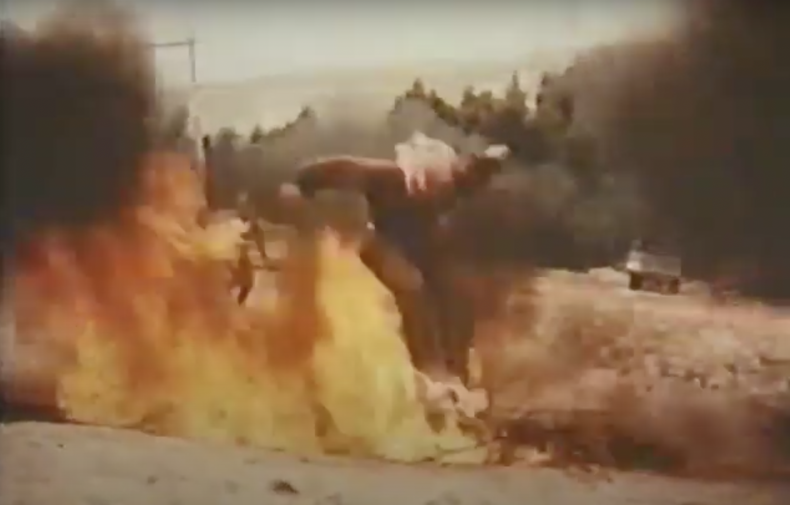
Gary Wilder posits in Concrete Utopianism that in order for us to understand how solidarity works, we must, “unthink” temporality, spatiality, and heterodox notions of historical processes.28 He urges scholars of the left to consider how “politics, ethics, and aesthetics are productively entwined...[and that] new social arrangements require and produce new historical and political subjectivities.”29 The mayo francés experienced by Giannoni while working in Italy, witnessing student demonstrations and police repression, created a political subjectivity that could interpret the events that would take place in Argentina as a part of a larger process. His film PALESTINE, ANOTHER VIETNAM / PALESTINE, OTRO VIETNAM (AR/IT/LB 1972) featured images very similar to those circulated in Cuban produced Tricontinental publications. They included tanks destroying fields, bombs being used against civilians, and fedayeen in training, jumping over open flames, reading themselves to fight a revolutionary war, a war against imperialism. These were not images of people without agency, these were not destitute refugees, but combatants.
In describing his role upon starting work at the University of Buenos Aires, Giannoni states, “Rudolfo Puigrós me dijo: la revolución ya viene.”30 This perspective, alongside the film festival and the work of the Third World Cinema Committee asserted the political role that filmmakers aspired to play in making revolutionary change. Part of the goal of these efforts was to help to ideologically replace notions of economic dependency, a term that had come to be a key descriptor of Latin American reality and a justification for intervention, with the notion of neo-colonialism and a recognition of the power of liberating the decolonizing world from the structures and geo-political arrangements that privileged imperial power.31 For a new generation of filmmakers that could connect to this radical moment of film politics, these earlier notions of common struggle helped make sense of the failures of the transition from dictatorship to truly disentangle Argentina from an unhealthy economic relationship to international financial structures and imperial power.
Conclusion
Argentine cinema has from its early days experienced a high degree of political potentiality. From its origins as an immigrant-driven industry to its emergence as a form of alternative documentary media, filmmakers working in Argentina have been connected to traditions of internationalist solidarity that have found their way into organizing and activist positions that have left their mark on the history of global cinema. Films made by Argentine directors occupy an important place in understandings of genres such as the testimonial film and militant cinema. The work of solidarity through cinema has been a critical means by which Argentine film has served to both lend support to movements beyond borders, but also to create support for an evolving set of leftist movements at home.
- 1
Fernando Martín Peña, ed. 60/90 Generaciones (Buenos Aires: Malba, Fundación Eduardo F. Constantini, 2003).
- 2
Charles R. Acland and Haidee Wasson, eds., Useful Cinema (Durham: Duke University Press, 2011), 1.
- 3
Robert Darnton, “What is the History of Books?” Daedalus 111, no. 3 (1982): 68.
- 4
Chris Atton, Alternative Media (London: Sage Publications, 2002), 26.
- 5
Jessica Stites Mor. Transition Cinema: Political Filmmaking and the Argentine Left since 1968 (Pittsburgh: University of Pittsburgh Press, 2012). See also César Maranghello, Artistas Argentinos Asociados: La epoypeya trunca (Buenos Aires: Ediciones del Jilguero, 2002).
- 6
Domingo di Nubila, La epoca de oro: Historia del cine argentino I (Buenos Aires: Ediciones del Jilguero, 1998). See also Rielle Navitski and Nicolas Poppe, eds., Cosmopolitan Film Culture in Latin America, 1896–1960 (Bloomington: Indiana University Press, 2017).
- 7
Edward Brudney, “’In Defense of Our Livelihoods’: Rethinking Authoritarian Legality and Worker Resistance during Argentina’s Proceso de Reorganización Nacional,” Labor 16, no. 4 (2019): 80.
- 8
Stites Mor, Transition Cinema, 58.
- 9
Marina Vargau, “Federico Fellini’s Effect in Argentine Cinema: The Case of Leonardo Favio,” Journal of Italian Cinema & Media Studies 12, no. 2 (2024): 189–205.
- 10
Nicolas Poppe, Alton's Paradox: Foreign Film Workers and the Emergence of Industrial Cinema in Latin America (New York: State University of New York Press, 2021).
- 11
Luca Caminati, “Italian Anti-colonial Cinema: Global Liberation Movements and the Third-Worldist Films of the Long ’68,” Screen 63, no. 2 (2022): 139–157.
- 12
Carolina Rocha, Argentine Cinema and National Identity: 1966–1976 (Liverpool: Liverpool University Press, 2018), 41–42.
- 13
Michael Chanan, Cuban Cinema (Minneapolis: University of Minnesota Press, 2004).
- 14
Mariano Mestman, “From Algiers to Buenos Aires: The Third World Cinema Committee (1973–74),” New Cinemas: Journal of Contemporary Film 1, no. 1 (2002): 45.
- 15
Fernando Solanas, Octavio Getino, and Jonathan Buchsbaum, “’Militant Cinema: An Internal Category of Third Cinema’ [1971] ‘Cine militante: una categoría interna del Tercer Cine’,” Framework: The Journal of Cinema and Media 62, no. 1 (2021): 23.
- 16
Eduardo Jakubowicz and Laura Radetich, La historia argentian a través del cine: Las “visions del passado” (1933–2003) (Buenos Aires: La Crujía Ediciones, 2006), 154.
- 17
Stites Mor, Transition Cinema, 89–90.
- 18
Jean-Claude Sergeant, “From Press Barons to Digital TV: Changing Media in France,” in Contemporary French Cultural Studies (New York and London: Routledge, 2020), 229–243.
- 19
Libia Villazana, “Hegemony Conditions in the Coproduction Cinema of Latin America: The Role of Spain,” Framework: The Journal of Cinema & Media 49, no. 2 (2007): 69. See also Jorge La Ferla, “El cine argentino. Un estado de situación,” in Hacer Cine: Producción audiovisual en américa latina, ed. Eduardo A. Russo (Buenos Aireas: Fundación teoría y practica de las artes. 2008), 220.
- 20
For more on the impact of these policies leading to the financial crisis, see Jennifer Adair, In Search of the Lost Decade: Everyday Rights in Post-Dictatorship Argentina (Oakland: University of California Press, 2020).
- 21
Fernando Redondo Neira, “Film Practices of Testimony and Commitment: Piquetero Cinema during Argentina’s 2001 Crisis,” Latin American Perspectives 48, no. 6 (2021): 243–253.
- 22
Jessica Stites Mor, “Networks of South-South Solidarity and Cold War Argentine Filmmaking,” in The Cultural Cold War and the Global South, eds. Kerry Bystrom, Monica Popescu, Katherine Zien (New York and London: Routledge, 2021), 182–197.
- 23
Luís Trindade, “A Ciné-Geography of Militant Cinema in the age of Three Worlds. Making Global History Appear in the Long 1960s,” Interventions 25, no. 2 (2023): 264.
- 24
Jessica Stites Mor, South-South Solidarity and the Latin American Left (Madison: University of Wisconsin Press, 2022). See also Also Marchesi, Latin America’s Radical Left: Rebellion and Cold War in the Global 1960s (New York: Cambridge University Press, 2018), Anne Garland Mahler, From the Tricontinental to the Global South: Race, Radicalism, and Transnational Solidarity (Durham: Duke University Press, 2018), and Lily Pearl Balloffet, Argentina in the Global Middle East (Palo Alto: Stanford University Press, 2020).
- 25
Carolina Bracco. “Third-World Cinema in Latin America and the Arab World: The Circulation of Imaginaries and the Shaping of a New Shared Identity,” Seminar presented by QMU's Centre for Communication, Cultural and Media Studies, April 2021, https://www.academia.edu/video/1qwR7k. Mariano Mestman, “Third Cinema/Militant Cinema: At the Origins of the Argentinian Experience (1968–1971),” Third Text 25, no. 1 (2011): 29–40; see also the excellent master’s thesis by Lubna Taha Alarda, "On Cinema and Revolutions: Tricontinental Militancy and the Cinema of the Palestinian Revolution," (Master's thesis, Queen's University, Canada, 2021).
- 26
Eugenia Palieraki, “Chile, Algeria, and the Third World in the 1960s and 1970s: Revolutions Entangled,” Latin America and the Global Cold War, eds. Field Jr, Thomas C., Stella Krepp, and Vanni Pettinà (Chapel Hill: University of North Carolina Press, 2020), 274–300; and Rafael Pedemonte, “The Meeting of Revolutionary Roads: Chilean-Cuban Interactions, 1959–1970,” Hispanic American Historical Review 99, no. 2 (2019): 275–302.
- 27
Jessica Stites Mor, “The Question of Palestine in the Argentine Political Imaginary: Anti-Imperialist Thought from Cold War to Neoliberal Order,” Journal of Iberian and Latin American Research 20, no. 2 (2014): 183–197.
- 28
Gary Wilder, Concrete Utopianism: The Politics of Temporality and Solidarity (New York: Fordham University Press, 2022), 2.
- 29
Wilder, Concrete Utopianism, 289.
- 30
Audiorecording reproduced in JORGE GIANNONI NN, ESE SOY YO (Gabriela Jaime, 1996), 00:32:48.
- 31
Mestman, “From Algiers to Buenos Aires,” 41.
Acland, Charles R., and Haidee Wasson, eds. Useful Cinema. Durham: Duke University Press, 2011.
Adair, Jennifer. In Search of the Lost Decade: Everyday Rights in Post-Dictatorship Argentina. Oakland: University of California Press, 2020.
Atton, Chris. Alternative Media. London: Sage Publications, 2002.
Balloffet, Lily Pearl. Argentina in the Global Middle East. Palo Alto: Stanford University Press, 2020.
Bracco, Carolina. “Third-World Cinema in Latin America and the Arab World: The Circulation of Imaginaries and the Shaping of a New Shared Identity.” Seminar presented by QMU’s Centre for Communication, Cultural and Media Studies, April 2021. https://www.academia.edu/video/1qwR7k.
Brudney, Edward. “’In Defense of Our Livelihoods’: Rethinking Authoritarian Legality and Worker Resistance during Argentina’s Proceso de Reorganización Nacional.” Labor 16, no. 4 (2019): 67–88.
Caminati, Luca. “Italian Anti-colonial Cinema: Global Liberation Movements and the Third-Worldist Films of the Long’68.” Screen 63, no. 2 (2022): 139–157.
Chanan, Michael. Cuban Cinema. Minneapolis: University of Minnesota Press, 2004.
Darnton, Robert. “What is the History of Books?” Daedalus 111, no. 3 (1982): 65–83.
Jakubowicz, Eduardo, and Laura Radetich. La historia argentian a través del cine: Las “visions del passado” (1933–2003). Buenos Aires: La Crujía Ediciones, 2006.
La Ferla, Jorge. “El cine argentino. Un estado de situación.” In Hacer Cine: Producción audiovisual en américa latina. Edited by Eduardo A. Russo, 215–242. Buenos Aireas: Fundación teoría y practica de las artes, 2008.
Mahler, Anne Garland. From the Tricontinental to the Global South: Race, Radicalism, and Transnational Solidarity. Durham: Duke University Press, 2018.
Maranghello, César. Artistas Argentinos Asociados: La epoypeya trunca. Buenos Aires: Ediciones del Jilguero, 2002.
Marchesi, Also. Latin America’s Radical Left: Rebellion and Cold War in the Global 1960s. New York: Cambridge University Press, 2018.
Mestman, Mariano. “From Algiers to Buenos Aires: The Third World Cinema Committee (1973–74).” New Cinemas: Journal of Contemporary Film 1, no. 1 (2002): 40–53.
Mestman, Mariano. “Third Cinema/Militant Cinema: At the Origins of the Argentinian Experience (1968–1971).” Third Text 25, no. 1 (2011): 29–40.
Navitski, Rielle, and Nicolas Poppe, eds. Cosmopolitan Film Culture in Latin America, 1896–1960. Bloomington: Indiana University Press, 2017.
di Nubila, Domingo. La epoca de oro: Historia del cine argentino I. Buenos Aires: Ediciones del Jilguero, 1998.
Palieraki, Eugenia. “Chile, Algeria, and the Third World in the 1960s and 1970s: Revolutions Entangled.” Latin America and the Global Cold War. Edited by Field Jr, Thomas C., Stella Krepp, and Vanni Pettinà, 274–300. Chapel Hill: University of North Carolina Press, 2020.
Pedemonte, Rafael. “The Meeting of Revolutionary Roads: Chilean-Cuban Interactions, 1959–1970.” Hispanic American Historical Review 99, no. 2 (2019): 275–302.
Peña, Fernando Martín, ed. 60/90 Generaciones. Buenos Aires: Malba, Fundación Eduardo F. Constantini, 2003.
Poppe, Nicolas. Alton's Paradox: Foreign Film Workers and the Emergence of Industrial Cinema in Latin America. New York: State University of New York Press, 2021.
Redondo Neira, Fernando. “Film Practices of Testimony and Commitment: Piquetero Cinema during Argentina’s 2001 Crisis.” Latin American Perspectives 48, no. 6 (2021): 243–253.
Rocha, Carolina. Argentine Cinema and National Identity: 1966–1976. Liverpool: Liverpool University Press, 2018.
Sergeant, Jean-Claude. “From Press Barons to Digital TV: Changing Media in France.” In Contemporary French Cultural Studies. Edited by Sian Reynolds and William Kidd, 229–243. New York and London: Routledge, 2020.
Solanas, Fernando, Octavio Getino, and Jonathan Buchsbaum. “’Militant Cinema: An Internal Category of Third Cinema’ [1971] ‘Cine militante: una categoría interna del Tercer Cine’.” Framework: The Journal of Cinema and Media 62, no. 1 (2021): 22–56.
Stites Mor, Jessica. Transition Cinema: Political Filmmaking and the Argentine Left since 1968. Pittsburgh: University of Pittsburgh Press, 2012.
Stites Mor, Jessica. “The Question of Palestine in the Argentine Political Imaginary: Anti- Imperialist Thought from Cold War to Neoliberal Order.” Journal of Iberian and Latin American Research 20, no. 2 (2014): 183–197.
Stites Mor, Jessica. “Networks of South-South Solidarity and Cold War Argentine Filmmaking.” In The Cultural Cold War and the Global South. Edited by Kerry Bystrom, Monica Popescu, and Katherine Zien, 182–197. New York and London: Routledge, 2021.
Stites, Mor, Jessica. South-South Solidarity and the Latin American Left. Madison: University of Wisconsin Press, 2022.
Taha Alarda, Lubna. "On Cinema and Revolutions: Tricontinental Militancy and the Cinema of the Palestinian Revolution." Master's thesis. Queen’s University, Canada, 2021.
Trindade, Luís. “A Ciné-Geography of Militant Cinema in the age of Three Worlds. Making Global History Appear in the Long 1960s.” Interventions 25, no. 2 (2023): 253–271.
Vargau, Marina. “Federico Fellini’s Effect in Argentine Cinema: The Case of Leonardo Favio.” Journal of Italian Cinema & Media Studies 12, no. 2 (2024): 189–205.
Villazana, Libia. “Hegemony Conditions in the Coproduction Cinema of Latin America: The Role of Spain.” Framework: The Journal of Cinema & Media 49, no. 2 (2007): 65–85.
Wilder, Gary. Concrete Utopianism: The Politics of Temporality and Solidarity. New York: Fordham University Press, 2022.