Home Movies and Family Archives in Latin-American Documentary Films
Table of Contents
Latin American Cinema in Ten Films and Five Modernities
Argentine Filmmaking between Three Eras
Nosferatu in Brazil
Nobody Alone and the Camera for Everyone
Memories of Encounter and the Encounter of Memories
Workings of Postmemory in Twenty-First Century Argentina
Home Movies and Family Archives in Latin-American Documentary Films
Transporting Memory
Living Archive – Before and After
This is an Open Access article distributed under the terms of the CC BY 4.0 License.
Suggested Citation: Praetorius, Charlotte. “Home Movies and Family Archives in Latin-American Documentary Films.” In Research in Film and History 8 (2026). https://doi.org/10.25969/MEDIAREP/24917.
Introduction
Since the beginning of the new millennium and with the advent of digitization, there has been a significant fascination, not only in Latin America but globally, with the cinematic and photographic legacy of the 20th century. In many films, especially documentaries, essay-films, and experimental films, there is a trend to reconstruct one’s family history using analog media and to tell it as part of a collective history.1 To describe this trend, literary scholar Marianne Hirsch coined the term “archival impulse.” She discusses this impulse mainly through artistic works that, by recourse to archival and amateur material, engage with the memory of historical catastrophes and crimes, such as the work of Golda Tencer And I Still See Their Faces: Images of Polish Jews and Susan Meiselas’ Kurdistan: In the Shadow of History. The central theme of both projects is the collection of materials and stories from “vanished communities.”2 This archival impulse has also influenced many artistic works, projects, and films from Latin America, particularly since the early 2000s. It’s important to note at the outset that the films I will discuss in the following are not only aesthetically diverse but also refer to very different historical and traumatic events that cannot be directly compared. The common thread in this essay is the artistic approach, which primarily consists of exploring the relationship between macro and micro history with filmic means while telling the story from a subjective and individual perspective and on the basis of a family archive.
Corpus
The selected examples are only a small part of what can be found in Latin American documentary filmmaking regarding this form of cinematic representation. Notably, there is a prevalence of Argentine examples, addressing the military dictatorship and the disappeared and murdered individuals associated with it since the early 2000s. For instance, in (H)HISTORIAS COTIDIANAS (AR 2001) by Andrés Habegger, six children of the “Desaparecidos”3 are interviewed, often talking about their family photos. Similarly, the documentary LOS RUBIOS (AR 2003) by filmmaker Albertina Carri explores the memory of her disappeared parents, reflecting on memory itself, its possibilities, and impossibilities of visualization. Another film that will be discussed in more detail is TIEMPO SUSPENDIDO (MX 2015) by Natalia Bruschtein, where the filmmaker tells her grandmother’s life story, who lost three of her four children and her husband during the military dictatorship in Argentina, fought for their memory throughout her life, and later suffered from dementia. The Ecuadorian film CON MI CORAZÓN EN YAMBO (2011) by María Fernanda Restrepo also addresses the loss of disappeared people through a visual family archive, albeit not against the backdrop of Argentinian history: the filmmaker recalls the abduction of her two brothers and its impact on her life.
Other examples tend to place political events in the background, connecting them more tangentially to individual fates. For instance, the Chilean film LA MEMORIA INFINITA (CL 2023) by Maite Alberdi focuses on the topic of dementia, similar to TIEMPO SUSPENDIDO. It tells the story of the Chilean journalist and author Augusto Góngora, who, for political rather than personal reasons, spent years fighting against forgetting and for remembering the crimes of the Chilean military dictatorship under Pinochet. Alberdi interweaves old family films with TV reports from the archives and newly shot material showing everyday life and the experience of dementia.
A film that focuses on historical amateur material is the Mexican film LA LÍNEA PATERNA (1995) by José Buil, tracing a family’s history from the 1920s to the 1950s. The film features impressively well-preserved analog material, including footage shot on 9.5mm with a Pathé Baby camera. Its rarity makes the material from the 1920s particularly fascinating, as amateur filmmaking was not yet widespread at the time and was mainly reserved for wealthy people. The aesthetics and materiality of the analog, as well as the connection between private and collective history, also characterize the films of the director Andrés di Tella. In works such as FOTOGRAFÍAS (AR 2007), 327 CUADERNOS (AR 2015), or FICCIÓN PRIVADA (AR 2019), he works with found photographic and film material, often incorporating archival or found footage used illustratively or as a temporal background.
Strategies of Narration and Materiality
These films closely look at family histories that have been brutally destroyed, making it impossible to separate the public and private, leading to their constant renegotiation. In dictatorships, private matters are often subject to state control. This is why the Argentinian cultural scholar Nicolás Pachilla understands the genre, which he calls “cine documental familiar” (family documentary), as a typical phenomenon of post-dictatorial cinema in Argentina:
In all these films, the director embarks on a quest around their family, inevitably leading to problems irreducible to the intimate nucleus, or conversely, starting from an affective experience related to a political event and eventually evolving into a family story. Whether appearing on screen or not, the narration is mostly presented in the first person through voiceover, structuring the story. The filmmaker often takes a prominent role in expressing their emotional response to both family and political events.4
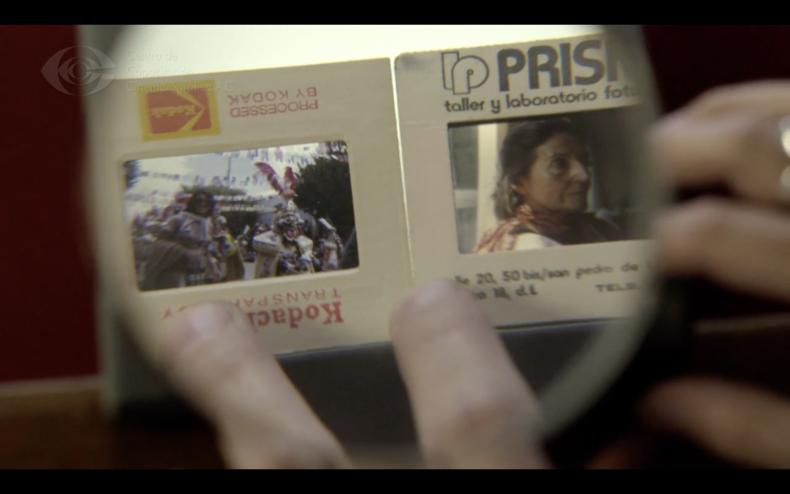
Besides similar narrative structures, there is a recurring style of staging and placing material in front of the camera. Material from albums or walls is filmed, held in hands, taken out of boxes, or sorted in front of the camera, presented one after another like a slideshow. And indeed, these scenes are underlaid with the clicking sound of a slideshow, even if the pictures are shown as material prints, not as projections, as seen in a scene in LA LÍNEA PATERNA. The material, as a tactile and analog object, always plays a central role, presenting albums, folders, and boxes as testimonies that emphasize the reality and authenticity of the material.
TIEMPO SUSPENDIDO 2015 © Centro de Capacitación Cinematográfica, FOPROCINE
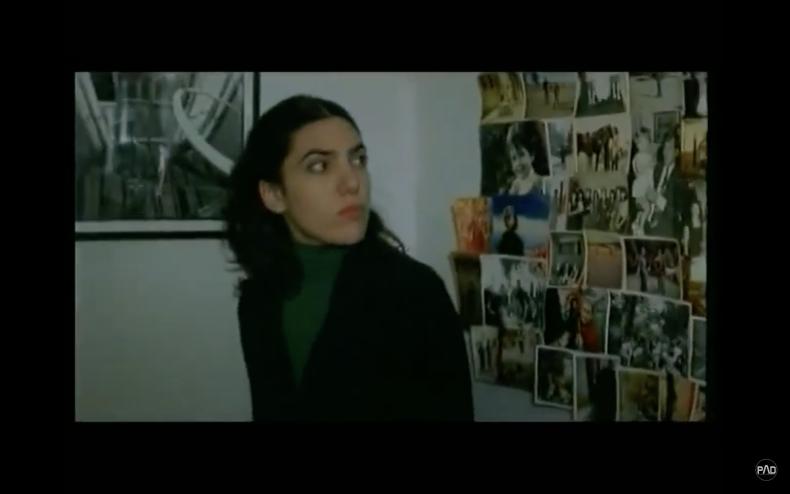
A good example to illustrate this is a scene in TIEMPO SUSPENDIDO, where the filmmaker Natalia Bruschtein is seen sitting in a library at the beginning of her film, sorting through her grandmother’s documents while the following quote is read in voiceover:
Our children re-signify us only when they can name us. And they can no longer do that... but we can name them. As can their classmates, their childhood friends and the survivors who knew them. They’ll be able to speak that multitude of names. He was my son, they were my daughters. As we parents grow old, our children blossom. That’s the way it should be and photos play a big role here. The last photograph is certainly the last one. Time disappears... it’s suspended.5
The cinematic memory work in TIEMPO SUSPENDIDO is particularly interesting because Laura Bonaparte, the filmmaker’s grandmother, has fought for decades against forgetting and for remembrance, but is now losing her memories due to dementia. The material, presented in the form of letters, photos, and Super-8 recordings that confront Bruschtein’s grandmother with her own forgotten past, is presented as evidence of both an individual and a collective history that threatens to disappear again due to the grandmother’s illness. This creates a complex web of material and personal evidence: photos are testimonies of something, survivors testify to the events in interviews and also to what can be seen in the photos. At times, the photos present themselves as evidence, as seen on posters carried by Bonaparte during political protests on the Plaza de Mayo in the 1980s. On various levels, the incorporation of photographic material in the film, as Susan Sontag puts it, repeatedly revolves around photography as irrefutable proof:
A photograph passes for incontrovertible proof that a given thing happened. The picture may distort; but there is always a presumption that something exists, or did exist, which is like what’s in the picture. Whatever the limitations (through amateurism) or pretensions (through artistry) of the individual photographer, a photograph – any photograph – seems to have a more innocent, and therefore more accurate, relation to visible reality than do other mimetic objects.6
Of course, images are always fragments, they come with gaps and blind spots, they are manipulated or edited; but in the films discussed here, it refers to its inherent indexicality. For this it is crucial that the photographic and filmic material in these films consists of private family pictures. Even though these materials cannot immediately, transparently, and self-evidently convey specific memories, they were created to capture memories. When the individuals depicted in the photos have passed away, the remaining photos often serve as a last anchor, becoming substitutes for memory that can still provide a connection to the family’s past. Thus, the focus of the films is not only to confirm and illustrate certain events but to construct and preserve a family memory through film. When the protagonist of TIEMPO SUSPENDIDO, due to dementia, cannot remember her children or their names while looking at their pictures, the photos seem to lose their meaning momentarily. However, as this process is captured in the film, it takes on the role of remembering, shares these memories with the audience and passes them on.
Analog Aesthetics
In addition to more classical documentary storytelling, as seen in TIEMPO SUSPENDIDO many filmmakers increasingly use the typical 16mm and Super 8 aesthetics, as it is typical for amateur film at least until the 1980s. An experimental approach to the material’s aesthetics is exemplified by the late Colombian director Ricardo Restrepo in his film CESÓ LA HORRIBLE NOCHE (2013).
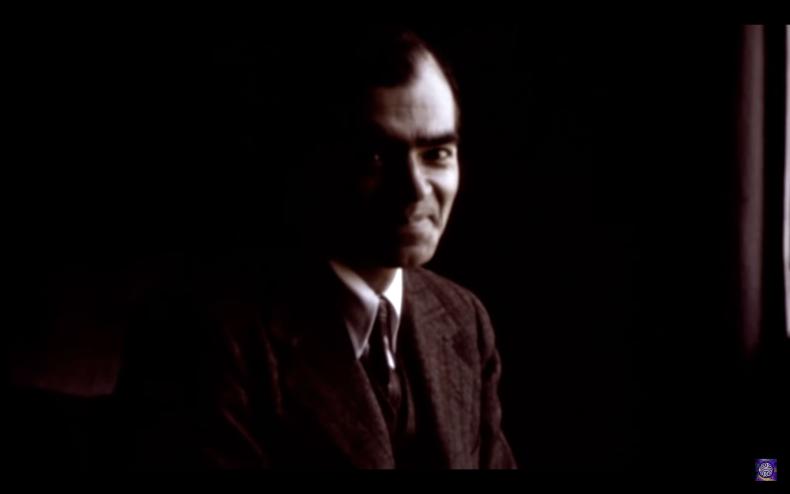
While old amateur film footage shows seemingly peaceful streets of Bogotá, the off-screen commentary questions “How can barbarism and injustice be explained through a family story, from an intimate perspective? / Cómo explicar la barbarie y la injusticia desde un relato familiar, desde una mirada íntima?” Restrepo deals with the events leading to and following the murder of Jorge Gaítan on April 9, 1948, using footage from his grandfather’s amateur film archive. He comments on the footage, appropriating it through various visual and auditory means. The well-preserved material from the 1940s is showing images of a bourgeois milieu. Well-dressed people happily dance, drink, smoke, and smile into the camera. The old film material is underlaid with music and sounds and also digitally reworked and slowed down so that it is charged with aura. Such nostalgic reworking of the material is typical of these films, even if the artistic approaches are quite different.
CESÓ LA HORRIBLE NOCHE 2013 © Pathos audiovisual
In CESÓ LA HORRIBLE NOCHE, this takes the form of revitalizing people in the material through digital post-processing. Other films fetishize the last material traces using and showing sometimes heavily scratched and aged film material. By presenting their findings as rarities, filmmakers use the old material as an aesthetic, cultural, and historical counterpart to the often-claimed digital immateriality. The presentation and appropriation of analog film material is a symptom of what Thomas Elsaesser called the “dialectic of material death and the hope for digital resurrection / Dialektik von materiellem Tod und der Hoffnung auf eine digitale Wiederauferstehung.”7
Latin American Amateur Film Heritage
This rises a much larger and more general question: What is the state of Latin American amateur film heritage? What preservation projects exist, and how is the material made accessible for researchers or artists? In recent years, the growing interest in amateur film has led to the establishment of numerous online archives in the United States and Europe. Platforms such as Indedits-Europe, Archive.org, European Film Gateway (EFG), Chicago Film Archives, South Side Home Movie Project, digit.de for West German amateur film, Open Memory Box for East German amateur film, and memoryscapes for Italian amateur film are only a few examples dedicated to preservation and access to entire amateur film and home movie collections.
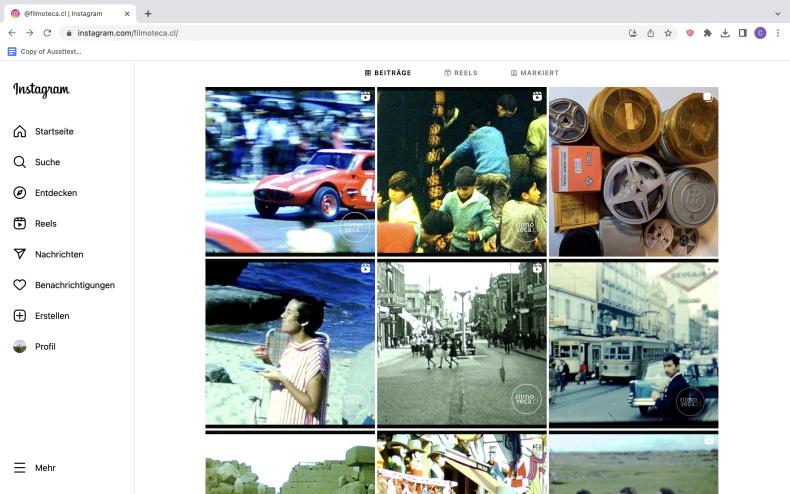
When researching Latin American amateur film, however, it turned out that apart from the Cineteca Nacional in Mexico with its Archivo memoria project, much less can be found online. The few existing initiatives appear to be small, underfunded projects, such as the Filmoteca.cl in Chile, focusing on so-called “orphaned” films. Despite accumulating a growing collection, the Filmoteca in Chile does not even have a proper website; the material is showcased only on social platforms like Instagram or Facebook. Similarly, the project Cine Amateur Peruano provides glimpses of its work on Facebook.
© Charlotte Praetorius
In contrast to Western amateur film, Latin American amateur film heritage seems precarious, in terms of preservation as well as accessibility. Diego Olivares, founder of the Chilean Filmoteca in Temuco, underscores that amateur films can hold special significance for historical memory, especially in countries like Chile with historically late and poorly developed film industries. Preserving amateur material and making it visible can extend and complement Chile’s film heritage, much of which was destroyed during the military dictatorship: “The analysis at different levels, especially technical and aesthetic, of the materials presented by filmoteca.cl on its Instagram account, for example, allows us to endorse the idea of a widening of the scope of national cinema […]. / El análisis en distintos niveles, sobre todo técnicos y estéticos, de los materiales presentados por filmoteca.cl en su cuenta de Instagram, por ejemplo, permite refrendar la idea de un ensanchamiento del alcance del cine nacional […].”8
In contrast, Western amateur film, particularly in North America and Western Europe, has been shaped by mass culture since the 1950s. Filming on Super 8 became a popular hobby, often depicting the idyllic world of the nuclear family in newly built homes and on affordable vacations – a world marked by political stability and prosperity. In contrast, the same period in many Latin American countries was characterized by political and economic upheavals that inscribed themselves into individual biographies and family histories, often through violence. The films discussed above, using private image and film archives, tell the story of the military dictatorship and draw on material as the last trace of the victims. Perhaps, this is precisely what distinguishes the archival impulse in the context of Latin American cinema from analog nostalgia in Western Europe and the US. While in all these cases amateur material is nostalgically charged, showing first steps, birthdays, and carefree days at the beach, in a Latin American context this material often does not serve as a reminiscence of a supposedly good old time but as the “last” image of people who have disappeared.
- 1
I wrote extensively about this topic in my dissertation: Charlotte Praetorius, Found Foto-Film. Aneignungen analoger Fotografie im zeitgenössischen Essay- und Dokumentarfilm (Marburg: Büchner, 2022).
- 2
Marianne Hirsch, „Der archivale Impuls der Nacherinnerung,“ in Album. Organisationsform narrativer Kohärenz, ed. Anke Kramer and Annegret Pelz (Göttingen: Wallstein, 2013), 125.
- 3
The term “desaparecidos” refers to the individuals who were forcibly disappeared during the military dictatorship.
- 4
“En todas ellas, el director o la directora emprende una búsqueda en torno a su familia que deriva ineluctablemente en problemas irreductibles al núcleo íntimo, o bien, por el contrario, parte de una experiencia afectiva en relación con un acontecimiento político para derivar eventualmente en alguna historia familiar. Por otra parte, sea que aparezca o no en pantalla, se presenta en la mayoría de los casos en primera persona mediante una narración en off que estructura el relato, y en la cual toma un rol protagónico lo que le sucede a nivel afectivo con respecto a los sucesos tanto familiares como políticos en cuestión.” Pablo Nicolás Pachilla, “Tres hipótesis sobre el cine documental familiar en Argentina (2001–2021),” Montevideo: Dixit 36, no. 2 (2022): 27.
- 5
English subtitles; original: “Solo nuestros hijos nos resignifican cuando pueden nombrar nos. Y ellos ya no pueden hacer lo pero nosotros a ellos sí. Y los compañeros de escuela y los amigos del barrio y los sobrevivientes que los conocieron podrán hablar de esa multitud de nombres. El y ellas fueron mis hijos. Mientras los padres envejecemos los hijos florecen. Así debe ser y aquí es donde las fotos juegan un papel importante. La última foto es definitivamente la última. El tiempo desaparecido, suspendido.” TIEMPO SUSPENDIDO (00:02:16).
- 6
Susan Sontag, On Photoghraphy (New York: RosettaBooks LLC, 2005), 3.
- 7
Thomas Elsaesser, „Die Geschichte, das Obsolete und der found footage Film,“ in Ortsbestimmungen. Das Dokumentarische zwischen Kino und Kunst, ed. Eva Hohenberger and Katrin Mundt (Berlin: Vorwerk 8, 2016), 153.
- 8
Diego Olivares Jansana, “Archivos, repertorios y usos del cine doméstico huérfano: la experiencia del Proyecto filmoteca.cl,” Montevideo: Dixit 36, no. 2 (2022): 51.
Elsaesser, Thomas. „Die Geschichte, das Obsolete und der found footage Film.“ In Ortsbestimmungen. Das Dokumentarische zwischen Kino und Kunst, edited by Eva Hohenberger, Katrin Mundt, 135–155. Berlin: Vorwerk 8, 2016.
Marianne Hirsch. „Der archivale Impuls der Nacherinnerung.“ In Album. Organisationsform narrativer Kohärenz, edited by Anke Kramer, Annegret Pelz. Göttingen: Wallstein, 2013.
Olivares, Diego. “Archivos, repertorios y usos del cine doméstico huérfano: la experiencia del Proyecto filmoteca.cl.” Montevideo: Dixit 36, no. 2 (December, 2022): PAGES.
Praetorius, Charlotte. Found Foto-Film. Aneignungen analoger Fotografie im zeitgenössischen Essay- und Dokumentarfilm. Marburg: Büchner, 2022.
Pachilla, Pablo Nicolás. “Tres hipótesis sobre el cine documental familiar en Argentina (2001–2021).” Montevideo: Dixit 36, no. 2 (December, 2022): PAGES.
Sontag, Susan. On Photoghraphy. New York: RosettaBooks LLC, 2005.