Memories of Encounter and the Encounter of Memories
Temporal Horizons in PARA RECIBIR EL CANTO DE LOS PÁJAROS (1995) and TAMBIÉN LA LLUVIA (2010)
Table of Contents
Latin American Cinema in Ten Films and Five Modernities
Argentine Filmmaking between Three Eras
Nosferatu in Brazil
Nobody Alone and the Camera for Everyone
Memories of Encounter and the Encounter of Memories
Workings of Postmemory in Twenty-First Century Argentina
Home Movies and Family Archives in Latin-American Documentary Films
Transporting Memory
Living Archive – Before and After
This is an Open Access article distributed under the terms of the CC BY 4.0 License.
Suggested Citation: Árva, Márton. “Memories of Encounter and the Encounter of Memories: Temporal Horizons in PARA RECIBIR EL CANTO DE LOS PÁJAROS (1995) and TAMBIÉN LA LLUVIA (2010).” In Research in Film and History 8 (2026). https://doi.org/10.25969/MEDIAREP/24913.
Introduction
Since colonialist hierarchies, teleological discourses, and the technologies of the cinema have been inexorably intertwined within the imperialist project of Western modernity/coloniality, films that aim at engaging with subaltern historical narratives are prone to challenge fundamental notions of modern temporality. For Ella Shohat and Robert Stam, the “intertextual invention” of “the Discovery” and “the New World” has been key to “the idea of history itself.”1 Conversely, revisionist films tend to defy hegemonic ideas about historical timelines and “assert links between past and contemporary oppressions and resistances.”2 Much has been written on these particular aspects of Icíar Bollaín’s TAMBIÉN LA LLUVIA (MX/ES/FR 2010), and its contributions to past and present anticolonial questionings, emphasizing its transnationalism,3 self-reflexivity,4 “rights-promoting storytelling,”5 structures of affect and emotion,6 female perspectives,7 or its metaphors and iconography.8 However, its handling of temporalities underlying the multilayered narrative has rarely been directly scrutinized, and more importantly, it has not been compared to Jorge Sanjinés’ PARA RECIBIR EL CANTO DE LOS PÁJAROS (BO 1995), a feature film released some fifteen years earlier, whose plot, just like that of TAMBIÉN LA LLUVIA, also centers on a film crew that arrives to contemporary Bolivia to shoot an historical epic on the conquest of the Americas.9
As both films engage in “metacinematic and multidisciplinary approaches”10 and create a metaleptic interplay11 between the past temporal horizon of the film-within-the-film and the present time of the shooting itself, a focused examination of the temporal notions that inform their take on the long history of imperialist exploitation of the indigenous peoples in what today is called Bolivia can shed light on their key differences in conceiving of and representing modern/colonial history. Hence, this study will ask what kind of temporal relations are established in the two films in question; how these relate to the films’ respective contexts of production; what kind of underlying notions of temporality may be traced in their expressive strategies; and, ultimately, what their political implications are within the ongoing struggles of indigenous social groups in Bolivia.
Modernity/Coloniality and Cinematic Time
In his book The Darker Side of Western Modernity, Walter Mignolo explains that time, as we know it today, is a result of detaching a technically and philosophically mediated concept from the fundamental cosmic or biological experience that things are changing within and around us.12 He asserts that the invention of modern notions went hand-in-hand with their imaginary chronological directionality. Thus, the binaries of “nature” and “culture,” “barbarism” and “civilization,” or “tradition” and “modernity” did not simply imply oppositions, but also a certain kind of temporal movement, “from” nature “to” culture, and so on. That is, in Western modernity, the concept of time has been used to imagine the logic of society, what also led to a particular notion of history: time began to classify cultural differences according to their proximity or distance to modernity.13 To be sure, in order for this particular “chrono-politics”14 to become hegemonic, other calendars were systematically deemed as unsustainable, different approaches to history and non-modern concepts of time were silenced and subalternized. Emerging from the intersection of the modern/colonial project’s ideological, scientific, and technological developments, cinema was a central part of this “general cultural imperative”15 that installed a global temporal regime in the second half of the 19th century by measuring, standardizing, and rationalizing time. Thus, cinema’s role in the imperialist venture was not only to popularize a Eurocentric imagery and its notion of progress and development,16 but also to contribute to the erasure of non-Western local times and, more importantly, to record, alienate, and externalize temporal experience itself, something that previously had been envisioned as indivisible, as “the continuum par excellence.”17
However, non-modern temporal perspectives and modes of historical consciousness have survived and are prone to resurface in discourse and praxis critical with the rhetoric of modernity/coloniality. Within a Latin American context, cultural critic Néstor García Canclini famously coined the term “multitemporal heterogeneity,” referring to the consequences of modernization processes that do not simply work by substituting the traditional with the modern, but, rather, introduce the impulses of Western modernity as coexisting with the many different symbolic and material practices, paces of life, and worldviews that have been already present in the region, and constantly interact with each other.18 As a result, instead of the unquestioned hegemony of “the regime of modern homogeneous time,”19 a multiplicity of temporal discourses are “added on top of previously existing ones, like porous layers that filter, wrap, detach, overlap, or fuse with one another, depending on the circumstances.”20
According to Lim, the cinematic reversal of modern/colonial temporality involves refusing the concepts of “anachronism” or “obsolescence” projected upon the non-modern “Other” and, in turn, affirming its temporal “immiscibility” or “untranslatability.”21 This would presuppose the opening up of the rationalized lineal timeline of capitalist modernity in the face of “a spectral time of haunting and return.”22 Shedding light on the conflictive encounters of worlds and cultures on different sides of the colonial divide, PARA RECIBIR EL CANTO DE LOS PÁJAROS and TAMBIÉN LA LLUVIA both articulate their reflections around the temporal dialogue between the moment of Invasion in the 15th and 16th centuries and that of the film shooting at the turn of the 21st century. Nevertheless, there has been a perplexing variegation and imprecision in the critical reception with regard to the exact nature of the relations between the temporal horizons that appear in the two films. The description of “multiple mirroring”23 or “echoes and reactivations,”24 “inverse images,”25 and a “double level of discourse”26 in Sanjinés’ work has been met with studies on Bollaín’s “reflexive strategy or mise en abyme,”27 her film’s “multilayered structure,”28 “mirror games,”29 “juxtaposition and dialogue,”30 or temporal “short circuits.”31 When the two works were compared, the rather vague term of “temporal crossing” was named as their common denominator.32 More than merely juggling with words, this question is of utmost importance, since the divergent takes on the temporal horizons imply dissimilar ways to conceive of the ruptures and continuities of (neo)colonial history, and, ultimately, engagements with worldviews and political projects, past and present.
Rehearsals, Repetitions, and Reflections
TAMBIÉN LA LLUVIA is a Spanish-Mexican-French coproduction released in 2010, that – as it has been commented in countless studies – stars Spanish and Latin American actors alike, not only pointing to the asymmetries between European and Latin American sociocultural spheres, but also within such unequal localities within the region as Mexico and Bolivia. Besides, it is a telling example of transnational filmmaking that epitomizes the boom of co-productions between Spain and Latin America, also fostered by initiatives and funding schemes like Ibermedia, which are, ultimately, aimed at a global market. As such, Bollaín’s work illustrates in a self-reflexive way the uneasy dilemma of whether such a format provides an effective means for local voices to break free from former imperialistic shackles or, rather, it sells out autochthonous concerns and images on the international market driven by sheer economic interests, perpetuating a neocolonial cultural dynamic and “rehashing, albeit unwittingly, old colonialist views of an essentialized and exoticized Latin America.”33
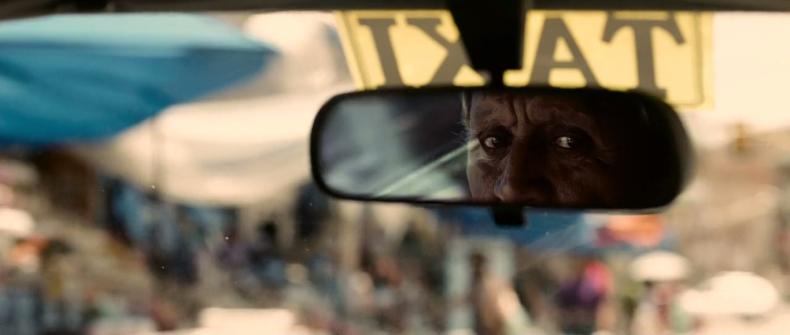
It is according to the idea of the interconnected waves of “early globalization” (colonization and the triangular slave trade) and contemporary “accelerated globalization” (new technologies and integrated transnational institutions serving neoliberal capitalism)34 that TAMBIÉN LA LLUVIA orchestrates its temporal structure by means of establishing dialogues between the historical horizon of the Invasion and that of the shooting. Its plot follows a Spanish film crew that chooses the Bolivian shooting location of the valley of Cochabamba and casts Daniel, a vocal leader of the local indigenous community, as one of the main protagonists of their film. However, Daniel is at the forefront of the so-called Water War, resisting the Bolivian government’s neoliberal maneuver to sell the rights to the supply of water to a transnational conglomerate. This way, the scenes in which Daniel is shown opposing the exploitation by neoliberal politics and transnational economic interests in the early 21st century alternate with images of him resisting the conquest of the Spaniards dressed up as Hatuey, his character in the film-within-the-film. Hatuey was the historical leader of the revolt of the Taíno indigenous people against the Spaniards in the late 15th and early 16th century, therefore, this temporal parallel and the similarities between the conflicts played out on the different narrative levels overtly suggest that there has been little change in the last 500 years when it comes to the abuse of the local population. As Lennon and Egan put it, “the doubled Daniel/Hatuey serves as a focal point for reading indigenous Latin American history in transhistorical terms.”35 Moreover, the unmistakable analogies in framing techniques evocatively assert the figure of temporal return in visual terms as well, pointing to the hypocrisy of the revisionist historical epic in the making within the film. Hence, in the words of historian Mariana Piccinelli:
TAMBIÉN LA LLUVIA offers a critical discourse on the oppression of impoverished and dispossessed communities by foreign countries; emphasizing the persistence of this situation of domination, which repeats itself from the beginning of the conquest of America by Europe to the present day (even by those who try to uncover this reality).36
TAMBIÉN LA LLUVIA © 2010 Piffl Medien. All rights reserved.
Although various studies have argued that Bollaín’s work collapses its temporal layers or makes them collide, my point here is to demonstrate quite the opposite: namely, that the aforementioned figure of temporal “repetition” emphasizes the separation of historical layers, rather than their union. For Fabrizio Cilento, TAMBIÉN LA LLUVIA’s narrative time “is circular – the story of colonialism loops like a snake devouring its own tail/tale.”37 This is, he writes, because a series of innovative editing techniques, uses of archival footage and reflexive scenes create a “dialogical exchange”38 between the timelines of the historical drama in the making, the story unfolding behind the scenes of the shooting, and the real-life Water War. However, while Bollaín’s stance is unquestionably to point to the problem of colonial continuities, hers is an intellectual game of evoking – ideological – overlaps, rather than a non-modern approach to temporalities.
Furthermore, Luis Prádanos presents an inspired analysis of the film that relies on decolonial border thinking, arguing that
Daniel mixes and links the universe of the conquest with that of the present and de-hierarchizes them by revealing a conception of time that is more cyclical than linear, since in both cases colonial/neocolonial exploitation is repeated due to the imperialist imposition of the logic of modern Western thought.39
While this approach is certainly compelling, it falls into the trap of conflating a properly “cyclical” conception of time with a mere “repetition” of events that remind of one another. Interestingly, the same interchangeability of categories can be read in the text of López Petzoldt and Araujo Pereira as well:
the lines of action approach each other, intertwine and reflect each other. They maintain a specular relationship with which a historical parallelism and a circular vision of time are emphasized, sometimes too evidently.40
Conversely, my claim is that the intellectually and poetically suggested interpretation regarding a “historical parallelism” between colonial past and neocolonial present cannot turn into “a circular vision of time,” because the very structure of the film relies on the fundamental “difference” and “disconnection” of the represented historical moments. As Frans Weiser makes clear, the film’s goal is “to render the audience conscious of the conventions and contradictions involved in (re)creating the past.”41 That is, at no point does Bollaín let her “historical epic” film-within-the-film really merge with the “social realist” frame of the shooting during the Water War.42 This can be easily confirmed by looking at the scene which shows the cast’s rehearsal in the interior garden of a hotel. The scene in question shows Antón, the actor who plays the role of Christopher Columbus, spontaneously turning the “Sitzprobe” (a rehearsal that focuses on the lines of the actors and actresses in the script without staging their movements) into a veritable performance, in which he approaches the indigenous service personnel, takes a woman’s earring into his hand and aggressively asks for more gold, thus highlighting the “intersection between the attitudes of Columbus’ crew and those of the film crew.”43 In spite of viscerally sensed colonial reflexes and the ingenious framing techniques that present the casually dressed actors with improvised props as veritable conquerors (see Antón/Colombus’ parasol as a substitute for the Spanish crown’s flagpole),44 it is very clear that we see a rehearsal, an “as if,” a rhetorical effect. This is underlined by Antón’s final comment – asking for forgiveness, since “we actors are like that, a bunch of pure egoists” – which provides a relief before one would really think that the past and the present could merge. In effect, as López Petzoldt and Araujo Pereira comment, “the set of filmic narrative procedures also simulates a representation of the scene as if it were ‘for real’.”45
I argue that such an approach, based on showing duplicates of oppressive gestures in different historical times, works through the recognition of an echo of the past in the present, rather than through a non-modern concept of time, understood as “cosmic relationality, co-present with ‘space’.”46 Bollaín’s film, therefore, quite literally, engages in historical reflection: it is reflecting on the return of the past in the present by creating a present image that is mirroring/duplicating the past. However, this also means that in order to recognize the repetition itself, the film has to separate the reflecting element (the creative process and the film-within-the-film) from the reflected element (the colonial past underpinning the present). The present reminds us of the past, but by doing so, it also makes clear that it is different from it.
This argument can be supported by highlighting a series of creative choices in TAMBIÉN LA LLUVIA that draw clear boundaries between “the two main temporalities of the film, distant past and present.”47 These include the scene in which the director, Sebastián, quickly closes the screenplay that he holds in his hands in order to interrupt the violent chase sequence from the 16th century historical epic that has come to life in his imagination, or when Antón and Daniel’s daughter watch reels from a previous shooting day in a local film theater. These moments, unmistakably produce “the effect of disrupting the illusion of reality that historical cinema typically presents, simultaneously drawing attention to the processes involved in constructing a version of the past.”48 Even the shooting of the scene in which Hatuey and his fellow rebel Taínos are burnt alive – which, for Cilento, indicates that temporalities “overlap fully”49 – follow this logic, since the Cochamamban police arrives only after the shooting has ended and indigenous characters have left their roles as 16th century natives. Additionally, the “making of” documentary itself constitutes a visual barrier that separates the images of past and present through its easily recognizable black and white colors and its different visual texture.
In sum, the striking “games of doublings”50 in Bollaín’s film powerfully suggest a connection and continuation between past and present coloniality, however, this is not constructed as a genuine temporal unity, rather, as a critical metacommentary, in which “history is not only unwittingly repeated, but also rehearsed by the very individuals who claim history as a didactic tool for educating others about past abuses.”51 The colonial past may, indeed, irrupt into the unmistakably distinct present, allowing for “the dialogue between different moments in history.”52 However, “Daniel/Hatuey synecdochically focalizes and drives two distinct histories,”53 consequently, it is always the timeline of the shooting/the Water War that “contains” the past moments, making it impossible that the two historical timelines converge into one and the same temporal horizon.
Collaboration, Continuity, and Circularity
Although a “superproduction”54 for Bolivian standards, PARA RECIBIR EL CANTO DE LOS PÁJAROS can be situated in a markedly different industrial and film historical context than TAMBIÉN A LLUVIA. Unlike the work of “readily exportable female director”55 Icíar Bollaín, the films of Jorge Sanjinés and his Ukamau Group are “firmly rooted in Bolivian history and society,”56 and although they have been circulating in European art film festivals, they enjoy a much more modest international visibility. Within this context, PARA RECIBIR EL CANTO DE LOS PÁJAROS can be seen in a twofold light. First, as a late example of the Ukamau Group’s endeavors to aesthetically approximate Andean cosmogonies. And second, as a recollection of Jorge Sanjinés’ personal memories from the shooting of his film YAWAR MALLKU (BO 1969), “narrated by Sanjinés in countless articles and interviews.”57 According to the anecdote, the director and his crew had to wait entire days in vain for the Andean community of Kaata with whose leader the shooting was arranged. However, they could only start the work after a collective agreement was reached through a coca leaf reading, by which the indigenous community confirmed that the filmmakers were in good faith. This is the episode summoned up by PARA RECIBIR EL CANTO DE LOS PÁJAROS, in which a mestizo film crew is planning to shoot in an Andean “ayllu”58 about the first violent encounters between the Spanish and the Incas.
As it has been well documented, the aforementioned occurrence signals a crucial moment that pushed the Ukamau Group toward a transformative learning process by which they sought to develop a “popular cinema” (that is, not a cinema for the people, but a cinema with and by the people). Involving Andean communities in the process of creation through discussions and a series of test screenings, they experimented for decades to define the requirements of a film form that could mobilize indigenous people. Having realized that this depended on “an intelligible means of communication based on the cultural coherence between the product and its recipient,”59 Sanjinés and his co-creators engaged in a cinematic exploration of “radically non-Western conceptions of individuality and temporality.”60 First, they needed to abandon the individualist focus of Western narratives in order to adopt the “centuries-old collective self-identity and self-perception”61 of Aymara and Quechua peoples. Second, they had to develop a cinematic grammar that is informed by the non-linear notions of Andean temporality, thus, one that “respects the natural unity of time and space.”62
As Josef Estermann explains, “Andean time is […] not ‘unidirectional’ (from past to future), but bi- or multidirectional. For cyclical rationality, the future is really behind, and the past ahead; but also vice versa.”63 In order to engage with these notions cinematically, the Ukamau Group was inspired by the sequence shots in Theodoros Angelopoulos’ O THIASOS (GR 1975) that unite more than one historical temporality.64 Eventually, they developed a particular narrative and formal device that ended up being called “integral sequence shot” or “all-encompassing sequence shot.” As Santiago Espinoza and Andrés Laguna explain, in such a shot, “time stops advancing linearly and the shot can encompass both the past and the present. […] with a simple pan, tracking shot or other similar camera movement, it comprises both past and present without further temporal references that a flashback would require.”65 A famous example of this kind of shot is the one towards the end of LA NACIÓN CLANDESTINA (BO 1989), in which the main protagonist looks back from a mountain slope at his past self who betrayed his community, and the camera shows this within the spatiotemporal unity of one cinematic shot.
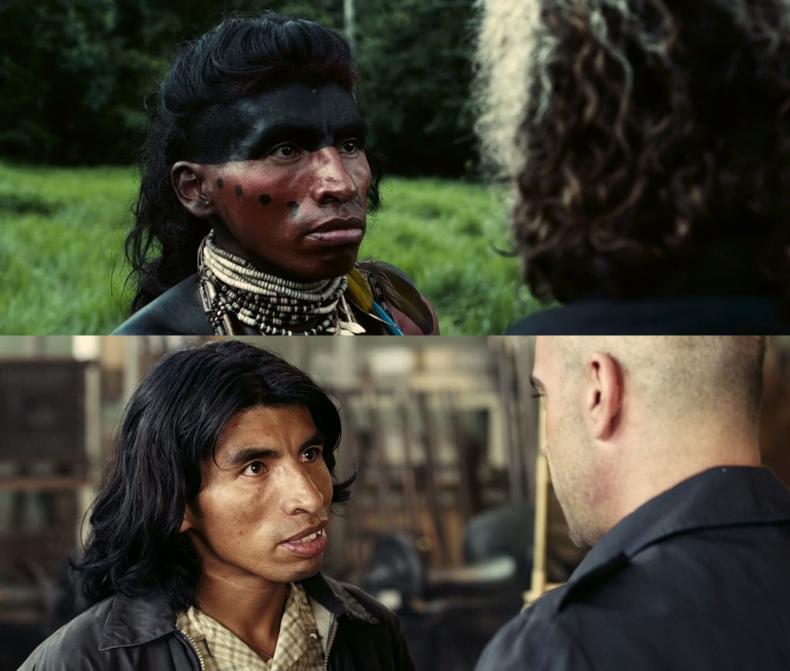
According to David M. J. Wood, PARA RECIBIR EL CANTO DE LOS PÁJAROS also “makes wide use”66 of this kind of shot when the camera moves between the conquerors that invade indigenous territory and the film crew that shoots the historical epic. Hence, the recounting of the director’s aforementioned personal memory in “a subtle, self-mocking film”67 meets here with an attempt to present the incidents of the 16th century and those of the late 20th century within one spatiotemporal unit.68 As Stephen Hart argues, time, in this film, “is not so much cyclical as pyramidal,” for the two temporal horizons can be perceived as “inverse images” of each other.69 On one hand, there is a scene in which the actor who plays Bartolomé de las Casas recites his lines to the film crew, as well as one that – reversing the already mentioned sequence of Hatuey’s execution – shows the filmmakers as “they decide to raise the weapons of the conquerors which are accessories of their film to really defend themselves.”70 On the other hand, most sequences are not reflective in the way we have seen it in the case of TAMBIÉN LA LLUVIA. There are hardly any rehearsals, no repetitions between what is supposed to be the film-within-the-film and what is shown as the shooting process, and the accompanying “making of” is also absent in this film. Sanjinés does not introduce the main actors-within-the-film to the viewer, and, oddly, the Spaniards that appear in the historical sequences hardly ever interact with the film crew. Rather, the temporalities and characters of the two storylines coexist within the film, occasionally crossing and connecting with each other. In such “crossover-moments,” they inhabit the same spatiotemporal unit (or even the same cinematic shot), yet they might strike us not as actors and filmmakers working on the same project, but as dwellers of diverse historical times.
A telling example of this non-modern approach to temporalities can be seen in the sequence that shows a group of armored Spanish soldiers plundering the homes of the indigenous and setting them on fire. The final dolly shot of the sequence follows a soldier running towards a wall that offers shelter to a handful of fellow conquerors who stand with their backs to the camera. As the frame is adjusted to reveal this latter group, the camera refocuses and shows the aforementioned soldiers turning towards the lens and walking out of the frame on both sides of the frame. At this point, the scene – which evidently represents the events of the 16th century – could come to its end. However, the camera suddenly moves again, this time slightly upwards and to the right, to show the film producer, a production assistant, and the cinematographer sitting on a crane and pointing the lens of his camera towards the soldiers who have just left the frame. There is no interaction between the soldiers and the film crew members, these latter looking both mesmerized and shocked in the direction of the conquerors. Such a shot, especially within the oeuvre of the Ukamau Group, might easily be perceived as one that “integrates” past and present just like the famous shot of the LA NACIÓN CLANDESTINA, recalled above. The lack of reaction from the film crew can be indicative in this regard, since the instructions “‘sound, camera, action!’ and ‘cut’” are recurrently heard in this film to “mark the border between the world and its representation/cinematic construction.”71 Thus, unlike Bollaín’s reflections, this particular choreography and visual rendering avoids echoes and doubles, resulting in a film experience that dissolves modern/rational spatiotemporal boundaries, so that “the historical and the filmic become self-osmotic.”72
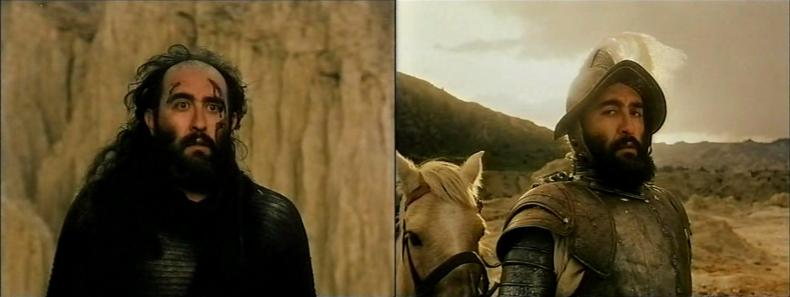
This understanding of the film’s temporal structure is supported by another key scene, in which the film producer not only appears as if he repeated the greedy 16th century Spaniard’s moves, but he literally encounters himself as a conqueror. Following a quarrel with his brother, Pedro, the film-producer-in-the-film takes a walk in the uninhabited part of the ayllu and falls into a pit. After he is miraculously saved by members of the indigenous community, he notices that Spanish conquerors – that viewers know from the historical scenes – are approaching him. Unlike the sequence described above, there is no shot in this sequence that would “encompass” the divergent time-worlds, however, the shot-reverse-shot shows Pedro – ever more astound by what he sees – and the armored leader of the colonial expedition facing each other. Strikingly, when the Spaniard moves closer to the camera, Pedro – and the viewer – realizes that they are the same person. The two identical, but differently dressed characters (producer and conqueror) look each other in the eye for a prolonged moment, until the latter – now bearing the facial features of the actor who previously had appeared in this role, albeit, seen from the side, so that his helmet covers most of his face – continues his journey, followed by enslaved natives that carry the looted gold.
The reading of this scene has not been univocal. For Aimaretti, the doubling of Pedro’s figure is a mental image, as she claims that “the producer hallucinates [...] in his arrogant pride.”73 Conversely, Hart sees this as “one of the most magical-realist scenes of the film,” in which “Pedro the Conquistador is a mirror image of Pedro the film producer.”74 I would argue that the unmistakable equation of the pretentious film producer with the heartless conqueror would be more coherent with the leftist film collective’s aesthetic and political project, since “such schematism, present in practically all of the director’s oeuvre, works to reinforce its didactic purpose.”75 Such an overtly pedagogical comment, on the other hand, also reinforces the film’s engagement with Andean notions of time as well as a cinematic representational strategy that is akin to what Lim calls a “propensity toward temporal critique, a tendency to reveal that homogeneous time is not ‘reality’ but rather a translation.”76
PARA RECIBIR EL CANTO DE LOS PÁJAROS © Trigon Film 1995. All rights reserved.
Just like Bollaín, Sanjinés also suggests that cinema “is itself part of the cultural invasion.”77 However, PARA RECIBIR EL CANTO DE LOS PÁJAROS does not simply shows the neo-colonial present as a time “recalling” the colonial past, but as “one and the same” time of violent exploitation. To be sure, just like in Bollaín’s case – or even more so –, there is an inevitable intellectual or ideological element in the functioning of Sanjinés’ film, and it would be simplistic to claim that the work itself somehow “contains” the aforementioned non-modern temporal notions. However, as Wood reminds us, although “Sanjinés has taken great interest in spectators’ reactions to their films, […] as politically committed filmmakers advancing an agenda, they have not (nor necessarily should they) favored ‘aberrant’ readings.”78 Furthermore, as I have pointed out, certain scenes in the film would not really make sense when not informed by an Andean worldview.
Correlations between Temporalities and Cinematic Decoloniality
The implications of the differences explained above are manifold. Although “both films share a redemptive story of conversion and bridge-building between colonizers and colonized,”79 their affective structure and narrative outcomes are clearly opposing each other, since Bollaín’s film provides for individual character development and “offers a feel-good Hollywood ending,”80 whereas Sanjinés’ version ends on a markedly gloomy note. In TAMBIÉN LA LLUVIA, Costa, the producer-within-the-film, leaves behind his former cynicism to end up risking his own life in a successful attempt to bring Daniel’s injured daughter to a hospital in the midst of the Water War, and, ultimately, embraces Daniel in an “excessively sentimental”81 scene. On the other hand, at the end of PARA RECIBIR EL CANTO DE LOS PÁJAROS, the film crew is unable to record the vivid birdsongs with their modern equipment, hence, not only does their shooting fail, but all they learn from this is that they should not have come to the indigenous highlands in the first place.
My claim is that this difference is directly linked to the notions of temporalities and self-reflexivity underlying the two films. Although – as Cilento rightly asserts – TAMBIÉN LA LLUVIA’s reflexivity effectively situates the film “ideologically in antithesis to the frozen nostalgia of Hollywood films depicting the conquest of the Americas,”82 the fact that the viewers are constantly reminded of the evoked past’s (re)constructed nature also creates a sense of its closure, thus, a safe distance from it. That is, just like the cowardly filmmakers can escape the increasingly dangerous shooting locations leaving behind the uncomfortable questions of the colonial past, “the viewer is separated from the problems of the developing world by a screen that inevitably reduces the film’s larger critique of capital.”83 This is not the case in Sanjinés’ work, where the structure of temporal parallels is nuanced by the aforementioned inevitable crossovers, in which the present-day protagonists are directly faced with the moment of Invasion. This implies that the colonial past, far from being hermetically closed, can irrupt in the present of the film, independently of the ideological stances or the receptivity of the characters. In the same vein, PARA RECIBIR EL CANTO DE LOS PÁJAROS, as Wood points out, breaks with the Ukamau Group’s comfortable position as festival phenomenon through its provocatively “overt didacticism” that, in effect, has triggered real-life controversies in the Bolivian public sphere.84
This point already refers to the possible connections between the temporalities within the films and those of their reception. As William C. Siska explains, “reflexive films in the traditional mode” do not alienate viewers, but make them enjoy “a behind-the-scenes look at how the industry ‘really works’,” whereas modernist critical reflexivity “calls for the examination of roots and beginnings grounded in the self.”85 The hypocrisy and complicity of the film team within TAMBIÉN LA LLUVIA is laid bare, at the same time, this does not directly imply that Bollaín herself would attempt to be self-critical about her own filmmaking practice, or that she, as a director, would not repeat the errors of her fictional Doppelgänger. Bollaín reflects on “the constraints placed upon filmmakers by twenty-first-century film-making practices,”86 and, as it has been noted in several studies, inescapably has to come up against the limits of her critique. On the other hand, Sanjinés directly criticizes his own past blindness/deafness to indigenous cultures (although it is also suggested that, by the time of making PARA RECIBIR EL CANTO DE LOS PÁJAROS, he already does “hear [the birds singing], for he has already gone through a long process of cultural learning”).87
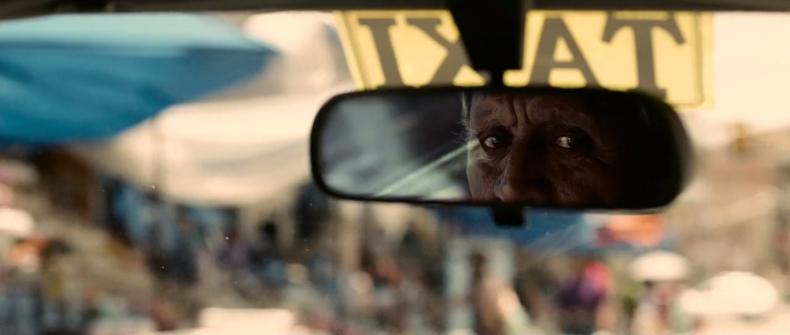
A comparison of two particular scenes is indicative in this regard. The first takes place after Costa’s aforementioned “epiphanic moment”88 at the end of TAMBIÉN LA LLUVIA, that stroke critics as “too simplistic,”89 “Manichean,”90 “intentionally improbable and yet imaginable,”91 or one that “entails a racist subtext”92 and portrays the Spanish film producer as “white savior.”93 Elisabeth L. Austin argues that this last sequence features a shot in the interior of the taxi that takes Costa to the airport, in which the Bolivian cab driver is looking in the rearview, producing a “critical gaze, aimed at the viewer as much as at Costa,”94 ultimately breaking through the surface of the uplifting happy end and aiming a postcolonialist critique at audiences. Conversely, in PARA RECIBIR EL CANTO DE LOS PÁJAROS, the film crew takes their members of indigenous ancestry as hostages and tie them to chairs, in response to the attack by the local community, a revenge after some of the filmmakers had gone hunting birds in a nearby forest. In this scene, the producer chases a production assistant with indigenous facial features, who, in turn, desperately asks for mercy, for “he is not an indio.” Whereas the glance in Bollían’s film is framed by the small rear-view mirror and is slightly off-axis, as if indicating that the taxi driver looks at Costa (and not directly at the audience), the long take in Sanjinés’ work shifts its focalization, and from an over-the-shoulder shot of Pedro, it turns into his point-of-view shot, thus, unmistakably “breaking the fourth wall” and identifying the viewer with the oppressive film producer that brings round the most open form of colonialist violence.
TAMBIÉN LA LLUVIA © 2010 Piffl Medien. All rights reserved.
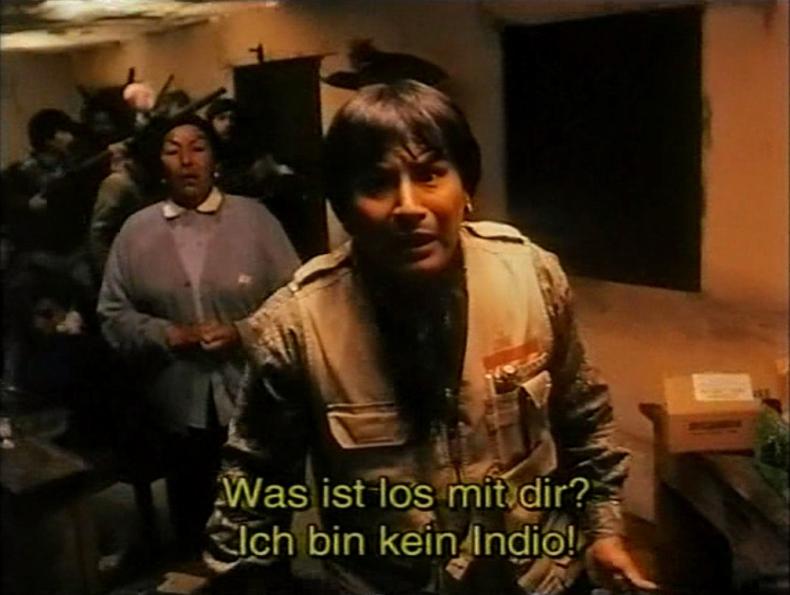
PARA RECIBIR EL CANTO DE LOS PÁJAROS © Trigon Film 1995. All rights reserved.
Finally, the aforementioned contrasts in the means of filmic expression also imply diverse conceptual approaches that may be related to existing forms of indigenous resistance. Silvia Rivera Cusicanqui notes that, since the 1960s, the peasant indigenous movement perceives oppression and discrimination of the Aymara and Quechua as “anachronism,” and argues for a recuperation of historical consciousness and dignity of the nations that constitute the majority of the population of what is today Bolivia.95 However, as she explains, there is a difference between identities, memory structures, and vindications of a fight based on the so-called “short memory” and on the “long memory.” The former is characteristic in territories where the process of “mestizaje,” or cultural and ethnic mixing, has been more intense (for instance, in the valley of Cochabamba) and recalls the collective experience of the popular revolution of 1952. It assumes a “campesino,” or peasant, identity as the political subject, and envisions a fight through syndicates possible as well as the return to a state-led revolutionary project. Whereas the latter, more widespread in the Andean highlands, sees the revolution of 1952 merely as a minor episode in the continuity of anticolonial battles since the Invasion, and vindicates an “indio” identity, as part of a society that was originally free and autonomous, but has been oppressed for centuries.96 That is, an indigenous politics informed by the “short memory” – analogously to Bollaín’s film – would look at the times of the Conquest from the perspective of the modern state, and see it as a past era that has already come to an end. Whereas the ongoing project that relies on the “long memory” of indigenous struggles – somewhat more closely to Sanjinés’ work, although it is far from presenting an indigenous perspective – would conceive of it as a “pachakuti,” a radical shift within circular temporality, but still part of the same spatiotemporal unit.97 The stakes are high, since the implications of the dissimilar approaches point to the crucial question of whether the problems of the indigenous societies might be addressed within the framework of modern mental categories, states, and political formations, or only through an overarching and radical anti- or decolonial transformation.
Conclusions
This article has ventured to analyze the different formal, narrative, and conceptual approaches to temporalities in TAMBIÉN LA LLUVIA and PARA RECIBIR EL CANTO DE LOS PÁJAROS, also aiming at shedding light on their political significance. As we have seen, both films present a series of “colonial and decolonial parallels and crossovers,”98 and are narrated “through the perspective of the ‘well-intentioned’ oppressor.”99 Bollaín’s work self-reflexively comments on the return and the intensification of cultural and socioeconomic dynamics of 16th century’s “early globalization” in the 21st century by highlighting the repetition of exploitative patterns between the Invasion, the Cochabamba Water War, and the transnational filmmaking process represented on screen. On the other hand, Sanjinés’ film is inspired by a longstanding exchange with Andean communities and some particular narrative-formal tools informed by European art cinema as well as non-modern notions of “the natural unity of space and time.” Therefore, it presents contemporary filmmaking (and film viewing) as straightforwardly linked to the cultural and economic plundering of the 16th century. Accordingly, the structure of Bollaín’s film remains within a traditional mode of metacinematic reflexivity that presents the filmic world as self-contained. Yet, Sanjinés also involves a direct appeal at its audience, thus, extending its self-criticism (from which the film’s idea originated) to the present moment of the reception, didactically linking the film’s diegetic world with the viewer’s reality. Thus, if Hollywood’s historical movies or other mainstream big budget productions – indirectly criticized and ridiculed in both films – have approached the moment of the Conquest as “just a sad spectacle” of the past,100 gone and forgotten, then TAMBIÉN LA LLUVIA “resuscitates” the colonial topic, pointing to its actual relevance, and PARA RECIBIR EL CANTO DE LOS PÁJAROS aims at creating a committed discourse and a viewer experience that immediately unites past and present temporal horizons within the framework of one and the same historical era. Ultimately, these disparities between the films also point to possible ways to conceive of the (dis)continuities between the colonial empire and the modern state, traceable in the worldviews and political engagements of existing indigenous movements in Bolivia. While Bollaín presents a historical vision in which, although the past still haunts the present, reformism through learning from popular struggles can effectively end colonial-style injustices, Sanjinés affirms that the only way out of past-and-present oppression is the recognition of the autonomy of non-modern indigenous mental, cultural and social structures.
- 1
Ella Shohat and Robert Stam, Unthinking Eurocentrism: Multiculturalism and the Media (New York: Routledge, 2014), 62–67.
- 2
Ibid., 72–73.
- 3
Stephanie Dennison, “Debunking Neo-Imperialism or Reaffirming Neo-Colonialism? The Representation of Latin America in Recent Co-Productions,” Transnational Cinemas 4, no. 2 (January 1, 2013): 185–195; Duncan Wheeler, “También La Lluvia/Even the Rain (Iciar Bollaín, 2010): Social Realism, Transnationalism and (Neo)Colonialism,” in Spanish Cinema 1973–2010: Auteurism, Politics, Landscape and Memory, ed. Maria M. Delgado and Robin Fiddian (Manchester: Manchester University Press, 2013), 239–255.
- 4
Fabrizio Cilento, “Even the Rain: A Confluence of Cinematic and Historical Temporalities,” Arizona Journal of Hispanic Cultural Studies 16, no. 16 (2012): 245–258; Jorge Marí, “Review of También La Lluvia, by Icíar Bollaín,” Hispania 95, no. 2 (2012): 369–371; Marta F. Suarez and Carmen Herrero, “Globalisation and Coloniality of Power in También La Lluvia / Even the Rain (2010): Exploring Resistance and Indigenous Empowerment,” ed. Ana María Fernandez, Ottawa Hispanic Studies 28 (March 1, 2020): 133–154.
- 5
Michelle Hulme-Lippert, “Negotiating Human Rights in Icíar Bollaín’s También La Lluvia,” Journal of Latin American Cultural Studies 25, no. 1 (January 2, 2016): 105–122.
- 6
Erika Bondi, “Conflicting Emotions: Globalization and Decoloniality in También La Lluvia,” Philosophy Study 6, no. 5 (2016); Elisabeth L. Austin, “Consuming Empathy in ‘También La Lluvia’ (2010),” Chasqui 46, no. 2 (2017): 313–329; Teresa Hiergeist, “Even the Rain (También La Lluvia, 2010),” in Lexicon of Global Melodrama (Bielefeld: transcript Verlag, 2022), 319–322.
- 7
Katarzyna Paszkiewicz, “Del cine épico al cine social: el universo metafílmico en También la lluvia (2010) de Icíar Bollaín,” Lectora: revista de dones i textualitat 18 (October 30, 2012): 227–240; Nelson Arturo González-Ortega and Laura Camacho Salgado, “Descolonizando la historia colonial de Bolivia en el siglo XXI: Negociación de las fronteras entre el pasado, presente y futuro en la película También la lluvia (2010),” in Bolivia en el siglo XXI: trayectorias históricas y proyecciones políticas, económicas y socioculturales, ed. Nelson Arturo González-Ortega (Madrid: Iberoamericana Vervuert, 2017), 311–342.
- 8
Alfredo Martínez-Expósito, “Southern Hegemonies and Metaphors of the Global South in También La Lluvia,” in Contemporary Latin American Cinema: Resisting Neoliberalism? ed. Claudia Sandberg and Carolina Rocha (Cham: Palgrave Macmillan, 2018), 27–42; Paul Joseph Lennon and Caroline Egan, “Conversion and Colonial History in Icíar Bollaín’s También La Lluvia (2010),” Bulletin of Hispanic Studies 96, no. 9 (October 2019): 935–952.
- 9
The immediate critical response in the Bolivian press raised the issue of Bollaín’s (and screenwriter Paul Laverty’s) possible plagiarism. See Andrés T. Laguna, “También la lluvia: Sobreviviendo,” en busca del tiempo recuperado, January 8, 2011, http://tiemporecuperado.blogspot.com/2011/01/tambien-la-lluvia-sobreviviendo.html; “Iciar Bollaín: En También la lluvia hay una celebración de la resistencia indígena,” Opinión Bolivia, March 6, 2011, https://www.opinion.com.bo/articulo/ramona/iciar-bollain-tambien-lluvia-celebracion-resistencia-indigena/20110306182400660500.html; Carlos Tena, “También la Lluvia: ¿Coincidencia o plagio?” Rebelion, January 22, 2011, https://rebelion.org/tambien-la-lluvia-coincidencia-o-plagio/. For a comparative analysis of the films, see Bruno López Petzoldt and Diana Araujo Pereira, “La Imposible Re-Representación Cinematográfica de La Conquista: Para Recibir El Canto de Los Pájaros (1995) y También La Lluvia (2010),” in Imaginários Coloniais: Continuidades e Rupturas Na América Latina Contemporânea, ed. Diana Araujo Pereira and Juan Pablo Martín Rodrigues (São Paulo: Dobra Editora, 2015), 227–260.
- 10
Joanna Page and Ignacio M. Sánchez Prado, “Temporalities in Latin American Film,” Arizona Journal of Hispanic Cultural Studies 16, no. 16 (2012): 206.
- 11
The concept of metalepsis refers to a movement between different narrative levels, or, with the words of Gérard Genette, a “paradoxical [...] transgression between the world of the telling and the world of the told.” Cited in David LaRocca, Metacinema: The Form and Content of Filmic Reference and Reflexivity (New York: Oxford University Press, 2021), 88.
- 12
Walter D. Mignolo, The Darker Side of Western Modernity: Global Futures, Decolonial Options (Duke University Press, 2011), 150–151.
- 13
Mignolo, The Darker Side of Western Modernity, 161.
- 14
Ibid., 177.
- 15
Mary Ann Doane, The Emergence of Cinematic Time: Modernity, Contingency, the Archive (Cambridge, Massachusetts: Harvard University Press, 2002), 3.
- 16
Shohat and Stam, Unthinking Eurocentrism, 104–114.
- 17
Cited in Doane, The Emergence of Cinematic Time, 8. Emphasis in original.
- 18
Néstor García Canclini, Hybrid Cultures: Strategies for Entering and Leaving Modernity (Minneapolis: University of Minnesota Press, 2005), 47.
- 19
Bliss Cua Lim, Translating Time: Cinema, the Fantastic, and Temporal Critique (Durham: Duke University Press, 2009), 11.
- 20
Paul A. Schroeder Rodríguez, Latin American Cinema: A Comparative History (Oakland: University of California Press, 2016), 14.
- 21
Lim, Translating Time, 32.
- 22
Ibid., 8.
- 23
All translations from Spanish are my own (M. Á.). María Aimaretti, “Entre imágenes y reflejos… o despeñarse en la alucinación identitaria: a propósito de Para recibir el canto de los pájaros (Jorge Sanjinés, 1995),” Secuencias: Revista de historia del cine 49 (2019): 124.
- 24
Aimaretti, “Entre imágenes y reflejos…,” 135.
- 25
Stephen Hart, “The Art of Invasion in Jorge Sanjinés’s Para Recibir El Canto de Los Pájaros (1995),” Hispanic Research Journal 3, no. 1 (February 1, 2002): 79.
- 26
Santiago A. Espinoza and Andrés T. Laguna, Una Cuestión de Fe. Historia (y) Crítica Del Cine Boliviano de Los Últimos 30 Años (1980–2010) (Cochabamba: Nuevo Milenio, 2011), 60.
- 27
Nelson Arturo González-Ortega and Laura Camacho Salgado, “Descolonizando la historia colonial de Bolivia en el siglo XXI: Negociación de las fronteras entre el pasado, presente y futuro en la película También la lluvia (2010),” in Bolivia en el siglo XXI: trayectorias históricas y proyecciones políticas, económicas y socioculturales, ed. Nelson Arturo González-Ortega (Madrid: Iberoamericana Vervuert, 2017), 325. Emphasis in original.
- 28
Alfredo Martínez-Expósito, “Southern Hegemonies and Metaphors of the Global South in También La Lluvia,” in Contemporary Latin American Cinema: Resisting Neoliberalism? ed. Claudia Sandberg and Carolina Rocha (Cham: Palgrave Macmillan, 2018), 33.
- 29
Sabine Schlickers, La conquista imaginaria de América: crónicas, literatura y cine (Frankfurt am Main: Peter Lang, 2015), 118.
- 30
Luis Prádanos, “Iluminando El Lado Oscuro de La Modernidad Occidental: Colonialismo, Neocolonialismo y Metalepsis En También La Lluvia de Icíar Bollaín,” Confluencia: Revista Hispánica de Cultura y Literatura 30, no. 1 (2014): 87.
- 31
Cilento, “Even the Rain,” 247.
- 32
López Petzoldt and Araujo Pereira, “La Imposible Re-Representación Cinematográfica de La Conquista,” 227.
- 33
Stephanie Dennison, “Debunking Neo-Imperialism or Reaffirming Neo-Colonialism? The Representation of Latin America in Recent Co-Productions,” Transnational Cinemas 4, no. 2 (January 1, 2013): 187.
- 34
Noël Carroll, “Art and Globalization: Then and Now,” The Journal of Aesthetics and Art Criticism 65, no. 1 (2007): 131–143.
- 35
Paul Joseph Lennon and Caroline Egan, “Conversion and Colonial History in Icíar Bollaín’s También La Lluvia (2010),” Bulletin of Hispanic Studies 96, no. 9 (October 2019): 944.
- 36
Mariana Piccinelli, “El cine y la representación de la historia latinoamericana en la película También la lluvia (Icíar Bollaín, 2010),” ILCEA. Revue de l’Institut des langues et cultures d’Europe, Amérique, Afrique, Asie et Australie 43 (June 30, 2021), https://doi.org/10.4000/ilcea.13478. My emphasis.
- 37
Cilento, “Even the Rain,” 247.
- 38
Ibid., 249.
- 39
Prádanos, “Iluminando El Lado Oscuro de La Modernidad Occidental,” 91. My emphasis.
- 40
López Petzoldt and Araujo Pereira, “La Imposible Re-Representación Cinematográfica de La Conquista,” 248. My emphasis.
- 41
Frans Weiser, “The Conventions of Unconventionality: Reconsidering the Cinematic Historian in Even the Rain,” Rethinking History 19, no. 2 (April 3, 2015): 269.
- 42
Katarzyna Paszkiewicz, “Del cine épico al cine social: el universo metafílmico en También la lluvia (2010) de Icíar Bollaín,” Lectora: revista de dones i textualitat 18 (October 30, 2012): 227–240.
- 43
Marta F. Suarez and Carmen Herrero, “Globalisation and Coloniality of Power in También La Lluvia / Even the Rain (2010): Exploring Resistance and Indigenous Empowerment,” ed. Ana María Fernandez. Ottawa Hispanic Studies 28 (March 1, 2020): 135.
- 44
González-Ortega and Camacho Salgado, “Descolonizando la historia colonial de Bolivia en el siglo XXI,” 333.
- 45
López Petzoldt and Araujo Pereira, “La Imposible Re-Representación Cinematográfica de La Conquista,” 238.
- 46
Josef Estermann, Filosofía andina: Sabiduría indígena para un mundo nuevo (La Paz: Instituto Superior Ecuménico Andino de Teología, 2007), 197.
- 47
Cilento, “Even the Rain,” 254.
- 48
Weiser, “The Conventions of Unconventionality,” 270.
- 49
Cilento, “Even the Rain,” 255.
- 50
López Petzoldt and Araujo Pereira, “La Imposible Re-Representación Cinematográfica de La Conquista,” 238.
- 51
Weiser, “The Conventions of Unconventionality,” 274.
- 52
González-Ortega and Camacho Salgado, “Descolonizando la historia colonial de Bolivia en el siglo XXI,” 312.
- 53
Paul Joseph Lennon and Caroline Egan, “Conversion and Colonial History in Icíar Bollaín’s También La Lluvia (2010),” Bulletin of Hispanic Studies 96, no. 9 (October 2019): 946.
- 54
David M. J. Wood, El espectador pensante: el cine de Jorge Sanjinés y el Grupo Ukamau (Mexico City: Universidad Nacional Autónoma de México, Instituto de Investigaciones Estéticas, 2017), 146; Aimaretti, “Entre imágenes y reflejos…” 121.
- 55
Duncan Wheeler, “También La Lluvia/Even the Rain (Iciar Bollaín, 2010): Social Realism, Transnationalism and (Neo)Colonialism,” in Spanish Cinema 1973–2010: Auteurism, Politics, Landscape and Memory, ed. Maria M. Delgado and Robin Fiddian (Manchester: Manchester University Press, 2013), 255.
- 56
Constanza Burucúa, Stephen Hart, and M J Wood, “‘New’ Latin American Cinema and Authorship: Old Wine in New Bottles?” Hispanic Research Journal 9, no. 2 (April 1, 2008): 157.
- 57
Burucúa, Hart, and Wood, “‘New’ Latin American Cinema and Authorship,” 158.
- 58
The “ayllu” is the basic unit of Andean collective identity: it is traditionally understood as the unit of collective property, of land as a community habitat, of collective work for the common good based on mutuality, and of marriage and familial relations. See Estermann, Filosofía andina, 220–223.
- 59
Jorge Sanjinés and Grupo Ukamau, Teoría y práctica de un cine junto al pueblo (Mexico City: Siglo XXI, 1979), 113.
- 60
Dennis Hanlon, “Traveling Theory, Shots, and Players: Jorge Sanjinés, New Latin American Cinema, and the European Art Film,” in Global Art Cinema: New Theories and Histories, ed. Rosalind Galt and Karl Schoonover (New York: Oxford University Press, 2010), 352.
- 61
Hanlon, “Traveling Theory, Shots, and Players,” 357.
- 62
Wood, “Andean Realism and the Integral Sequence Shot.”
- 63
Estermann, Filosofia andina, 201. Emphasis in original.
- 64
Hanlon, “Traveling Theory, Shots, and Players,” 352.
- 65
Santiago A. Espinoza and Andrés T. Laguna, Una Cuestión de Fe. Historia (y) Crítica Del Cine Boliviano de Los Últimos 30 Años (1980–2010) (Cochabamba: Nuevo Milenio, 2011), 167.
- 66
Burucúa, Hart, and Wood, “‘New’ Latin American Cinema and Authorship,” 158.
- 67
Stephen Hart, “Mama Coca and the Revolution: Jorge Sanjinés’s Double-Take,” in Contemporary Latin American Cultural Studies (New York: Routledge, 2003), 296.
- 68
As María Aimaretti indicates, PARA RECIBIR EL CANTO DE LOS PÁJAROS, a revisionist take on the Invasion and Conquest of the Americas, was originally intended for the 1992 quincentennial, but due to financial problems, its release had to be postponed some three years, to the beginning of 1995. See Aimaretti, “Entre imágenes y reflejos…” 118.
- 69
Hart, “The Art of Invasion,” 79.
- 70
Wood, El espectador pensante, 149.
- 71
López Petzoldt and Araujo Pereira, “La Imposible Re-Representación Cinematográfica de La Conquista,” 248.
- 72
Hart, “The Art of Invasion,” 77.
- 73
Aimaretti, “Entre imágenes y reflejos…” 132.
- 74
Hart, “The Art of Invasion,” 78.
- 75
Wood, El espectador pensante, 148.
- 76
Lim, Translating Time, 26. Emphasis in original.
- 77
Hart, “The Art of Invasion,” 73.
- 78
Burucúa, Hart, and Wood, “‘New’ Latin American Cinema and Authorship,” 160.
- 79
Juan Poblete, “Coloniality and Cinema,” in The Routledge Hispanic Studies Companion to Colonial Latin America and the Caribbean (1492–1898), ed. Yolanda Martínez-San Miguel and Santa Arias (New York: Routledge, 2021), 156.
- 80
Elisabeth L. Austin, “Consuming Empathy in ‘También La Lluvia’ (2010),” Chasqui 46, no. 2 (2017): 313.
- 81
Marí, “Review of También la lluvia, by Icíar Bollaín,” 370.
- 82
Cilento, “Even the Rain,” 246.
- 83
Austin, “Consuming Empathy in ‘También La Lluvia’ (2010),” 313.
- 84
Wood, El espectador pensante, 149.
- 85
William C. Siska, “Metacinema: A Modern Necessity,” Literature/Film Quarterly 7, no. 4 (1979): 286–288.
- 86
Stephanie Dennison, “Debunking Neo-Imperialism or Reaffirming Neo-Colonialism? The Representation of Latin America in Recent Co-Productions,” Transnational Cinemas 4, no. 2 (January 1, 2013): 186.
- 87
Wood, El espectador pensante, 148.
- 88
Luis Prádanos, “Iluminando El Lado Oscuro de La Modernidad Occidental: Colonialismo, Neocolonialismo y Metalepsis En También La Lluvia de Icíar Bollaín,” Confluencia: Revista Hispánica de Cultura y Literatura 30, no. 1 (2014): 97.
- 89
Cilento, “Even the Rain,” 253.
- 90
Dennison, “Debunking Neo-Imperialism or Reaffirming Neo-Colonialism?” 192.
- 91
Michelle Hulme-Lippert, “Negotiating Human Rights in Icíar Bollaín’s También La Lluvia,” Journal of Latin American Cultural Studies 25, no. 1 (January 2, 2016): 12.
- 92
Teresa Hiergeist, “Even the Rain (También La Lluvia, 2010),” in Lexicon of Global Melodrama (Bielefeld: transcript Verlag, 2022), 320.
- 93
Suarez and Herrero, “Globalisation and Coloniality of Power in También La Lluvia / Even the Rain (2010),” 140.
- 94
Austin, “Consuming Empathy in ‘También La Lluvia’ (2010),” 322–323.
- 95
Silvia Rivera Cusicanqui, Oprimidos pero no vencidos: luchas del campesinado aymara y qhechwa de Bolivia, 1900–1980 (La Paz: Hisbol, 1986), 212.
- 96
Cusicanqui, Oprimidos pero no vencidos, 212–218.
- 97
Wood, “Andean Realism and the Integral Sequence Shot.”
- 98
Juan Poblete, “Coloniality and Cinema,” in The Routledge Hispanic Studies Companion to Colonial Latin America and the Caribbean (1492–1898), ed. Yolanda Martínez-San Miguel and Santa Arias (New York: Routledge, 2021), 155.
- 99
Espinoza and Laguna, Una Cuestión de Fe, 61.
- 100
Cilento, “Even the Rain,” 253.
Aimaretti, María. “Entre imágenes y reflejos… o despeñarse en la alucinación identitaria: a propósito de Para recibir el canto de los pájaros (Jorge Sanjinés, 1995).” Secuencias: Revista de historia del cine 49 (2019): 117–138.
Austin, Elisabeth L. “Consuming Empathy in ‘También La Lluvia’ (2010).” Chasqui 46, no. 2 (2017): 313–329.
Bondi, Erika. “Conflicting Emotions: Globalization and Decoloniality in También La Lluvia.” Philosophy Study 6, no. 5 (2016).
Burucúa, Constanza, Stephen Hart, and M J Wood. “‘New’ Latin American Cinema and Authorship: Old Wine in New Bottles?” Hispanic Research Journal 9, no. 2 (April 1, 2008): 147–163. DOI: https://doi.org/10.1179/174582008X272842.
Carroll, Noël. “Art and Globalization: Then and Now.” The Journal of Aesthetics and Art Criticism 65, no. 1 (2007): 131–143. DOI: https://doi.org/10.1111/j.1540-594X.2007.00244.x.
Cilento, Fabrizio. “Even the Rain: A Confluence of Cinematic and Historical Temporalities.” Arizona Journal of Hispanic Cultural Studies 16, no. 16 (2012): 245–258.
Cusicanqui, Silvia Rivera. Oprimidos pero no vencidos: luchas del campesinado aymara y qhechwa de Bolivia, 1900–1980. La Paz: Hisbol, 1986.
Dennison, Stephanie. “Debunking Neo-Imperialism or Reaffirming Neo-Colonialism? The Representation of Latin America in Recent Co-Productions.” Transnational Cinemas 4, no. 2 (January 1, 2013): 185–195. DOI: https://doi.org/10.1386/trac.4.2.185_1.
Doane, Mary Ann. The Emergence of Cinematic Time: Modernity, Contingency, the Archive. Cambridge, Massachusetts: Harvard University Press, 2002.
Espinoza, Santiago A., and Andrés T. Laguna. El Cine de La Nación Clandestina. Aproximación a La Producción Cinematográfica Boliviana de Los Últimos 25 Años. La Paz: Gente Común, 2009.
Espinoza, Santiago A., and Andrés T. Laguna. Una Cuestión de Fe. Historia (y) Crítica Del Cine Boliviano de Los Últimos 30 Años (1980–2010). Cochabamba: Nuevo Milenio, 2011.
Estermann, Josef. Filosofía andina: Sabiduría indígena para un mundo nuevo. La Paz: Instituto Superior Ecuménico Andino de Teología, 2007.
García Canclini, Néstor. Hybrid Cultures: Strategies for Entering and Leaving Modernity. Minneapolis: University of Minnesota Press, 2005.
González-Ortega, Nelson Arturo, and Laura Camacho Salgado. “Descolonizando la historia colonial de Bolivia en el siglo XXI: Negociación de las fronteras entre el pasado, presente y futuro en la película También la lluvia (2010).” In Bolivia en el siglo XXI: trayectorias históricas y proyecciones políticas, económicas y socioculturales, edited by Nelson Arturo González-Ortega, 311–342. Madrid: Iberoamericana Vervuert, 2017.
Hanlon, Dennis. “Traveling Theory, Shots, and Players: Jorge Sanjinés, New Latin American Cinema, and the European Art Film.” In Global Art Cinema: New Theories and Histories, edited by Rosalind Galt and Karl Schoonover, 351–367. New York: Oxford University Press, 2010.
Hart, Stephen. “Mama Coca and the Revolution: Jorge Sanjinés’s Double-Take.” In Contemporary Latin American Cultural Studies. New York: Routledge, 2003.
Hart, Stephen. “The Art of Invasion in Jorge Sanjinés’s Para Recibir El Canto de Los Pájaros (1995).” Hispanic Research Journal 3, no. 1 (February 1, 2002): 71–81. DOI: https://doi.org/10.1179/hrj.2002.3.1.71.
Hiergeist, Teresa. “Even the Rain (También La Lluvia, 2010).” In Lexicon of Global Melodrama, 319–322. Bielefeld: transcript Verlag, 2022. DOI: https://doi.org/10.1515/9783839459737.
Hulme-Lippert, Michelle. “Negotiating Human Rights in Icíar Bollaín’s También La Lluvia.” Journal of Latin American Cultural Studies 25, no. 1 (January 2, 2016): 105–122. DOI: https://doi.org/10.1080/13569325.2015.1091300.
Laguna, Andrés T. “También la lluvia: Sobreviviendo.” en busca del tiempo recuperado, January 8, 2011. http://tiemporecuperado.blogspot.com/2011/01/tambien-la-lluvia-sobreviviendo.html.
LaRocca, David. Metacinema: The Form and Content of Filmic Reference and Reflexivity. New York: Oxford University Press, 2021.
Lennon, Paul Joseph, and Caroline Egan. “Conversion and Colonial History in Icíar Bollaín’s También La Lluvia (2010).” Bulletin of Hispanic Studies 96, no. 9 (October 2019): 935–952. DOI: https://doi.org/10.3828/bhs.2019.56.
Lim, Bliss Cua. Translating Time: Cinema, the Fantastic, and Temporal Critique. Durham: Duke University Press, 2009.
López Petzoldt, Bruno, and Diana Araujo Pereira. “La Imposible Re-Representación Cinematográfica de La Conquista: Para Recibir El Canto de Los Pájaros (1995) y También La Lluvia (2010).” In Imaginários Coloniais: Continuidades e Rupturas Na América Latina Contemporânea, by Diana Araujo Pereira and Juan Pablo Martín Rodrigues, 227–260. São Paulo: Dobra Editora, 2015.
Marí, Jorge. “Review of Review of También la lluvia, by Icíar Bollaín.” Hispania 95, no. 2 (2012): 369–371.
Martínez-Expósito, Alfredo. “Southern Hegemonies and Metaphors of the Global South in También La Lluvia.” In Contemporary Latin American Cinema: Resisting Neoliberalism? edited by Claudia Sandberg and Carolina Rocha, 27–42. Cham: Palgrave Macmillan, 2018. DOI: https://doi.org/10.1007/978-3-319-77010-9_2.
Mignolo, Walter D. The Darker Side of Western Modernity: Global Futures, Decolonial Options. Duke University Press, 2011.
Opinión Bolivia. “Iciar Bollaín: En También la lluvia hay una celebración de la resistencia indígena.” Opinión Bolivia, March 6, 2011. https://www.opinion.com.bo/articulo/ramona/iciar-bollain-tambien-lluvia-celebracion-resistencia-indigena/20110306182400660500.html.
Page, Joanna, and Ignacio M. Sánchez Prado. “Temporalities in Latin American Film.” Arizona Journal of Hispanic Cultural Studies 16, no. 16 (2012): 203–210. DOI: https://doi.org/10.1353/hcs.2012.0014.
Paszkiewicz, Katarzyna. “Del cine épico al cine social: el universo metafílmico en También la lluvia (2010) de Icíar Bollaín.” Lectora: revista de dones i textualitat 18 (October 30, 2012): 227–240.
Piccinelli, Mariana. “El cine y la representación de la historia latinoamericana en la película También la lluvia (Icíar Bollaín, 2010).” ILCEA. Revue de l’Institut des langues et cultures d’Europe, Amérique, Afrique, Asie et Australie 43 (June 30, 2021). DOI: https://doi.org/10.4000/ilcea.13478.
Poblete, Juan. “Coloniality and Cinema.” In The Routledge Hispanic Studies Companion to Colonial Latin America and the Caribbean (1492–1898), edited by Yolanda Martínez-San Miguel and Santa Arias, 147–161. New York: Routledge, 2021.
Prádanos, Luis. “Iluminando El Lado Oscuro de La Modernidad Occidental: Colonialismo, Neocolonialismo y Metalepsis En También La Lluvia de Icíar Bollaín.” Confluencia: Revista Hispánica de Cultura y Literatura 30, no. 1 (2014): 87–100.
Sanjinés, Jorge, and Grupo Ukamau. Teoría y práctica de un cine junto al pueblo. Mexico City: Siglo XXI, 1979.
Schlickers, Sabine. La conquista imaginaria de América: crónicas, literatura y cine. Frankfurt am Main: Peter Lang, 2015. DOI: https://doi.org/10.3726/978-3-653-06075-1.
Schroeder Rodríguez, Paul A. Latin American Cinema: A Comparative History. Oakland: University of California Press, 2016.
Shohat, Ella, and Robert Stam. Unthinking Eurocentrism: Multiculturalism and the Media. Second Edition. New York: Routledge, 2014.
Siska, William C. “Metacinema: A Modern Necessity.” Literature/Film Quarterly 7, no. 4 (1979): 285–289.
Suarez, Marta F., and Carmen Herrero. “Globalisation and Coloniality of Power in También La Lluvia / Even the Rain (2010): Exploring Resistance and Indigenous Empowerment.” Edited by Ana María Fernandez. Ottawa Hispanic Studies 28 (March 1, 2020): 133–154.
Tena, Carlos. “También la Lluvia: ¿Coincidencia o plagio? – Rebelion.” Rebelion, January 22, 2011. https://rebelion.org/tambien-la-lluvia-coincidencia-o-plagio/.
Weiser, Frans. “The Conventions of Unconventionality: Reconsidering the Cinematic Historian in Even the Rain.” Rethinking History 19, no. 2 (April 3, 2015): 268–284. DOI: https://doi.org/10.1080/13642529.2014.973716.
Wheeler, Duncan. “También La Lluvia/Even the Rain (Iciar Bollaín, 2010): Social Realism, Transnationalism and (Neo)Colonialism.” In Spanish Cinema 1973–2010: Auteurism, Politics, Landscape and Memory, edited by Maria M. Delgado and Robin Fiddian, 239–255. Manchester: Manchester University Press, 2013.
Wood, David M. J. El espectador pensante: el cine de Jorge Sanjinés y el Grupo Ukamau. Mexico City: Universidad Nacional Autónoma de México, Instituto de Investigaciones Estéticas, 2017.
Wood, David M.J. “Andean Realism and the Integral Sequence Shot.” Jump Cut. A Review of Contemporary Media 54 (2012). https://www.ejumpcut.org/archive/jc54.2012/WoodSanjines/index.html.