Transporting Memory
CABRA MARCADO PARA MORRER as an Audiovisual Infrastructure for Remembering
Table of Contents
Latin American Cinema in Ten Films and Five Modernities
Argentine Filmmaking between Three Eras
Nosferatu in Brazil
Nobody Alone and the Camera for Everyone
Memories of Encounter and the Encounter of Memories
Workings of Postmemory in Twenty-First Century Argentina
Home Movies and Family Archives in Latin-American Documentary Films
Transporting Memory
Living Archive – Before and After
This is an Open Access article distributed under the terms of the CC BY 4.0 License.
Suggested Citation: Rünker, Maximilian. “Transporting Memory: CABRA MARCADO PARA MORRER as an Audiovisual Infrastructure for Remembering.” In Research in Film and History 8 (2026). https://doi.org/10.25969/MEDIAREP/24914.
Introduction
The story of the documentary film MAN MARKED FOR DEATH, 20 YEARS LATER / CABRA MARCADO PARA MORRER (Eduardo Coutinho, BRA 1984) is permeated by various forms of historical experience of violence. This is nothing unusual for a film dedicated to the agitation of trade unions and interest groups in Brazil in the 1960s: the demands, the protests and not least the strike, which are all dealt with, are interruptions of orders in which the relationships of work, effort and wages, as well as power and questions of justice, are irritated and potentially iterated. And this left-wing political engagement was a metaphorical thorn in the side of the emerging and ruling military dictatorship both before and after it seized power. However, CABRA MARCADO PARA MORRER (hereinafter referred to as CABRA for short) is decisively characterised by another version of violence, namely the interruption or demolition, which in this case is also dictated by the state or, more precisely, by the military.
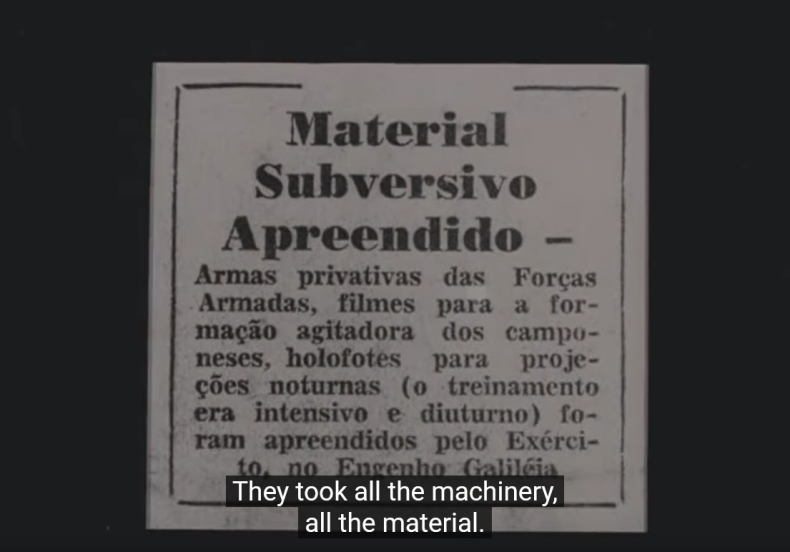
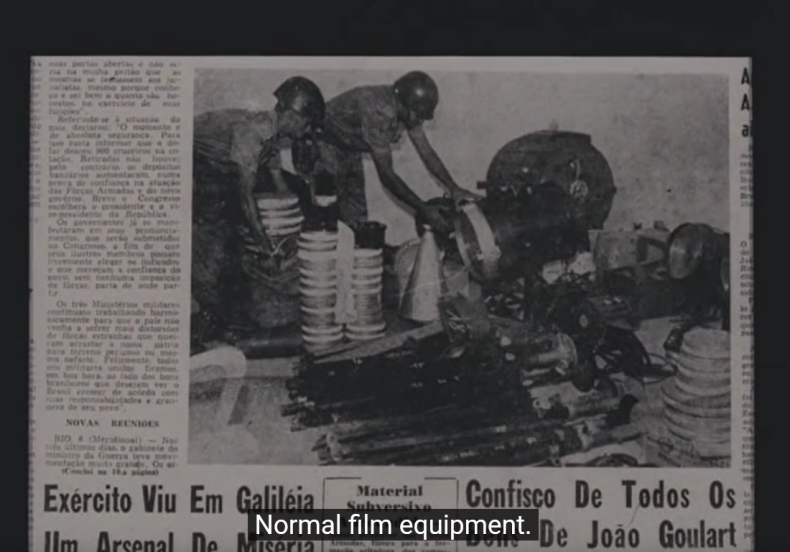
In order to understand this, the complex production history of the film must first be explained: in 1962, Joao Pedro Teixiera, the leader of the Associcao de Lavadores e Trabalhadores Agricolas de Sapé, a local branch of the Brazilian Communist Party in the rural north-east of the country, is arrested, tortured and shot by two military policemen. Two years later, the young director Eduardo Coutinho began filming CABRA, which he conceived as a kind of biopic with non-professional actors and chose the small town of Galileia in the state of Pernambuco as the filming location. After around two months of work, filming was interrupted by the so-called “O Golpe de Estado,” the military coup that would subsequently plunge Brazil into a dictatorship that lasted around twenty years. Some members of the crew were briefly arrested, most of them fled south via Recife, and large parts of the equipment were confiscated, although fortunately some film reels were already on their way to Rio de Janeiro and thus escaped confiscation. It was not until around sixteen years later, at the beginning of the 1980s, that Coutinho viewed the material from this shoot again and contacted those involved at the time. This was the only way he could finally complete the film, which is now known as CABRA and is more of a documentary playing out on several interwoven time levels than the semi-fictional feature film he had initially aimed for.
CABRA MARCADO PARA MORRER © 1984 Mapa Filmes. All rights reserved.
The cancellation of the production by a determined state intervention and the retention of the results to date by the military certainly represent something like the greatest possible disruption of film work. However, in the following I would like to argue how the film manages to make positive use of the break and the resulting fragmentation. Firstly, the interruption of the production leads to a temporal distribution, insofar as the ultimately completed film oscillates between different time levels and interweaves them. Secondly, the historical experience of violence of military rule also results in a spatial distribution, which particularly affects Joao Teixeira's wife and children: after the murder and the subsequent repression by the local military police, most of them leave their home state of Pernambuco and live from then on, without further contact, spread across the entire Brazilian Atlantic coast. I would therefore like to play with the ambiguity of the term “to remember”, namely in its meaning of remembering as well as putting together what was previously broken. However, this raises the question: how can the temporal (and spatial) gaps and cracks caused by a violent interruption be bridged? In this text, the positions of infrastructure studies and film studies will be interwoven to provide a possible answer.
Wide Distances – Theories of Infrastructure
In the introduction to her book Infrastruktur-Arbeit, media scientist Gabriele Schabacher defines the phenomenon of infrastructure as follows:
Infrastructures thereby bring different entities into systemic, stable relationships with interdependencies: natural and technical things (e.g. raw materials, machines), human and non-human living beings (e.g. people, animals) as well as signs and discourses (e.g. signalling languages, regulations and laws). In this way, infrastructures are able to coordinate complex information and material flows, i.e. to move and process energy, people, goods or messages, i.e. to transfer, store and process them.1
Western modernity forms the starting point for these descriptions. The term infrastructure primarily covers all those devices that ensure supply in the broadest sense and transport ‘something’ from one place to another for this purpose. These can therefore be electricity and water lines, waste disposal facilities such as sewerage systems, and in particular transport routes and (tele)communication systems. However, Schabacher himself mentions a broader concept of infrastructure, which also includes institutions such as hospitals, schools and theatres. What both levels of this definition have in common is that they ostensibly emphasise structural devices, which, however, do not include a backspace – which can itself be of a structural nature, but also includes the level of bureaucracy, jurisdiction or, generally speaking, regulation. In other words, infrastructures always include a level that cannot be materially defined in the true sense, both in terms of their own constitution and their performance or purpose. According to Schabacher, the transport of messages is also to be seen as infrastructural work.
In order to trace the specific infrastructural performance of the film CABRA, however, a concept of infrastructure is needed that emphasises this aspect even more strongly. Various texts by sociologist Susan Leigh Star are useful here. Firstly, because she derives her definition of the term more strongly from “mediation-oriented, practice-theoretical and [...] bureaucratic media-oriented questions”2 and thus works closely with a classic definition of media technologies. This is particularly evident in the text “Steps towards an Ecology of Infrastructure: Design and Access for Large Information Spaces,” written together with Karen Ruhelder. It begins with a definition of the term: according to the authors, infrastructures are “decentralised technologies used across wide geographical distance.”3 To concretise this dictum, the two choose an information technology example, more precisely a scientifically used communication and archiving device: using ethnographic methods, Star and Ruhleder consider the introduction of a database within a specialist biological community dedicated to genetic research in the field of worm breeding. This provides two things: on the one hand, it offers the possibility of text-bound exchange with colleagues whose place of work and work location cannot be easily reached and thus enables written correspondence, i.e. ultimately the transport of messages. On the other hand, Star and Ruhleder describe the device in particular with regard to the possibility of being able to view research results that have already been achieved or to post research reports that have already been completed and written. The focus here is less on what is sometimes experienced as instantaneous transmission and more on storage and preservation.
A second reason why Leigh Star's reflections on infrastructure can be useful is that “[m]uch of her work was concerned with giving voice to those silenced, living on the margins.”4 This is expressed in particular in another text, also written in collaboration. Together with Janet Ceja Alcalá and Geoffrey Bowker, Leigh Star proposed linking infrastructures and memories. Specifically, they refer to North American institutions in which exhibits of the First Nations and indigenous populations of the USA and Canada are on display or can be viewed. They refer to these as “recordkeeping infrastructure”5 in the very first lines of the text. With this, the three authors imply that memory cannot do without concrete devices and techniques. The term “recordkeeping” seems particularly important here, not least because it is also a film-specific term. On the one hand, the word “record” refers to various forms of document, i.e., the “business record” (list of economic transactions), “criminal record” (list of convictions) and “medical record” (history of possible diseases and treatments). On the other hand, this also refers to the basic, film-technical operation of recording, both on the optical level by means of the camera and on the acoustic level by means of various microphones.
The following question can be derived from this: To what extent does CABRA work out the specific quality of (documentary) film as a recording medium that encapsulates information, i.e., images and sounds, for future use? To what extent does film perform work that can also be called infrastructural, namely the transport of messages in the sense of specifically constellated data, whereby film is to be seen as a compilation of optical and acoustic data? In order to answer these questions, specific film studies positions should and must now be included.
Becoming-Document
In his introduction to theories of documentary film, Oliver Fahle writes: “History cannot simply be watched. Its reconstruction is dependent on techniques and procedures.”6 This raises the question of the extent to which film – and documentary film in particular – is suitable for making historical experience presentable and thus perceptible. Or rather: What techniques does a film like Cabra, which deals with the history of industrial action and persecution during the Brazilian military dictatorship, use to convey what happened and at the same time do justice to those affected?
The film scholar Philip Rosen had dealt intensively with the first of these two problems. He defines the documentary film primarily in terms of its fundamental posthumousness. This applies not only to events that are already recognised by society as a whole as part of contemporary history. It also includes comparatively recent experiences. Rosen goes so far as to extend this to the comparatively fast-moving, usually daily reports of television images. Based on this circumstance of a kind of constitutive latency, Rosen argues that the process of documenting – as a characteristic feature of documentary film – is also to be seen as a historiographical process. The visually and acoustically recorded and thus available data of the past are organised, marked as part of reality and, not least, brought under control and kept under control. Rosen writes
If shots as indexical traces of past reality may be treated as a conversion as documents in the broad sense, documentary can be treated as conversion from the document. This conversion involves a synthesising knowledge claim, by virtue of a sequence that sublates an undoubtable referential field of pastness into meaning. Documentary as it comes to us from this tradition is not just ex post facto, but historical in the modern sense.7
What exactly does Rosen mean by this “conversion from the document”? Ultimately, he is trying to understand how traces of the past are elevated to the status of a document. This leads to a very consequential thesis: the documentary film itself cannot be considered a document, but is rather a kind of “becoming-document.” It is the staging of this process, which, as Rosen emphasises, includes in particular temporally determined processes such as chronologisation and sequentialisation: “I am suggesting that basic to these is the value placed on sequenciation. This value lies in the great assistance sequenciation provides for centralising and restricting meanings derived from the points at which actual contact with the real is asserted – the realm of the document.”8
This means that documentary films work and have a decidedly creative and form-giving effect. They are to be understood as a process that places “mere” traces of the past in an order and achieves this with the help of sequentialisation techniques, i.e., tools developed by classical historiography. The relationship between cause and effect, or the creation of meaning, links sequentialisation to genuinely cinematic processes. Media scholar Friedrich Balke, for example, emphasises that the “filmic material (through montage, continuity editing, intertitles, later commentary voiceover, prohibition of the return of the camera's gaze and thus denial of the shooting situation) is ordered in such a way that the filmic syntagm is simultaneously legible as an articulated argumentation.”9
Documentary films are therefore more than the mere reproduction of data and facts that are categorised as “true” or, even more charged, as “truthful.” In a general criticism of a simplistic and imprecise division between fictional feature films and factual documentary formats, Balke attempts to emphasise the extent to which the above-mentioned processes can be attributed a creative added value. This in turn raises the question: What means does Coutihno use to process his material in CABRA? And what arguments can be drawn and formulated from this?
To Remember
The Oxford English Dictionary lists two entries under the verb “to remember”. The first reads as follows: “to retain in or recall to the memory; to keep in mind; to recollect (a thing, person, fact, event, saying, etc.).” This definition addresses two interconnected levels of the term. Firstly, the level of storage and a kind of stowing away (to retain, to keep), which also has a spatial connotation by means of a preposition (to retain in, to keep in). Secondly, the level of recalling or retrieving, which is placed in a temporal context by the prefix “re-” (to recall, to recollect).
The peculiar production history of CABRA enables Coutinho to connect both levels of remembering. As explained at the beginning, the film consists of material that was created or shot at different times. Firstly, this includes various photos and newspaper cuttings that report on the events surrounding Joao Teixeira's murder in 1962. Secondly, the footage of the biopic shot with non-professional actors, which is interrupted early and unfinished by the intervention of the military police. Thirdly, the interviews that Coutinho conducted in Pernambuco at the beginning of the 1980s, in which the protagonists of the planned film about Joao Teixieira talk about both the experience of filming at the time and their living conditions under the repressive military dictatorship. This constellation offers a kind of trick that Coutinho knows how to use: he shows the participants in the first shoot the footage taken at the time, and, as he emphasises in an off-screen commentary, in a largely unorganised and barely processed form. This is shown in several scenes, two of which are particularly expressive: firstly, a public screening in the small market square of Galileia. Secondly, the first meeting between Coutihno and Joao Pedro’s widow, Elisabeth, who was also involved as an actress in the planned film about her husband’s life.
The scene showing the screening in the marketplace is first and foremost a scene of reunion and recognition. As Coutinho reports off-screen, almost all of the non-professional actors have left the town, if not the region. Some of them have even taken on other names or have more or less gone into hiding and their current environment knows nothing of their previous political agitation or their involvement in the film project, which was banned by the state. One of the supporting actors, Braz Francisco da Silva, is now known as Joao and had to leave Galileia in the same year as Golpe, while another protagonist, Cicero, now lives and works in Sao Paulo, some three thousand kilometres away. The scenes showing the men watching the footage, which was almost twenty years old at the time, are therefore characterised by interjections such as “Mariano... it’s him,” “I recognised him,” or “Don’t talk about him, because he’s behind you.”
These moments reveal one of the techniques CABRA uses to reconstruct history. The interrupted production history, which is thus spread over two temporal levels, offers the opportunity to confront the participants with records of their own past. The fact that this happens in front of a camera means that the film at this moment is the recording of the presentation of something that has already been recorded. This in turn means that its mode of operation in these scenes cannot be limited to the mere storage of data, but that a specific quality of transmission is inherent in it. This will be further emphasised and elaborated on below.
Before that, one more point: Coutinho continually intersperses the footage of the film screening with scenes in which the protagonists are shown in their living or working environment. For example, we see Braz working in one of his fields, which he cultivates as a farmer in an unnamed location in north-east Brazil. Cicero, on the other hand, is shown working as a metalworker and Coutihno, like Braz, asks him about his routines and living conditions. This constellation is remarkable at this point because, as already explained, both are still clandestine at the time of these recordings and in some cases have not been referred to by their previous names for years. The possibility of filming the immediate private surroundings of these trade unionists, who had previously been exposed to repression and police arbitrariness, and literally getting them to speak on their behalf, is not only a specific achievement on Coutinho's part, but also a political gesture. Oliver Fahle writes elsewhere: “The political does not disappear, but appears in the documentary film in speech (‘fala’) and in the everyday (‘cotidiano’) [...].”10
CABRA thus appears as an archive of audiovisual traces that, on the one hand, are created under the auspices of a political regime and, at the same time, turn against this regime, despite all the efforts to make any traces beyond the film’s own narrative unrecognisable. This possibly singular achievement of the film now consists of involving those who were involved in the compilation of this archive in the further processing of the traces, possibly in the “becoming-document” itself. The images and sounds of the recordings presented, the fact that Coutihno found shelter in 1964 thanks to a network of supporters and was able to store film reels and remaining equipment in various hiding places, and the basic, technical film property that recordings can be played back at a later point in time, are the points that make CABRA a cinematic example of an infrastructure for remembering.
In this description, the film extrapolates – and this could in turn be a potentially genuine cinematic achievement – an aspect that is already present in the theses of Alcará, Bowker, and Star, but which only comes into play in fragments: while Star (like Schabacher) emphasises the spatial transport, i.e., the distance-overcoming power of infrastructures, the cinematic techniques of remembering seem to be more about a kind of temporal transport and the overcoming of a distance that can be represented more clearly in years and decades than in kilometres and miles. This point will be emphasised again in the final section, focusing on the Teixiera family.
To Re-member
The OED gives a second meaning of the verb “to remember” with the following definition: “to put together again, to reverse the dismembering of sth.” As already indicated above, Joao Teixiera’s descendants were also affected by persecution and subsequent dispersion. Elisabeth Teixiera takes the name Marta and lives with two of her eleven children in the neighbouring state of Paraiba, while the remaining siblings live spread out across the west coast of Brazil and generally have no contact with each other.
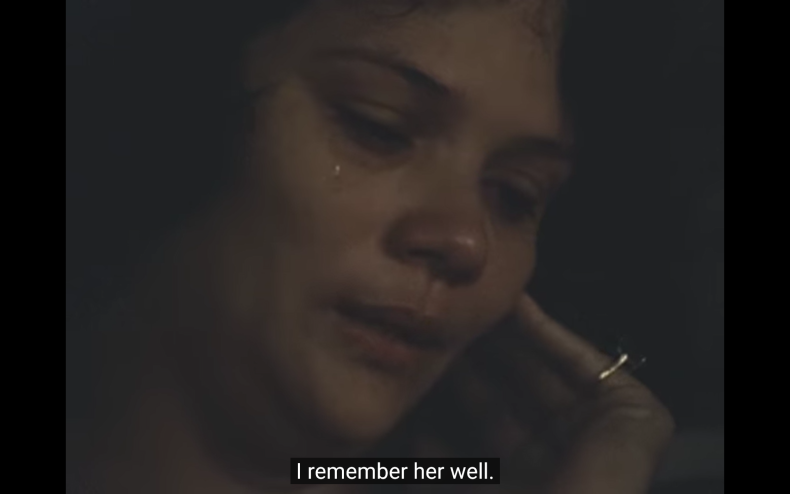
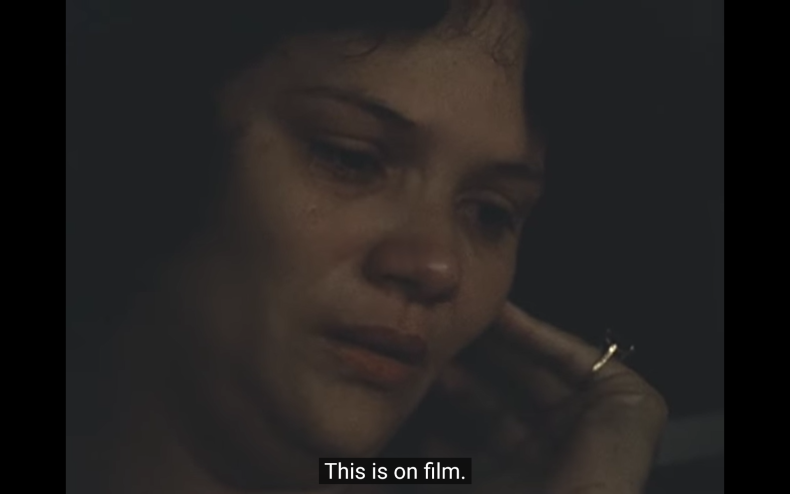
Part of Coutinho’s research is therefore to track down the individual members of the family and interview them. In doing so, he takes on a remarkable dual role: on the one hand, he is something of a chronicler of the family history, including its embedding in the violent history of the military dictatorship. On the other hand, he also passes on messages between relatives, some of whom have not heard from each other for more than fifteen years. One remarkable scene in this respect is the one in which Coutinho visits one of the eldest daughters, Marta. She now lives in the greater Rio de Janeiro area and has children of her own. After a brief greeting, Coutinho shows her photos he has taken of Elisabeth and her brothers Carlos and Abraham, who live with her. Marta begins to cry and Coutinho starts a conversation about the family, asking her to what extent she still has memories of her mother and father. She tells him that she has fond memories of both of them, how she grew up with her grandmother after her father's death, and the disappointment her brothers had caused her. After a cut, we see Marta standing at a table with one of her children in her arms. Coutinho places a tape recorder in front of her and presses the play button. Elisabeth’s voice is heard and she talks about how liberated she feels now that she believes she no longer has to hide. Marta bows her head down, puts her hand in front of her face and begins to sob. The scene ends as we see Marta’s tear-streaked face, while Elisabeth’s off-screen voice tells us that she plans to see her children again.
CABRA MARCADO PARA MORRER © 1984 Mapa Filmes. All rights reserved.
CABRA MARCADO PARA MORRER © 1984 Mapa Filmes. All rights reserved.
Coutinho again chooses a method to make history perceptible. These are again recordings, but this time they are photographs or audio recordings. In this way, the film once again takes up the interconnected functions of storing and reproducing in order to bring the past closer in the truest, equally emotional sense. An emphatic reading would describe these scenes – and there are other examples, such as when the younger sister Joana reads out a letter from Elisabeth – as catharsis. However, I want to focus on something else here. Namely, that CABRA reveals a piece of Brazil’s historical experience, especially in the conversations with the family members, which on the one hand remains singularly tied to the fate of the Teixiera family and at the same time is embedded in the broader context of a dictatorship history. This interweaving can only emerge where these people, as both victims and witnesses, are made to speak. And the means by which they achieve this speaking position is the use of media as a means of conveying the past. Oliver Fahle describes it as follows: “Coutinho knows that he cannot find the reality of Brazil with documentary film. Because it doesn’t exist and it certainly can’t be discovered in supposed representations of the Brazilian people. But this reality reveals itself through conversations with the people, by dramatising, exposing and expressing it in conversation.”11
CABRA thus tells the story of a forced dispersion and makes the experience of the disintegration of communities tangible, without explicitly mentioning this even once. Even if this term is used by Friedrich Balke in a slightly different context, the description of an “aesthetics of the fragment”12 is just as appropriate here. Because at no point does the film offer any idea or narration of so-called “closure.” It is not about giving in to a phantasm of correction or the restorative gesture of restoring family unity. Rather, the idea of a “re-membering” presented here pursues the idea of a re-constellation that does not deny the historical experience of violence, which first and foremost caused the disruption and rupture, but includes it as a factor to be grasped in some form of articulation.
In order to achieve this, Coutinho expands the infrastructural use of storage media within his film. As already indicated above, the scenes emphasised here can only be understood if recording and playback are not regarded as separate functions. It is only through storage that the data and information, i.e., the images and sounds, become mobile and can be transported to other places, for example to family members long thought lost. This results in a broader interlocking of infrastructures and media: it is not just the “wide geographical distances,” but above all the temporal distances. Marta, for example, has not heard her mother’s voice for around fifteen years. And, to return once again to an emphatic description, it is probably also emotional distances, caused by persecution and loss, that are not overcome or healed, but nevertheless bridged and, in particular, made perceptible.
Janet Alcará, Geoffrey Bowker, and Susan Leigh Star have organised their text on the “infrastructures for remembering” in such a way that it also contains short paragraphs in which they describe personal experiences. The essay ends on an emphatic note: they quote the poet T.S. Eliot to conclude on a hopeful note: “our fragments may be put together again by another self.”13 In case of CABRA, this “another self” may not be a concrete human self, but the interweaving of voices, images, faces and, in particular, the techniques that make it possible to see and hear them after years and despite thousands of kilometres of distance.
- 1
Gabriele Schabacher, Infrastruktur-Arbeit. Kulturtechniken und Zeitlichkeit der Erhaltung (Berlin: Kulturverlag Kadmos, 2022), 7.
- 2
Sebastian Gießmann and Nadine Taha, ed., Grenzobjekte und Medienforschung (Bielefeld: transcript, 2017), 14.
- 3
Susan Leigh Star and Karen Ruhleder, “Steps toward an Ecology of Infrastructure: Design and Access for Large Information Spaces,” Information Systems Research 7, no. 1 (1996): 117.
- 4
Ellen Balka, “Obituary. Susan Leigh Star (1954–2010),” Social Studies of Science 44, no. 4 (2010): 650.
- 5
Janet Alcará, Geofrey Bowker, and Susan Leigh Star, “Infrastructures for Remembering,” in Boundary Objects and Beyond: Working with Leigh Star, ed. by Geoffrey Bowker, Stefan Timmermanns, Adele E. Clarke, and Ellen Balka (Cambridge/London: the MIT Press, 2015), 323.
- 6
Oliver Fahle, Theorie des Dokumentarfilms zur Einführung (Hamburg: Junius, 2020), 153.
- 7
Philip Rosen, “Document and Documentary: On the Persistence of Historical Concepts,” in Theorizing Documentary, ed. Michael Renov (New York / London: Routledge, 1993), 71.
- 8
Ibd., 74.
- 9
Friedrich Balke, „Theorie des Dokumentar- und Essayfilms,“ in Handbuch Filmtheorie, ed. Bernhard Groß and Thomas Morsch (Wiesbaden: Springer VS, 2021), 197.
- 10
Oliver Fahle, „Andere Szenen. Geschichte und Diskurs des zeitgenössischen brasilianischen Dokumentarfilms,“ montage AV 30, no. 1 (2021): 44–45.
- 11
Ibid., 52.
- 12
Balke, „Theorie,“ 71.
- 13
Alcará, et al., “Infrastructures for Remembering,” 335.
Alcará, Janet, Geoffrey Bowker, and Susan Leigh Star. “Infrastructures for Remembering.” In Boundary Objects and Beyond: Working with Leigh Star, edited by Geoffrey Bowker, Stefan Timmermanns, Adele E. Clarke, and Ellen Balka, 323–339. Cambridge / London: The MIT Press, 2015.
Balka, Ellen. “Obituary. Susan Leigh Star (1954–2010).” Social Studies of Science 44, no. 4 (2010): 647–651.
Balke, Friedrich. “Theorie des Dokumentar- und Essayfilms.” In Handbuch Filmtheorie, edited by Bernhard Groß and Thomas Morsch, 193–210. Wiesbaden: Springer VS, 2021.
Fahle, Oliver. „Andere Szenen. Geschichte und Diskurs des zeitgenössischen brasilianischen Dokumentarfilms.“ montage AV 30, no. 1 (2021): 37–57.
Fahle, Oliver. Theorie des Dokumentarfilms zur Einführung. Hamburg: Junius, 2020.
Gießmann, Sebastian, and Nadine Taha, ed. Grenzobjekte und Medienforschung. Bielefeld: transcript, 2017.
Leigh Star, Susan, and Karen Ruhleder. “Steps toward an Ecology of Infrastructure: Design and Access for Large Information Spaces.” Information Systems Research 7, no. 1 (1996): 111–134.
Rosen, Philip. “Document and Documentary: On the Persistence of Historical Concepts.” In Theorizing Documentary, edited by Michael Renov, 58–90. New York / London: Routledge, 1993.
Schabacher, Gabriele. Infrastruktur-Arbeit. Kulturtechniken und Zeitlichkeit der Erhaltung. Berlin: Kulturverlag Kadmos, 2022.