To See You (is to love you): Novak Variations
This is an Open Access article distributed under the terms of the CC BY-NC-ND 4.0 License.
Suggested Citation: Gibbs, John. “To See You (is to love you). Novak Variations.” In Research in Film and History (2026): 1–8. https://doi.org/10.25969/mediarep/24737.
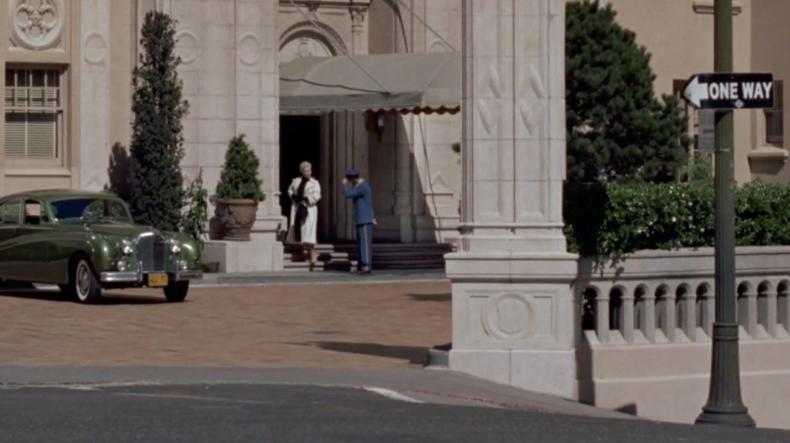
Creator’s Statement
A found footage film as much as a video essay, I originally intended not to write an accompanying statement for TO SEE YOU (IS TO LOVE YOU): NOVAK VARIATIONS. I felt it spoke for itself – and I still do, conceiving of it as practice research, rather than practice-led research, with the project’s achievements and findings embodied in the video. The statement that Research in Film and History invites, placing the work in relation to film history, then provides additional context.
TO SEE YOU (IS TO LOVE YOU) can be considered a companion piece to BACKLOT CONNECTIONS, published last year in this journal. In both, different movies are cut together to form a new creative geography; spatial, visual, aural and thematic juxtapositions enable unexpected relationships and resonant patterns to emerge. Additionally, TO SEE YOU (IS TO LOVE YOU) conducts its analysis through picture editing and sound mixing without commentary in the form of voice over or captions on screen. Of my videographic work it comes closest to the platonic ideal, held by some exponents of the video essay, of making analysis or argument purely through selection, juxtaposition and montage.
The idea for the project arose when I saw PUSHOVER (Richard Quine, 1954) on broadcast television and was struck by a number of things: its interest as a movie; its similarities to REAR WINDOW (Alfred Hitchcock, 1954) and VERTIGO (Alfred Hitchcock, 1958); the quality of its performances; the fact that I’d not heard of it before. I soon began to think of investigating the relationships between these three films as a critical filmmaking project, though it was only later, when high quality materials for PUSHOVER became available, that this could be realised. The delay between inspiration and opportunity proved no bad thing from a creative point of view, and the piece rapidly found its form when I started editing, supported by the ideally focussed environment of the Reading Videographic Retreat.
One area of reflection that the comparison invites is on the chronology of production. As the closing credits of the video essay make clear, PUSHOVER premiered the month before REAR WINDOW and almost four years before VERTIGO.1 So there is no likelihood of PUSHOVER drawing ideas from either of the Hitchcock films, nor could elements of REAR WINDOW have been inspired by PUSHOVER – though it’s possible VERTIGO inherited more from PUSHOVER than a lead actress.
As well as surveillance across a courtyard, PUSHOVER and REAR WINDOW demonstrate a number of parallel elements, including the use of the telephone to communicate covertly and the speculative comparison of women through ideologically-framed lenses. L.B. Jefferies (James Stewart) projects values onto the women he dubs Miss Torso and Miss Lonelyhearts, while Mrs and Mr Thorwald embody an extreme vision of what he imagines to be the emasculating effect of marriage. In PUSHOVER, while Lona McLane (Kim Novak) holds Paul Sheridan’s (Fred MacMurray) attention, his colleague Rick McAllister (Phil Carey) is distracted by hardworking nurse Ann Stewart (Dorothy Malone) in the next apartment.
As the video reveals, the correspondences with VERTIGO are at least as interesting. The first shot of PUSHOVER that appears in TO SEE YOU (IS TO LOVE YOU) is deployed as the ‘missing’ shot in VERTIGO – a close-up of Novak driving that indicates that her character knows that she is being followed. There are sequences in both films in which her character leads a man who is tailing her back to his own apartment, to his surprise. And in both, a detective is professionally engaged to surveil Novak’s character, before becoming unprofessionally involved with her (a pattern that appears in other crime films and films noir, of course).
To what extent has the footage from the original films been altered? Apart from the overlaying and substitution of different soundtrack elements, very little. I cropped three of the shots of Novak in the apartment in PUSHOVER, to remove the vignette of the binoculars when Stewart wasn’t using them in REAR WINDOW; I employed a dissolve to move more rapidly from the bar to Sheridan’s apartment in PUSHOVER; there is a small elision in the exchange between Judy and Scottie in the Empire Hotel, to bring the line “you remind me of somebody” closer to “a pick up”; two shots have been removed from the sequence from BELL BOOK AND CANDLE, where in the original there is some business with Stewart getting out of a taxi and crossing the sidewalk. If I remember rightly, one of the shots of Stewart looking out of the window in REAR WINDOW has changed places in the order with another from the same sequence (in the original Jefferies is looking at ‘Miss Lonelyhearts’), to better align his look with Novak’s movement across the virtual way. The song from which the essay takes its name is part of the soundtrack of REAR WINDOW, playing from Miss Lonelyhearts’ apartment (performed by Bing Crosby, music by Jimmy Van Heusen, lyrics by Johnny Burke, for ROAD TO BALI (Hal Walker, 1952), another Paramount production); to the acoustic environment of REAR WINDOW’s courtyard I added the sound of rainfall, to accompany the heavy rain that falls in the sequence from PUSHOVER. I’m pleased with the Kuleshov experiment that this passage of the video essay provides, where Stewart’s interested, puzzled looking at Miss Lonelyhearts’ imagined dinner for two is transformed, in its newly edited context, into lascivious fascination.
TO SEE YOU (IS TO LOVE YOU) cuts the films together in ways that identify correspondences between the social situations Novak’s characters have to negotiate, and the ways these are presented, including the actor’s and characters’ sardonic awareness of the casually sexist rules of engagement. “You remind me of somebody” / “I’ve heard that one before too”; “You remind me of someone” / “Hundreds of times”. And then there is the parallel of the kiss, where Novak is in danger of being smothered and subsumed by the man – especially in VERTIGO, famously – before she breaks away and (in the video essay) sets off on the road again. The performances’ alive intelligence emanates beyond the context of their original setting, contributing to Novak’s cumulative journey through the video essay. There is a thoughtful independence and an agency to her characters that becomes the more apparent when liberated from the narrative arcs that lead to their downfall.
TO SEE YOU (IS TO LOVE YOU) constructs a cumulative picture of Novak besieged by the desirous looks of men. VERTIGO and REAR WINDOW are themselves explicitly about the processes of objectification and projection that characterise much narrative cinema – it can be suggested that they provide the central examples in Laura Mulvey’s famous article because they not only make visible but are self-consciously critical of the pervasive structures it identifies. The video essay foregrounds an encirclement of looks and attempts at control, while also presenting Novak’s characters’ resistance to these structures and situations. Unlike VERTIGO, BELL BOOK AND CANDLE has a narrative where the audience are strongly aligned with Novak’s character on the cognitive axis of point of view, to employ Douglas Pye’s framework (2000). In both, Stewart’s character is ignorant of the reality of the situation and how his romantic feelings (infatuations, indeed) might be manipulated, but in VERTIGO we share his limited position for most of the film whereas in BELL BOOK AND CANDLE we know more than him from the outset. Among other consequences, this provides the video essay with an articulation of Novak’s characters’ desires (and romantic frustrations) in its coda, a welcome departure from a pervasive male perspective.
I asked Edward Gallafent, who devotes an excellent chapter to Kim Novak in Adultery and the Female Star (2018), to share his impressions of TO SEE YOU (IS TO LOVE YOU). He makes a related point, commenting on:
the very adept use of the soundtrack, as well as the scripting, in the moment from BELL BOOK AND CANDLE which ends the essay, and which eloquently places its Novak character in a world with possibilities very remote from those of the earlier films. A kind of intimacy is at work here which is available nowhere else – but then the Novak character is allowed something quite different, in speaking to her pet. An example of how small, and how large, are the movements between the films highlighted here.
Gallafent’s response to TO SEE YOU (IS TO LOVE YOU): NOVAK VARIATIONS also reflects on what the film / video essay contributes to thinking about the relationship between canonical films and their less esteemed relations:
There is a temptation to think of very famous and celebrated films as sui generis, as if everything about them is a unique product of the genius of this particular filmmaker and these stars at this moment. This video essay reminds us that there are elements at work here that are generic, for example, say the shots of figures at the wheel of cars, the impassive faces that we alone see, observed by nobody within the narrative. There is also an opportunity to observe how the apparently simple use of a conventional moment – I’m thinking here of the two exchanges built around the word ‘pick up’ – offer both something familiar, and accessible but also the marked differences between the characters and situations in front of us, reflected in the minutiae of the acting that we are watching. This is made easier to register here by the common factor that the character who understands herself to be read in this way is being played by Kim Novak.
TO SEE YOU (IS TO LOVE YOU) draws attention to the risks of thinking about films and their makers at the expense of the contexts and traditions in which they work. Even if we recognise the rich and enduring power of genre, we don’t necessarily register the abundance of further conventions and practices in play. Filmmakers as prestigious as Hitchcock at big five Paramount, and directors as underrated as Quine at little three Columbia, work “within a living, three-dimensional history”, as Douglas Pye put it in response to TO SEE YOU (IS TO LOVE YOU), a range of material, actions, visual traditions and social constructions that filmmakers draw on, or challenge, sometimes consciously, sometimes not. TO SEE YOU (IS TO LOVE YOU) makes this apparent by attending to variations in the work of Kim Novak, our guide through this social landscape and semantic terrain, insights a director-centred approach might struggle to achieve.
- 1
BELL BOOK AND CANDLE (Richard Quine, 1958) was released in the same year as VERTIGO, repeating the pairing of Kim Novak and James Stewart to greater success at the box office.
Gallafent, Edward. Adultery and the Female Star. London: Palgrave Macmillan, 2018.
Gibbs, John. “Backlot Connections”. Research in Film and History (2025): 1–14. http://dx.doi.org/10.25969/mediarep/23838.
Mulvey, Laura. “Visual Pleasure and Narrative Cinema”. Screen 16, no. 3 (1975): 6–18.
Pye, Douglas. “Movies and Point of View”. Movie 36 (2000): 2–34.